



Gurugram: Haryana’s new industrial policy proposes increasing employment subsidy, revamp of hubs and establishment of new townships–measures that industry bodies say will help but don’t resolve their longstanding issues linked to land costs, power failures and inspector raj.
The Haryana Industrial Policy 2026, expected to be launched next month, targets Rs 1 lakh crore in investment and five lakh new jobs, government officials told ThePrint Thursday.
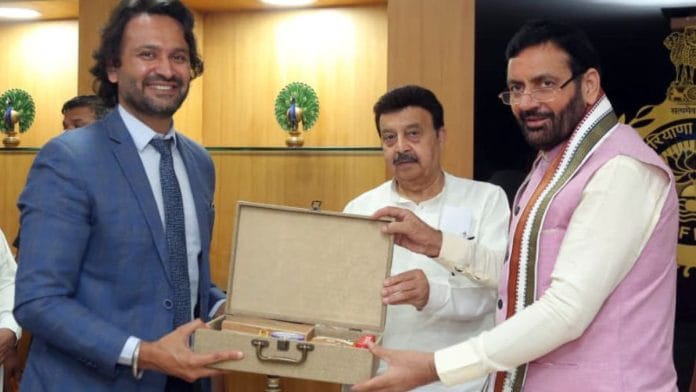
Chief Minister Nayab Singh Saini, and Industries and Commerce Minister Rao Narbir Singh have held multiple rounds of meetings with industrialists to discuss the policy.
A session at Haryana Bhawan in Delhi Wednesday drew more than 15 industrialists from pharmaceuticals, solar and data centre sectors. A separate sitting was held with textile exporters from Panipat, Sonipat, Faridabad and Hisar—districts that are among the country’s top export earners but are currently under distinct strain.
Saini, in the meeting, acknowledged that the sector’s difficulties are separate in nature and directed officials to prepare a dedicated report on them.
According to officials, the policy proposes doubling of employment subsidy to industries, from Rs 48,000 to Rs 1 lakh per employee per year.
The 2026-27 state budget also proposed a Rs 500 crore Saksham Fund to revamp ageing industrial estates in Sonipat, Hisar, Ambala, Yamunanagar, Sirsa, Fatehabad, Nilokheri, Bahadurgarh, Barwala and Panipat.
New Industrial Model Townships (IMTs) will be developed too. Land acquisition is underway in Ambala and Naraingarh, and proposals have been invited for IMTs in Tosham, Jind, Rewari, Faridabad and Rai.
Ashok Chhabra, media coordinator to the chief minister, said the new policy would incorporate genuine and reasonable suggestions from industry.
Also Read: Dushyant Chautala at odds with 2nd Haryana DGP in 6 months—‘Ajay Singhal blocked my number’
Land, power, the inspector
Rakesh Chhabra, who heads the Federation of Indian Micro and Small & Medium Enterprises (FISME), the Rai Industry Association and the Haryana Chamber of Commerce and Industry’s Sonipat chapter, said the consultations keep surfacing the same unresolved complaints. The most persistent is land cost.
“The cost of land is becoming prohibitive for the industry. The lands auctioned by HSIIDC (Haryana State Industrial & Infrastructure Development Corporation) are very costly, particularly in the NCR area. Unless the government provides a solution to this, it won’t be easy to attract new industry in the state,” he said.
Power supply is the second chronic problem. “There is no shortage of power in Haryana as such. However, owing to poor infrastructure leading to frequent breakdowns, the industry fails to get uninterrupted power supply, which is essential for growth,” Chhabra said. He also flagged the “return of inspector raj”, a term used to refer to excessive government regulation.
The safety and health wing of the Labour Department can now visit industrial units without prior permission from its head office, a requirement that had, for decades, served as a check on arbitrary inspections, he said.
“If the government allows inspector raj to return, it will harm the industry,” Chhabra said.
Wage timing, incentive gap
An anomaly in the incentive structure is another issue.
The state government pays Rs 3,500 per month per worker for seven years to industries in zones B, C and D—but zone A units, including those at Rai, are excluded, Chhabra said.
In Haryana, districts are classified into A, B, C and D zones based on levels of industrial development.
Highly developed districts such as Gurugram and Faridabad fall in category A, and receive the least incentives. Under-developed regions such as Nuh and Sirsa are in category D, and industries here get maximum benefits, subsidies and tax concessions.
Chhabra said this incentive limitation makes little sense, particularly at a time when minimum wages have been increased.
From 1 April this year, the Haryana government ordered a 30 to 35 percent increase in minimum wages for industry workers. Currently, wages are earmarked at Rs 15,220 per month for unskilled workers, Rs 16,780 for semi-skilled, Rs 18,500 for skilled and Rs 19,425 for highly skilled.
The timing of this increase, Chhabra said, was particularly difficult for industries. The war in West Asia has also disrupted exports, and prices of petroleum-derived raw materials such as plastics, nylon, sulphur and urea have sharply risen.
“In such a scenario, the government could have increased wages in two instalments rather than one go,” he said.
Chhabra said industries will be keenly looking at the policy for incentives.
“Haryana allocated Rs 1,950.9 crore to industry and commerce in its 2026-27 budget estimates against Rs 1,327.7 crore in the revised estimates of 2025-26, a jump of 47 percent. A major chunk of this budget goes to incentives for the industry. How the government plans to give these incentives is known only through the industrial policy of the government,” he added.
The 80 percent problem
Rajeev K. Chawla, President of the Integrated Association of Micro Small and Medium Enterprises (IAMSME), focused on what he called a decades-old injustice no policy has fixed: the exclusion of industrial units in non-conforming areas from government incentives.
“In Haryana, 80 percent of the industry is situated in non-conforming areas,” he said, referring to areas that are not part of designated industrial clusters.
These units came up in villages that were absorbed into urban sprawl. They lack change of land use certificates largely because industrial land developed by HUDA in the past, and HSIIDC now, has never kept pace with demand, he said.
“The government gives them electricity, charges GST, enforces labour law, takes everything where it has to take. But when it comes to giving incentives, these industries are called non-conforming area units,” Chawla said.
The government did move on this last year.
The Haryana Management of Civic Amenities and Infrastructure Deficient Areas Outside Municipal Area (Special Provisions) Amendment Act allows clusters of at least 50 industrial units spread over 10 acres to collectively apply for legal status. This means that units can be treated as authorised industries until a final decision is taken by the government.
“The industry hopes the problem will be resolved soon,” Chawla said.
He also flagged documentation-based harassment. For instance, he said, in cases where land has been purchased in a woman’s name to avail lower stamp duty while her husband operates the unit, authorities demand a lease deed between the two.
“When the number of documents required for every compliance are listed, the government should ensure that no unnecessary documents are demanded,” Chawla said.
The solar panel subsidy—available only to textile units that install solar power units—drew ire. “Other sectors can switch to solar too. This completely defies logic,” he said.
Footwear industry moving out
Subhash Jagga, Senior Vice President of the Confederation of Indian Footwear Industry, said Haryana’s competitive cost gap is particularly hurting the footwear industry.
The Bahadurgarh park in Jhajjar—one of the largest footwear parks in the country—is emptying. “The industry is slowly shifting to nearby Rajasthan, where new footwear hubs are developing at Bhiwari and Jaipur. The biggest reasons are cheaper power and cheaper labour. Haryana already had higher electricity tariffs, and now it has increased labour wages by 30 to 40 percent,” Jagga said.
Amit Agarwal, Commissioner and Secretary in the Industry and Commerce Department, told ThePrint the policy will be ready soon, and is expected to be approved in the next cabinet meeting.
Also Read: Haryana sees late-night rejig. Khullar remains most powerful officer in Saini CMO with 18 depts
Two issues every state should fix :
1. Electric costs. Why the hell do we electricity for farmers ? Like I can understand if it’s a crop which is not profitable or is under pressure because of climate change but seriously there are Punjabi farmers who literally roam around on huge SUVs. So lower it for the industry.
2. Obviously it’s the lower bureaucracy. I don’t need to say anything about this because this is well known yet remains the number one problem in this country.