


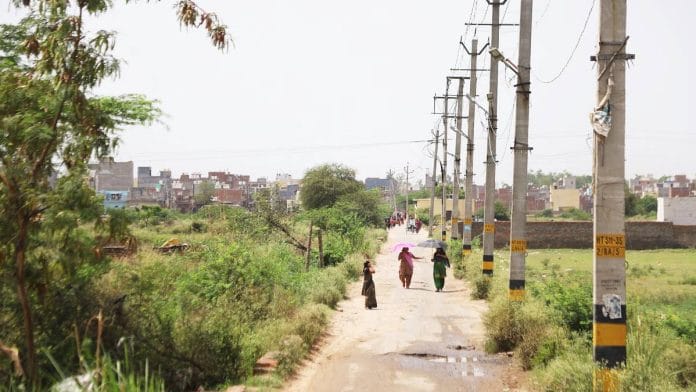
Chandigarh: The Haryana Cabinet, under Chief Minister Nayab Singh Saini, Tuesday approved the Land Pooling Policy 2026, which replaces the 2022 policy and changes the way owners are paid for the land they contribute for projects.
Under the new policy, landowners, as a group, will get 50 percent of the total saleable area of a project, as per its approved layout plan, and the development agency will keep the other half.
A senior officer in the Haryana government explained to ThePrint that the new policy has done away with the old yardstick set in 2022, according to which an owner’s entitlement depended on the market value of his raw land, worked out by an empanelled valuer as a proportion of the project cost.
The new policy sets no such valuation. The 50 percent refers to the saleable area of the finished project, and not to half of the land originally contributed, he said.
What each owner finally gets will depend on how much land he put in and on the approved layout. The owners’ share will include commercial sites as per the prescribed entitlement. The rest will be residential, industrial or institutional plots, depending on the project. The minimum plot size is 100 square metres for residential use, 250 for industrial and 500 for institutional use. Owners can also ask for bigger plots within their entitlement.
Those who contribute more than 2,000 square metres will be eligible for commercial sites in the form of kiosks or booths, wherever applicable. However, owners with less than 999 square metres will not get developed plots. They will be paid in cash, either the compensation due under the Right to Fair Compensation and Transparency in Land Acquisition, Rehabilitation and Resettlement Act, 2013, or the reserved price of the plot, whichever is higher.
The 2013 Act, notified by the Bhupinder Singh Hooda government in Haryana, had come into force on 1 January, 2014, replacing the colonial-era Land Acquisition Act of 1894. It had made the market value of land the base for compensation, multiplied it by a factor notified by the state government and added a solatium of 100 percent on top.
The policy approved Tuesday also promises interim financial help of Rs 1 lakh per acre every year for four years from the date the sale deed is registered. The amount is proportionate to the area contributed and has to be paid within 15 days of the sale deed. Any delay will attract simple interest of 9 per cent a year.
The deadline for infrastructure has been tightened to four years from the final approval of a project. If the development agency does not deliver roads and services within that time, the land goes back to the owners. They will also get Rs 5 lakh per acre as additional compensation. The period can be stretched by one year if 75 percent of the landowners agree.
Holders of Land Entitlement Certificates can now club them to apply jointly for larger plots. The time the development agency has to buy back allotted plots has gone up from one year to three. Registered land aggregators will get 0.5 percent of the collector rate of agricultural land in the revenue estate, to be paid by the agency after the sale deed process is complete. Land pooling through the e-Bhoomi portal has been kept out of the new policy.
How it differs from 2022
The 2022 policy had opened the door to voluntary pooling for a wide range of projects, even where the government had not started acquisition. The Haryana Shehri Vikas Pradhikaran (HSVP) could take up residential, commercial, institutional and infrastructure projects in urbanisable areas. The Haryana State Industrial and Infrastructure Development Corporation (HSIIDC) could take up industrial, infrastructure and institutional projects across the state. Owners could come forward directly or through aggregators and receive Land Entitlement Certificates, which could be traded or mortgaged.
The 2022 policy also carried interim assistance of Rs 1 lakh per acre. The 2026 policy keeps the voluntary approach and the annual payment, while it changes the basis of allotment, fixes the payment period at four years and adds the reversion clause and the Rs 5 lakh compensation.
Pooling in Haryana began in 2012
Haryana’s experiment with land pooling is older than the 2022 policy. In September 2012, the Haryana Urban Development Authority (HUDA), now HSVP, offered owners whose land was being acquired for residential sectors a choice. They could take developed plots instead of money. For every acre, they could get a residential plot of 1,000 square yards and a commercial site of 100 square yards. The minimum contribution was 1,000 square yards.
HSIIDC brought a similar scheme for industrial projects in 2012. Owners could opt for a plot of 1,200 square yards for every acre pooled. Both schemes applied only where acquisition proceedings had already begun. They were, in effect, a different way of paying compensation within the acquisition process.
The Amaravati model
The new policy invites comparison with Andhra Pradesh’s land pooling for Amaravati, its greenfield capital. The package was announced on 7 December, 2014, under Chief Minister N Chandrababu Naidu. The Andhra Pradesh Capital Region Development Authority (APCRDA) Act was passed on December 30, 2014, and the scheme came into force on 1 January, 2015.
After the state was divided in 2014, the residual Andhra Pradesh needed a new capital. The government wanted a large contiguous parcel in the Vijayawada-Guntur region and sought farmers’ consent instead of relying only on acquisition. According to information available on the website the Andhra Pradesh Capital Region Development Authority (APCRDA), more than 25,000 farmers gave over 30,000 acres in the first round.
Farmers were given residential and commercial plots in the capital city, with the entitlement depending on the category of land they gave. The plots were allotted by lottery.
Amaravati was thus a one-time exercise to build a state capital. Haryana’s policy serves as a standing framework for any project taken up by agencies like HSVP and HSIIDC. It applies one formula, a fixed share of saleable area, and puts a deadline on the agency to deliver infrastructure.
(Edited by Nivedita Patil)