



New Delhi: States with some of India’s lowest fertility rates are still setting aside money to encourage female sterilisation, even as some are starting to introduce measures to encourage people to have more children, says an EAC-PM working paper.
Tamil Nadu, Andhra Pradesh, Karnataka and Telangana—all with total fertility rates (TFR) between 1.3 and 1.5—together budgeted to incentivise close to 4.3 lakh female sterilisations annually during the 2024-26 cycle.Sterilisation is a permanent contraceptive method intended to prevent future pregnancies—tubectomy for women and vasectomy for men.
The finding is particularly notable in Andhra Pradesh and Tamil Nadu, where nearly six in 10 married women are already sterilised. Yet, the two states budgeted for more female sterilisations per capita than Uttar Pradesh, according to the paper, ‘The Ghost of Population Past: How Population Control Persists in India’.
The northern state has a higher fertility of 2.6 but accounts for a fraction of the sterilisation coverage.
A TFR of 2.1 is generally used as the replacement fertility level—the average number of children women need to have for one generation to replace the previous generation.
India’s family-planning system has not fully adjusted to the country’s demographic transition, according to the authors—EAC-PM member Sanjeev Sanyal, EAC-PM Director Aakanksha Arora and EAC-PM consultant Virat Singh.
Also Read: India’s fertility rate below replacement level, financial strain a key factor, finds UN report
Sterilisation still gets bulk of incentives
India’s national average TFR is 1.9, while several southern and other states have remained below replacement fertility for more than two decades. Annual births have also fallen from about 29.3 million in 2001 to 23.2 million in 2023—roughly the same level as in 1974.
Despite this, about 80 percent of fiscal allocations for incentives and compensation under family planning went towards terminal methods, primarily sterilisation, in 2025-26.
The share was higher at 84.3 percent in 2026-27, the authors found.
Under the existing system, a sterilisation can trigger payments to the person undergoing the procedure, the Accredited Social Health Activist (ASHA) or another person who mobilises the acceptor, and the healthcare provider.
The paper says an ASHA worker can earn four times as much by counselling and motivating a couple to adopt a permanent limiting method after two children compared with reversible methods. “This is a well-oiled incentive structure that implicitly promotes population control.”
The working paper also flags what it calls a policy contradiction in Tamil Nadu. In August, the state extended maternity leave for government employees to one year for the birth of a third child, while simultaneously budgeting direct benefit transfers (DBTs) to incentivise 1.6 lakh female sterilisations in 2026-27.
“Bureaucratic inertia and cultural indoctrination have ensured that states have not fully grasped the consequences of suppressing fertility and maintaining the status quo, when, in fact, they are no longer relevant,” the paper states.
This paradox, the authors said, is particularly evident in states introducing measures to promote higher fertility while continuing to allocate funds to incentivise sterilisations. The paper describes the simultaneous push for higher births and sterilisation incentives as an “explicit policy contradiction”.
Also Read: Late marriages, too few babies—how Sikkim is fighting a fertility crisis with IVF
End to sterilisation incentives?
The paper recommends a broad overhaul of the family-planning system, particularly in states that have reached or fallen below replacement fertility.
It calls for an end to all sterilisation-linked DBT payments, including acceptor payments, wage-loss compensation and enhanced incentives for service providers. It also recommends eliminating motivational payments linked to terminal methods and incentives given to ASHA workers for persuading couples to limit to two children.
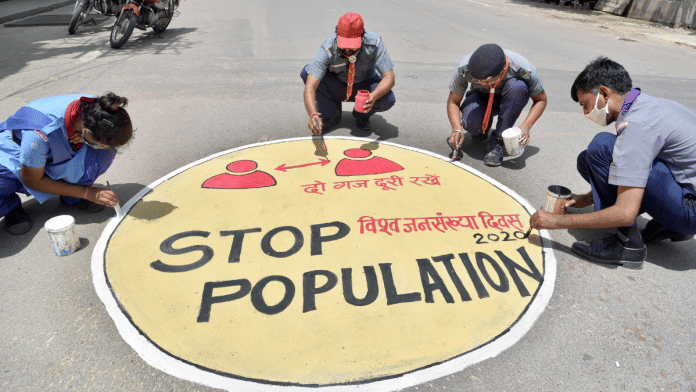
The authors further recommend discontinuing family-planning awards, World Population Day celebrations and Vasectomy Fortnight campaigns when these are framed around population control.
The working paper calls for adjusting the scope of Mission Parivar Vikas—the government’s programme focused on improving access to family planning in high-fertility areas—in states already at or below replacement fertility.
Andhra Pradesh is cited as an example of the policy shift that the authors believe is needed. Its 2026-27 health plan has no fiscal allocation for DBTs to incentivise male or female sterilisation, after the state allocated about Rs 12 crore annually during 2024-26 for DBTs linked to 1.25 lakh female sterilisations.
Its new Population Management Programme proposes incentives for second and third children, including financial support and other benefits. “The new population policy proposes a one-time direct cash incentive of Rs. 25,000 for a second child, and onwards, and a monthly stipend of Rs. 1,000 for the third child’s first five years,” the report states.
The other proposals include full government coverage of educational expenses and lifetime health insurance to any household with three or more children. The paper estimates that these incentives could cost Andhra Pradesh close to Rs 1,000 crore annually.
The authors, however, clarify that they are not arguing against family planning or contraception for health, child spacing or personal preference. Their central argument is that “population control is no longer relevant as an objective of state policy” and that family-planning policies need to reflect India’s new demographic reality.
(Edited by Tony Rai)
Also Read: VHP wants Andhra CM Naidu’s cash incentives for having 3rd & 4th child to be just for Hindu couples