



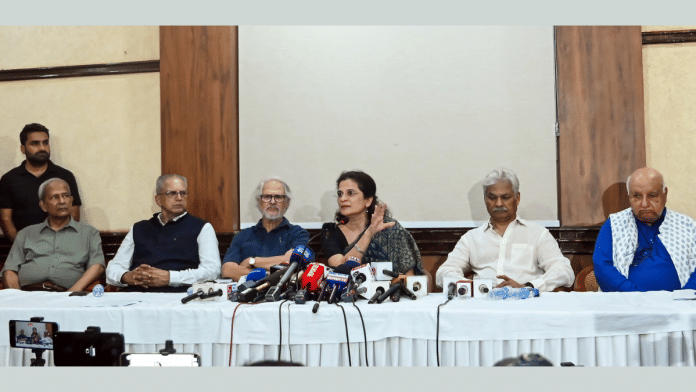
New Delhi: A delegation of former civil servants and citizens Monday attempted to submit to the Election Commission of India a “people’s charge sheet” asking the Chief Election Commissioner Gyanesh Kumar to “resign and avoid any further disgrace”.
However, while the charge sheet and a “notice of impeachment” was to be served to Gyanesh Kumar, the delegation couldn’t do so as all routes to Nirvachan Sadan have been barricaded. The delegation then released the letter to the public at the Press Club of India Monday.
The delegation included former Delhi Lieutenant Governor Najeeb Jung, former Union Home Secretary G. K. Pillai, political activist Yogendra Yadav, former government secretary Amitabha Pandey, former ambassador Ashok Sharma, former IB special director and former CIC Yashovardhan Azad, former civil servant Ashish Joshi, and founder of citizens’ group Satark Nagrik Sangathan (SNS) Anjali Bhardwaj.
The “charge sheet” levels six charges against Gyanesh Kumar—subversion of the collective functioning of ECI, wilful and unauthorised alteration of Statutory Form 6, unlawful centralisation and manipulation of electoral-roll administration, unprecedented mass disenfranchisement through SIR, conduct incompatible with independence and impartiality, and repeated breach of statutory duty.
Demanding Gyanesh Kumar’s removal from the office of CEC, the letter asserts, “The foregoing acts cannot be viewed as isolated administrative lapses. Taken together, they constitute a sustained pattern in which the constitutional authority entrusted to protect the people’s electoral sovereignty has been used in a manner that disregards legality, collegial decision-making, impartiality and the statutory rights of electors.”
“The result has been large-scale disenfranchisement, erosion of public confidence and the weakening of the Election Commission’s institutional independence. By these acts and omissions, you have forfeited the moral and constitutional authority to continue as Chief Election Commissioner of India.”
The chargesheet begins by highlighting the high stature of the office of the Chief Election Commissioners, but says that “instead cannot but recall that your appointment was made by subverting the safeguards laid down by the Supreme Court for ensuring the independence of the Election Commission,” the letter said.
“We therefore ask you (Gyanesh Kumar) to resign and avoid any further disgrace. Otherwise, we, the people of India, are compelled to serve upon you this notice of impeachment and demand your removal from office,” the letter adds.
It points out that Article 324(5) of the Constitution protects the Chief Election Commissioner from removal except on grounds of “proved misbehaviour or incapacity”. It then goes on to list six charges against him.
‘Forcing people to make false declarations’
The first charge is subversion of the collective functioning of the Election Commission, alleging that Kumar has repeatedly exercised powers vested in the ECI without placing matters before the Commission for proper consideration and decision.
“The Special Intensive Revision (SIR), among other major decisions, was undertaken. without adequate discussion, deliberation, consultation, rule-making or recorded proceedings… Decisions taken in the name of the Commission without being placed before it constitute a fundamental abuse of constitutional authority,” the ‘charge sheet’ says.
The second charge is “wilful and unauthorised alteration” of statutory Form 6, which has to be filled out by new voters. The changes in Form 6 required applicants to choose one of three statements: Whether their name appeared in the electoral roll during the last SIR held in the early 2000s, whether the name of a parent or grandparent appeared in that roll, or whether neither their name nor that of their parents appeared in it.
After an Indian Express investigation claiming that the Form 6 change was made without adequate authority, the ECI had clarified last month that “for the non-SIR period, the forms applicable as per Rules (the Registration of Electors Rules 1960) will be used”, in an apparent u-turn on the changes made to the form.
The letter now says that “the subsequent restoration of the original Form 6 constitutes powerful evidence that the earlier procedure lacked lawful authority”.
Moreover, the delegation’s letter points out that under the original Form 6, citizens are expected to declare that they are applying for inclusion for the first time. Therefore, by forcing those citizens who existed on the electoral rolls but were excluded during the SIR period to make this declaration, Kumar was “guilty of forcing crores of citizens to make a false declaration to correct an error for which the electoral authorities themselves were responsible”.
‘Incompatible with independence and impartiality’
The third charge is “unlawful centralisation and manipulation of electoral-roll administration”, alleging that the Commission had authorised the ECINet platform “in a manner that either undermined or displaced the statutory role of Electoral Registration Officers, who are the authorities legally entrusted with additions, deletions and corrections in electoral rolls”.
Last month, after the Indian Express investigation, ECI had also announced formation of a committee headed by Senior Deputy Election Commissioner (DEC) and including an independent expert from IIT/IIIT to review the ECINET to double-check that it complies with the provisions of the Acts and Rules and submit a report to the commission.
This decision, the delegation’s letter now says, “amounts to an extraordinary admission that a system already used to delete crores of names on the electoral rolls had not been adequately established to be legally compliant”.
The fourth charge is the “unprecedented mass disenfranchisement through SIR”, and the fifth charge is “conduct incompatible with independence and impartiality”.
The fifth charge by the delegation mentions Kumar’s “public interventions directed against opposition political leaders, your combative political rhetoric, and the cumulative pattern of decisions and actions surrounding SIR”.
“You can no longer be a referee in a game where you are widely perceived to be aligned with a player,” the letter asserts.
The sixth charge is the “repeated breach of statutory duty”, alleging, “Section 32(1) of the Representation of the People Act, 1950 makes it an offence for an election official, without reasonable cause, to commit an act or omission in breach of official duty in connection with the preparation or revision of electoral rolls. The unauthorised alteration of statutory forms, the circumvention of statutory Electoral Registration Officers, the use of dubious technological systems, concealment of records, non-disclosure of relevant information and failure to rectify known violations together disclose a prima facie pattern of wilful breach of official duty.”
(Edited by Viny Mishra)
Also read: Losing Gyanesh Kumar and winning UP is the best option before Modi-BJP to silence critics
If people like GK Pillai who tried to frame Hindus and army officers for terrorism is against CEC then I think CEC must be doing the right thing.
Stooges of previous congress govts trying to repay their debt