







New Delhi: The Department of Telecommunications (DoT) has told a parliamentary committee that BharatNet, the government’s rural broadband programme, has not achieved its main objective of delivering high-speed connectivity to every Gram Panchayat (GP), even after substantial expenditure across two phases.
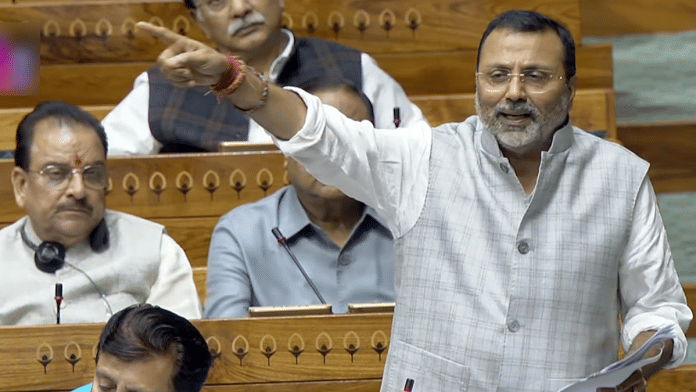
The admission is recorded in the 32nd report of the Standing Committee on Communications and Information Technology—chaired by Bharatiya Janata Party Member of Parliament Nishikant Dubey—which was presented to the Lok Sabha and laid in the Rajya Sabha on 6 August.
The report reviews schemes under the Digital Bharat Nidhi (DBN), the new name for the Universal Service Obligation Fund (USOF) under the Telecommunications Act, 2023.
During the committee’s examination, a DoT representative said that despite spending on resources, Phase-I and Phase-II of BharatNet “could not achieve the intended level of success”, which was to provide 1 gigabits per second (Gbps) connectivity in every gram panchayat along with associated utilisation.
The department attributed the shortfall to procurement and tender delays under state-led models, disputes with implementing agencies, right-of-way clearances, forest land issues and difficult terrain in tribal and Left Wing Extremism-affected areas.
The figures cited to the committee show the scale of the gap. As on 28 February 2026, out of about 2.64 lakh GPs, only 78,899 had operational Points of Presence (PoPs). In Phase-I, 40,610 of 1,20,208 GPs are operational—under half. In the Phase-II CPSU-led model, the report records 2,918 operational GPs against 24,229 planned.
The committee noted that the private BBNL-led model recorded better progress than the CPSU-led model, and that “variable performance standards, inadequate accountability mechanisms and non-synchronised execution” had led to sub-optimal outcomes.
On funding, the report states that ₹40,635 crore has been disbursed from the DBN as on 28 February 28, 2026, and that the Amended BharatNet Programme carries an outlay of about Rs 1.39 lakh crore.
The Department’s own figures show under-spending against budget: in 2023-24, Rs 5,000 crore was allotted and Rs 3,075.54 crore spent; in 2024-25, Rs 6,500 crore was allotted and Rs 3,995.01 crore spent. The fund is financed by a 5 percent Universal Access Levy on the Adjusted Gross Revenue of telecom licensees, credited to the Consolidated Fund of India.
Utilisation of the created network also trailed targets. Against a goal of 1.5 crore fibre-to-the-home connections, the report records 9,48,237 active connections. The committee said that “utilisation levels remain sub-optimal when compared to the scale and potential of the network”, and that the benefits of connectivity had not fully reached rural and remote areas.
On mobile connectivity, the committee was told that projects with a total outlay of ₹42,467 crore had reached 69.6 per cent commissioning of towers. The Border Out Post (BOP/BIP) project, which the committee flagged as strategically important, stood at 41.7 per cent, with 251 of 602 towers commissioned.
The committee said delays in such areas “dilute the intended strategic outcomes” and called for a high-level mechanism to fast-track clearances. It also noted that 28.73 lakh subscribers were using the services, with average data use of 21.48 GB a month, below the national average of 25.70 GB.
The BharatNet report shows limited use of penalty provisions. Liquidated damages levied across DBN schemes from 2020-21 up to February 28, 2026 total Rs 46.46 crore, of which Rs 31.01 crore was in 2025-26. Office memoranda for levying such damages on service providers were issued on September 22, 2025, days after the department briefed the committee on September 9.
The report on BharatNet also records instances of implementing agencies seeking funds outside contracts. RailTel, given a front-loaded subsidy of Rs 31.46 crore for North-East nodes, sought repeated extensions and later requested additional money for “network refresh” and replacement of expired equipment.
The department said such requests “were not aligned with the provisions of the agreement(s) and tender conditions”. In the Andaman and Nicobar Islands, 68 of 88 towers were commissioned; the Department said the service provider “has expressed inability as it is not commercially viable”, and the remaining sites were descoped with penalty.
On research, the committee noted that under the Telecom Technology Development Fund, 136 projects worth about Rs 543 crore had been sanctioned, with 104 projects worth Rs 271 crore in 6G. It said outcomes on “commercialisation, scalability, and tangible impact on rural connectivity” should be demonstrated, and asked the department to prioritise field-ready technologies for rural areas.
The committee recommended a model-wise and state-wise performance audit of BharatNet, a time-bound roadmap with defined accountability, performance-linked incentives and disincentives for public sector undertakings, and a unified monitoring framework. It asked the department to report updated figures on fund utilisation.
(Edited by Nardeep Singh Dahiya)
Also read: Does PM-WANI need a reset? India’s public Wi-Fi is everywhere and nowhere