


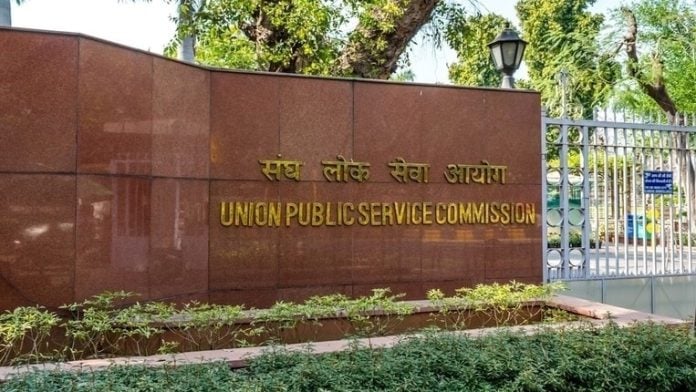
New Delhi: As the Centre gets down to finalising the 2026 batch of Civil Services Examination (CSE) recruits in the next few months—with the UPSC Mains result declared Thursday—it finds itself in a Catch-22 situation.
Eight months after the final results of last year’s CSE were announced, the Centre has neither allocated the service to successful candidates nor started their Foundation Course training because of what it calls a lack of clarity in implementing the Supreme Court’s 11 March judgement in the OBC creamy layer matter.
The apex court had ruled that OBC candidates, whose parents work in Public Sector Undertakings or the private sector, cannot be excluded from benefits of reservation solely on the basis of either their parents’ salary income, or agricultural income. The primary measure for identifying the “creamy layer”, the court had affirmed, should be the social status of the parents. The matter will be taken up in court Friday after the government, in September, sought clarification on the applicability of the 11 March order.
The delay has not just upset the training schedules and subsequent posting of the new CSE recruits. The Centre’s indecisiveness to start the Foundation Course (FC) on time could also jeopardise the training schedule and postings of the 2026 batch of All India Services, which comprise the IAS, Indian Police Services, Indian Foreign Service, Indian Forest Service and other Group-A central services.
The uncertainty has also added to the anxiety of the 2025 batch recruits. Generally after the CSE results are out, the new recruits are first allocated their service based on their rankings. By August-end or early September, they undergo the mandatory four month FC training at Lal Bahadur Shastri National Academy (LBSNAA) and other partner institutions. The training concludes in December.
But it is already the first week of November, and there is no indication from the Centre as to when the FC will start. The course is not just important to equip the young officers with the knowledge and skills required to deliver their job as a public servant. It also instills in them the basic camaraderie needed “for smoother conduct of the affairs of the government”.
Once the FC is over in December, the Phase I or professional training begins. It involves imparting service specific teachings to successful candidates, followed by their district training and a Phase II training. Each of these has a fixed time frame. A delay in starting the FC can have a cascading effect on not only the schedule of the other training modules, but also the final posting of officers to their respective cadres.
Senior officials in the central government, aware of the matter, told ThePrint that the delay has been caused because of the Department of Personnel and Training’s (DoPT) apprehension that implementing the Supreme Court’s 11 March ruling could result in a fresh raft of litigation from new recruits belonging to OBC category, who will be impacted. The DoPT is the nodal agency of the Government of India, which makes policies related to recruitment, cadre management, training among others.
The officials, who did not want to be named, added that this will further mess up the situation, which has already been complicated by the apex court’s order to implement its judgement retrospectively.
Also read: From Chambal to UPSC: How a dacoit’s grandson fought the stigma of his past
Imbroglio over SC’s order
At the heart of the delay is the top court’s 11 March judgement on determination of equivalence with regards to OBC creamy layer. The apex court had directed the Centre to implement its 1993 office memorandum that mandated that parental or agricultural income alone cannot be the sole criteria for determining the creamy layer status of OBC candidates.
The judgement, which the court said should be implemented with retrospective effect, threatens to open a Pandora’s box. A senior government official said it would have implications, not just on service allocations of new CSE recruits, but also existing seniority of past successful candidates, who are already in service, besides recruitments made by state governments.
This led the Centre to file a miscellaneous petition on 24 August, seeking clarification on applicability of the 11 March ruling and directions from the court on its implementation. In one of the petitions, the Centre also sought two years’ time from the apex court to consult all stakeholders and establish an equivalence of posts in PSUs and identify similar posts in the private sector.
‘A Catch-22 situation’
A senior IAS officer involved in decision making related to 2025 CSE recruits told ThePrint that its a Catch-22 situation for them.
“Agreed that SC has not stayed the service allocation of the new recruits. But the challenge before us is, which formula do we apply while allocating the services—the SC’s 11 March judgement that said creamy layer status of OBC candidates cannot be decided on the basis of either their parental or agricultural income alone, or the existing rules for the OBC creamy layer that was in place when the candidates filled their form and took the CSE exams in 2025,” said the officer, requesting anonymity.
The existing rules in place, when CSE-2025 candidates took the exam, counted the salary income of parents of OBC candidates, who work in PSUs or the private sector, when determining their creamy layer status. If the parental salary income of such candidates was more than Rs 8 lakh per annum—the threshold fixed for determining creamy layer—the candidates were excluded from non-creamy layer status.
The discrepancy arose because the same rules did not count the candidates’ parental salary income if they worked in government jobs, while determining their creamy layer status. It was this disparity that was challenged in the court and addressed by it in its 11 March ruling.
“We are waiting for the SC’s clarification,” the official quoted above said.
Of the 958 candidates selected in 2025 CSE, more than 300 candidates had applied under the OBC non-creamy layer category, a second government official said.
“If we go ahead with SC’s order and make the service allocations, it will be in compliance with the court order but will be unfair on the candidates, who had applied based on the existing income criteria rules in place to determine the creamy layer status,” the second official said.
The official added that it will need two years time to consult all stakeholders. “There are many states to be consulted, there is wider consultation required because of the different categories… we will need two years’ time.”
The SC had, on 17 September, reserved its order on Centre’s plea.
The Centre had also moved an application before the SC to be allowed to start the foundation course by applying the old principle. “We had moved two applications. In the second one, we had said that let’s start the FC now and whatever is the outcome of the SC order, we will follow in future,” the second official said.
The official, however, added that though the imbroglio over the OBC creamy layer matter has delayed the training of the new recruits but will not impact the seniority of the successful candidates. “Seniority is counted from the first of January of the year service allocations are made and FC starts. The seniority of all the new recruits will start on the same day.”
Senior government officials said that for candidates awaiting allocation of services and delayed FC, the situation has caused anxiety and uncertainty.
Sanjeev Chopra, former LBSNAA director, said that the delay was unfortunate and could result in truncated training. “This is something urgent and calls for a Special Leave Petition. Unfortunately many other things have taken over. And this matter has not received the kind of importance it should have received. That’s why this problem has come.”
The FC, Chopra said, is crucial for young officers as besides training them on the requisite skill, it helps build friendship and a sense of togetherness among the young officers. “The Centre could have started the FC for the new recruits. The delay could result in truncated training. It will affect the bonding and camaraderie built during the training period among the young civil servants.”
Chopra said he does not remember any such precedent in the past where the FC was delayed so much. “Even during the Covid pandemic, the FC concluded by December,” he said.
He added there are ways of handling the situation now that there is a delay. “One is we can do the professional courses first. We can start Phase I and then after the professional course we can have all the services do a special FC. It can be given a new name. That would make more sense. Perhaps that’s the way out.”
One of the government officials quoted earlier said that it’s a very tough decision. “It’s a challenge for the DoPT. They have to formulate a policy amid very difficult, unsettled and contested circumstances. It is unprecedented.”
Also read: Jaymin Patel vs UPSC: The 2.06-mark fight that reached the Supreme Court