



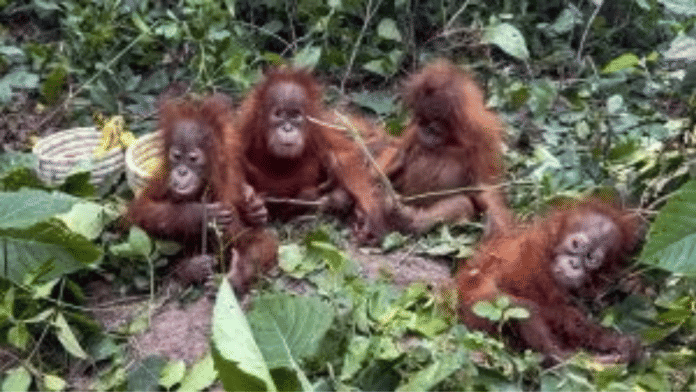
New Delhi: The five baby orangutans found in Odisha may have grabbed headlines with their adorable pictures going viral, but behind those innocent faces lies a grim reality. Wildlife trafficking to feed a growing market for ‘exotic pets’ is thriving in India, often in plain sight, with animals smuggled across international borders as part of a multibillion-dollar black market.
From ball pythons, bearded dragons and leopard geckos to colourful birds such as macaws, cockatoos, African grey parrots, eclectus parrots, sun conures, cockatiels and lovebirds, a wide range of exotic animals fall prey to the illegal wildlife trade.
While the US and Europe are major markets for reptiles, exotic birds and other unusual pets, the Middle East has a particular demand for falcons, which are often seen as symbols of ‘prestige and status’. In India, too, the market for exotic pets is growing, aided by gaps in regulation and weak enforcement, sources across multiple agencies told ThePrint.
Demand in India is particularly high in metropolitan cities and among affluent households, driven by novelty, status, social media and the ease with which sellers can be found online, investigators told ThePrint.
Compounding the challenge is the scale and complexity of the trafficking networks behind this trade. Such is the demand, the money involved and the reach of these operations that even agencies that do not primarily investigate wildlife crime are increasingly training personnel to detect and investigate such cases.
In India, the Central Bureau of Investigation (CBI) has registered approximately 100 wildlife-crime cases since 1997, investigating offences ranging from the smuggling of tiger skins and bones and rhino poaching to trafficking in pangolin scales, red sanders and exotic animals.
On 2 and 3 September, India’s CBI and agencies from Thailand held a two-day case coordination meeting on live-animal trafficking with INTERPOL’s Environmental Security Sub-Directorate, where investigators exchanged information on exotic-species trafficking trends, smuggling routes, concealment methods and potential targets.
The focus has also shifted to strengthening capacity to handle such crimes. Three Indian Technical and Economic Cooperation (ITEC) programme courses for “Wildlife and Conservation Practitioners”, conducted in 2024 and 2025, covered wildlife and forest crimes, investigation and prosecution, and challenges faced by enforcement agencies. The courses were attended by 65 officers from foreign law-enforcement agencies.
With trafficking networks increasingly operating across borders, the CBI has also stepped up international cooperation. It participates in the INTERPOL-led Operation Thunder, which targets wildlife-trafficking networks, and uses intelligence from multiple sources to identify targets, map criminal patterns and investigate cases with national and international links.
“The CBI has been actively contributing to international cooperation in combating wildlife trafficking and has successfully hosted two Regional Investigative and Analytical Case Meetings involving multiple foreign jurisdictions in collaboration with INTERPOL during the last two years,” an agency officer told ThePrint.
According to investigators, around 84 exotic reptile species are prominent in India’s illegal pet trade, with the ball python among the most common and popular.
“It has become a status symbol, something to show off in Instagram reels and videos. People want to own exotic pets without realising the damage they are causing to the ecological balance. This growing obsession with keeping rare and unusual animals as pets is becoming a serious menace,” a source said.
The source added that the trade is particularly difficult to tackle because these networks operate across countries, rely on multiple intermediaries and increasingly use social media to connect sellers and buyers. “The networks are typically multi-layered and transnational, involving collectors, breeders, brokers, dealers, transporters and buyers across the world, hence it is very essential that law enforcement agencies across the world coordinate and share information,” the source said.
From pet shops to social media
A second officer said the trade is increasingly moving online.
According to investigators, platforms such as WhatsApp, Telegram, Facebook and Instagram are being used to connect sellers, brokers and buyers, allowing trafficking networks to reach customers across cities and international borders.
“For traffickers, these platforms provide another way to connect with potential buyers without relying entirely on physical markets or established dealers,” the officer said. “Payments are made online using various modes, with a single payment sometimes split into multiple smaller transactions to evade detection.”
Trafficked from Thailand, Malaysia, Indonesia
A CBI officer told ThePrint that there is an increasing trend of live exotic animals and birds being smuggled between Southeast Asia and South Asia.
“Air routes are predominantly used, with live animals trafficked from countries such as Thailand, Malaysia and Indonesia to South Asian countries, including India. Singapore is also used as a transit point en route,” the officer said.
Another frequently used corridor is the land route from Thailand through Myanmar into India.
According to sources, Thailand is an important regional market and transit hub for both the legal and illegal exotic-animal trade, with animals sourced from or moved through other parts of Southeast Asia. Myanmar, meanwhile, serves as a geographical bridge between Southeast Asia and India, offering traffickers access to the country through the northeastern states.
“It is difficult to effectively man the land border between Myanmar and India’s northeastern states, offering traffickers multiple routes to move consignments across. The combination of established wildlife markets and supply networks in Southeast Asia, proximity to India and porous land borders makes this route attractive to trafficking networks,” a source said.
Air routes, parcels and forged permits
According to investigators, air routes are among the most commonly used channels for trafficking exotic animals, with smugglers concealing them in parcels, courier consignments and cargo.
But trafficking does not always involve animals being physically hidden.
Investigators say traffickers also use forged, misused or incomplete CITES permits and other documents to move animals across borders. In some cases, animals caught in the wild are falsely declared as captive-bred to disguise their origin and facilitate their movement.
CITES—the Convention on International Trade in Endangered Species of Wild Fauna and Flora—is an international agreement between governments aimed at ensuring that international trade in wild animals and plants does not threaten their survival. Trade in species covered by the convention is regulated through a system of permits and certificates issued subject to specified conditions.
“Sometimes legitimate pet shops, breeders, logistics businesses and intermediaries are also used as cover for the illegal trade,” the officer quoted earlier said.
Traffickers also resort to other forms of concealment. Rhino horn and ivory, for instance, may be cut into pieces, disguised or painted to make detection more difficult. Protected species may also be mixed with non-protected ones or moved using fraudulent documents, according to a Directorate of Revenue Intelligence report.
When does an exotic pet become illegal?
Keeping an exotic bird or reptile is not necessarily illegal in India, but the possession and trade of certain species are regulated, a CBI source said.
CITES-listed species covered under Schedule IV of the Wildlife (Protection) Act must be registered with the concerned state’s Chief Wildlife Warden, and owners are required to establish their lawful acquisition. Imports must be backed by the prescribed CITES and import documents, while births, deaths and transfers, including through sale or gifting, must also be reported.
“Whether possession is legal or illegal depends on the animal’s origin and the paperwork. If an animal or bird was imported, was it declared and registered? Can the chain of ownership be established? An animal that can legally be kept as a pet can still become part of wildlife trafficking if it is smuggled across borders, concealed in baggage or cargo, or brought into the country using forged documents,” the source said.
Those violating these requirements can face action under the Wildlife (Protection) Act and, in cases involving cross-border smuggling, the Customs Act, the source added. Authorities can seize trafficked animals and birds, which may subsequently be repatriated to their country of origin or placed in designated zoos and rescue centres.
From tiger skins to exotic birds—CBI’s wildlife cases
Over the years, the CBI has investigated several major wildlife trafficking and poaching cases, including the Sariska tiger poaching scandal, which surfaced in the mid-2000s, and cases linked to notorious wildlife trafficker Sansar Chand involving the smuggling of tiger skins and bones.
Its investigations have also covered rhino poaching in Assam; trafficking in pangolin scales and leopard skins in Chandigarh; sea cucumbers in Lakshadweep; ivory tusks; peacock feathers being smuggled to Bangkok; and the illegal trade or export of shawls containing guard hair of the protected Tibetan antelope, used to make shahtoosh. The agency has also investigated the smuggling of red sanders, a prized timber species endemic to parts of Andhra Pradesh, data accessed by ThePrint shows.
More recently, the CBI’s wildlife cases have expanded to include the illegal trade in exotic species. The agency has investigated trafficking of exotic birds in Delhi, Kerala and Tamil Nadu.
In one such case in 2025, the CBI seized 14 exotic birds including blue-eyed cockatoos, sun conures, crimson-bellied parrots, a blue-and-yellow macaw and Alexandrine parakeets along with three iguanas that were allegedly being bred and kept for sale.
(Edited by Viny Mishra)
Also read: What is the legal future for orangutans found in Odisha? Two apes have been waiting for 4 yrs