



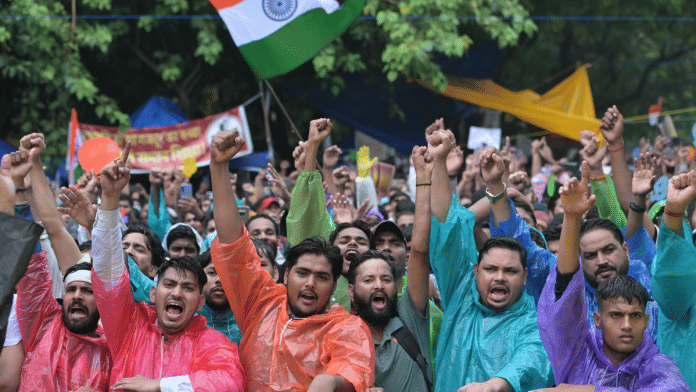
Chennai/New Delhi: As student protests against the NEET paper leak continue across the country, Tamil Nadu’s ruling Tamilaga Vettri Kazhagam (TVK) party has revived a long-standing debate—on whether education should be a part of the State List or Concurrent List of the Seventh Schedule of the Constitution.
In a statement following the protests at New Delhi’s Jantar Mantar demanding Education Minister Dharmendra Pradhan’s resignation, the TVK emphasised that education must be transferred back from the Concurrent to the State List. This would grant states full authority over education policy, including medical education.
As an interim measure, if immediate transfer faces legal hurdles, the party has proposed creating a “Special Concurrent List” to empower state governments with enhanced decision-making powers until a full constitutional amendment is achieved.
Education was originally a State subject under the Indian Constitution, allowing states to regulate the subject. Tamil Nadu, like other states, exercised significant control in this period, shaping policies aligned with its social justice goals and two-language formula.
However, the Indira Gandhi government moved education to the Concurrent List through the 42nd Constitutional Amendment during the Emergency in 1976. This move paved the way for national policies like NEET to be introduced at the Central level.
In addition to the demand to restore education to the State List, the TVK also reiterated that the party does not just want the irregularities in the examination to be resolved, but it wants the complete abolition of the NEET exam.
Successive governments in Tamil Nadu have opposed the NEET exam for about a decade now and argued that NEET disadvantages students from rural areas, government schools, and underprivileged backgrounds in Tamil Nadu, who traditionally performed well through Class 12 marks-based admissions.
The TVK has now advocated reverting to a system in which states control medical admissions based on higher secondary performance, which it views as fairer and aligned with principles of social justice.
Health Minister K.G. Arunraaj says putting education in the State List upholds the principles of federalism, allows policies tailored to local socio-economic realities such as Tamil Nadu’s emphasis on social justice and reservations, and prevents the imposition of uniform national systems that disadvantage regional students.
Arunraaj alleges that NEET goes against federal principles, and that centralised exams are vulnerable to irregularities such as paper leaks. In a statement to the media, he emphasised that the Tamil Nadu government will continue all measures, including resolutions and legal options, to abolish NEET, while providing support like the 104 helpline for stressed aspirants.
Other TVK leaders also echoed these concerns.
TVK Minister Aadhav Arjuna wrote on X, “Understanding the sentiments of students who are leading a protest against the NEET exam brought by the Union government against students’ welfare, the Union government must immediately scrap the NEET exam. Likewise, it must immediately take steps to move education to the State List.”
What did the Constituent Assembly discuss while deciding to place education in the State List, why was it moved to the Concurrent List, and what does the Constitution currently say? ThePrint has the answers.
Also Read: Appointed to new fast-track court for NEET paper leak cases, who is judge Anu Grover Baliga
What does the Constitution say
The Seventh Schedule of the Constitution contains three lists: the Union List, State List and Concurrent List.
According to Article 246, the Union government has exclusive powers to make laws on subjects in the Union List, while state governments can make laws on subjects in the State List.
As for the Concurrent List, both the Central and state governments can enact laws listed under it.
According to Article 254, if there is a conflict between the laws, the Central law will override the state law. However, Article 254(2) provides an exception to this rule. It says that if a Central law and a state law in the same Concurrent List subject have conflicting provisions, the State would have to get the President’s approval for the law.
Currently, Entry 25 of the Concurrent List, added by the 42nd Amendment, says, “Education, including technical education, medical education and universities, subject to provisions of entries 63, 64, 65 and 66 of List I; vocational and technical training of labour.”
Entry 63 pertains to Benares Hindu University, Aligarh Muslim University, Delhi University and any other institution of national importance.
Entry 64 relates to institutions for scientific or technical education wholly or partly financed by the government of India and declared by a Parliamentary law to be institutions of national importance.
Entry 65 relates to union agencies and institutions for professional, vocational or technical training, including the training of police officers, the promotion of special studies/research, or scientific or technical assistance in the investigation or detection of a crime.
Entry 66 pertains to coordination and determination of standards in institutions for higher education or research and scientific and technical institutions.
Why education was a State subject
The Constituent Assembly debated the inclusion of education as a State subject on 2 September 1949.
The draft Constitution made education a State subject, subject only to a single Entry in List I, allowing central control over Benares Hindu University and Aligarh Muslim University. Dr B.R. Ambedkar moved an amendment to make education a state entry, subject to a few more exceptions under List I and List III.
Other amendments were also moved. For instance, one amendment proposed that education be made “subject to the supervision, direction and control of the Government of India”.
Another member, Hasrat Mohani, advocated for education to be in the Concurrent List, but cautioned, “Even then, I do not say that it be included in the First List. As I do not want to make the Centre all-powerful, I am trying to get this included in the Concurrent List.”
Another member, Shibban Lal Saxena, said that it was his firm belief that at least higher education must be a Central subject “in order to have one single unified nation”.
Saxena quoted Education Minister Maulana Abdul Kalam Azad, who wrote a letter to the Drafting Committee in April 1948, saying “there should be central guidance if not central control” on education in India.
Azad felt that “if it can be secured that Education throughout India follows the same general pattern, we can be sure that the intelligentsia of the country will be thinking on similar lines”.
This, he said, “would be a better check against the dangers of fragmentation than any centralisation of Government or concentration of power in the hands of the Central Authority”.
In response, T.T. Krishnamachari, a member of the drafting committee of the Constitution, urged members to pursue items relating to Education in List I, saying that the provisions confer enough power on the Centre to coordinate the educational activities of the states in the field of higher education, technical education, vocational education and scientific research, hinting at a balance between the Centre and states’ powers.
These amendments were then negated, and education was left to be a part of the State list. The final entry in the State list said, “Education including universities, subject to the provisions of entries 63, 64, 65 and 66 of List I and entry 25 of List III”. Original Entry 25 of List III pertained to “vocational and technical training of labour”.
Why Indira Gandhi intervened
The seeds for the 42nd Amendment were sown by the Swaran Singh Committee set up in 1976 during the Emergency.
The 12-member committee was headed by then external affairs minister, Sardar Swaran Singh, and was appointed by then Congress President D.K. Barooah.
Making a raft of recommendations, the committee’s report said while the Constitution had functioned without any serious impediment, difficulties had been thrown up on the interpretation of some of its provisions, “more particularly when they concern the right of Parliament to be the most authentic and effective instrument to give expression and content to the sovereign will of the people”.
On Centre-State coordination, Part VIII of the recommendations said that agriculture and education are “subjects of prime importance to the country’s rapid progress towards achieving desired socio-economic changes”, and that the “need to evolve all-India policies in relation to these two subjects cannot be overemphasised”.
“It is, therefore, suggested that Education and Agriculture should be placed in the Concurrent List. It may be clarified that the administration of these subjects will remain with the State Governments,” it had added.
Accepting this recommendation, the 42nd Amendment then transferred education to the Concurrent List.
What has DMK said on NEET
Tamil Nadu has a legacy of resistance against NEET since its introduction, viewing the centralised exam as an assault on the state’s autonomy, social justice policies, and the educational aspirations of rural and Tamil-medium students.
Successive governments, across parties, have passed resolutions, bills, and sought exemptions, arguing that the test favours urban, CBSE-background students and coaching-centric preparation, but the bill seeking NEET exemption, called the Tamil Nadu Admission to Undergraduate Medical Degree Courses Bill, 2021, was returned first by the Governor and then the President withheld assent to the same.
The DMK has also consistently supported moving education back to the State List as a means to protect state rights and eliminate exams like NEET.
Education Specialist at UNICEF, Aruna Rathnam, who was also a part of the special committee constituted to draft a State Education policy, said the committee had recommended making education a part of the State List.
“Health and education should be a part of the State List because the beneficiaries are the local people of the state. The state needs to have a decision-making system and control over the education sector because then the curriculum and the examination system can be tailor-made for the local people and it only benefits them directly, while retaining state autonomy,” she told ThePrint.
The committee said consolidated marks obtained both in Class XI and Class XII board examinations should be the basis for admission to all courses in higher education.
The committee recommended that the Tamil Nadu government may take appropriate measures to ensure that education was brought back in List II (State List) of the Seventh Schedule of the Constitution of India.
“Such a system brings a sense of ownership over the educational system as well in a psychosocial manner, which benefits the students’ overall education and wellbeing,” added Aruna Rathnam.
Earlier, the DMK had passed resolutions committing to this, criticising the BJP-led Centre for misusing the Concurrent List to impose policies such as the National Education Policy (NEP) and the three-language formula while disregarding state resolutions on NEET exemptions.
DMK leaders, including former Chief Minister M.K. Stalin, have argued that only by restoring education to the State List can states fully address local welfare, eradicate NEET, and uphold federalism, echoing long-held demands from the Dravidian movement.
“The Tamil Nadu Legislative Assembly unanimously passed legislation seeking exemption from NEET. States that seek exemption from NEET should be allowed to do so. Diversity in admissions need not compromise standards, it can strengthen both equity and excellence. The Union Government must hold consultations with an open mind rather than treating uniformity as an end in itself. India does not need greater centralisation. It needs greater trust in its States, its schools and its students,” Stalin wrote in a post on X on Thursday.
(Edited by Sugita Katyal)
Also Read: SC vows to end NEET ad-hocism, says it will go ‘extra mile’ to institutionalise exam system
Tamil Nadu’s stance on this issue is absolutely correct.
The Centre has no business ramming through education policies and conducting exams for institutions funded and managed by states.
Education and Health – both must be placed squarely under the State’s prerogative. The Concurrent list of the Constitution is the root cause of such friction and disharmony. Ideally, it should be done away with.