





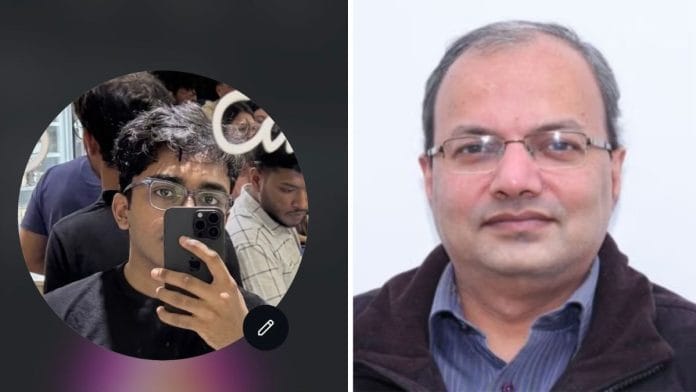


New Delhi: On Tuesday, soon after the central government temporarily blocked Telegram ahead of the 21 June NEET-UG re-exam, Nisarga Adhikary, a 19-year-old cybersecurity researcher, quipped that such a ban cannot stop paper leaks.
In response to the National Testing Agency’s (NTA’s) statement backing the block, he wrote on X that blocking Telegram completely wasn’t even possible. “Telegram is designed in such a way, which easily allows people to use proxies and other methods of circumvention.”
His employer, IIT Kanpur director Manindra Agrawal, saw the post and replied with a facepalm emoji. “Will need to sit him down and explain,” he wrote.
Adhikary is no random critic. He made headlines in May after publishing a blog post about security flaws in the CBSE’s exam portal.
He had said at the time that it took him less than an hour to find the vulnerabilities in the school exam board On-Screen Marking (OSM) system. “Anyone can impersonate any examiner. The access control is totally broken,” he wrote.
Impressed by Adhikary, IIT-K director Agrawal reached out to hire him after the blog post. Adhikary joined C3iHub, IIT Kanpur’s cybersecurity hub, as an Open Source Intelligence (OSINT) and threat intelligence engineer.
Weeks later, the two have ended up on opposite sides of a debate on X.
Explaining his position, Agrawal said that the problem was not people sharing leaked papers on Telegram. It was people using Telegram to fake a leak. “It can be used to spread fake news of a leak that appears genuine,” he wrote. “It was done by someone during JEE Advanced. It causes unnecessary confusion.”
Speaking to ThePrint, he walked through how the Telegram ban helps.
“A person creates a Telegram channel linked to a group. The day before an exam, they post any random PDF in the channel. It shows up in the group with a timestamp. After the exam, they replace that PDF with the actual question paper. In the channel, the edit is visible. But in the linked group, the timestamp does not change. The old time stays. The new file appears.”
“Now in the group it appears that the PDF file of the question paper was posted one day before the exam,” Agrawal further said. “And then you go to town saying look, I had a copy of the paper one day before. This creates unnecessary and completely false panic.”
The Agrawal-Adhikary exchange comes at a time when several Internet service providers (ISPs), Google PlayStore and Apple Store have already complied with the ban. The NTA, arguing in favour, has said that fraudsters have been running Telegram channels with names like ‘NEET Mafia’, collecting around Rs 1.5 crore from students by falsely promising them the question paper.
The X exchange
When another X user listed six other platforms including Discord, Signal and WhatsApp that could also be used to spread a real leak, Agrawal agreed. “Closing access to Telegram is not going to solve it. The problem being addressed is different. Telegram allows one to fake a leak without leaving a trace,” he wrote.
Adhikary then replied: “Sir, Telegram shows it too.” He posted a link to an open source code in Telegram that shows edit timestamps.
Seventeen-year-old Sarthak Sidhant, another student whistleblower who exposed CBSE’s OSM procurement irregularities and appeared before a parliamentary panel to present his findings, also replied to Agrawal. “Just because a communication medium has elements of misinformation, we have decided to shut it down,” he wrote. “Doesn’t WhatsApp have elements of misinformation? Doesn’t the Indian press? What’s the reasoning behind shutting down entire Telegram?”
Agrawal posted a follow-up. “Telegram, as I write, has this special feature that allows editing of a post without reflecting that edit has been done. This is dangerous. No other major social media channel has this.”
When ThePrint asked Agrawal whether his exchange with Adhikary was a serious disagreement, he said: “It’s fun banter, of course.”
(Edited by Gitanjali Das)
What is with the title of the article? These phrases that is used in article, does not make sense.