



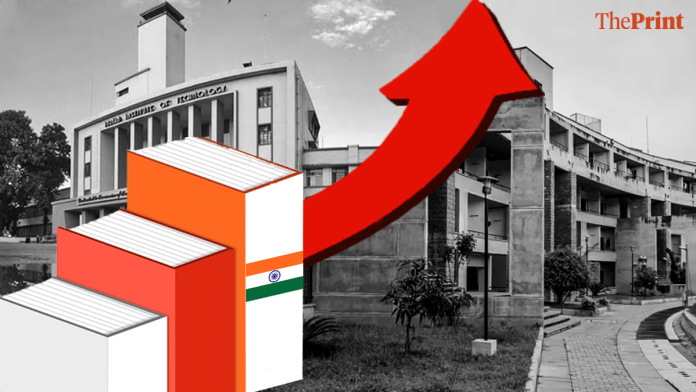
New Delhi: Indian universities have continued to rise in the QS World University Rankings 2027, with the Indian Institute of Technology, Delhi, maintaining its position as the country’s top-ranked university at 118th global rank. This is not the only victory for India, however.
No fewer than 18 universities have got their highest-ever ranking, and more than half of Indian universities in the list have moved up the list. Interestingly, private universities also figure in this all-round improvement.
The ranking shows a definite shift, with not just IITs, but central, state as well as private institutes improving their performance over last year. The University of Delhi is now at rank 322, and Anna University at 470. Private institutes, such as Shoolini University in Himachal Pradesh and Chandigarh University, have also improved their ranks.
A total of 18 Indian universities have for the first time got their highest-ever positions in the list. Of these, 13 of them were not IITs.
This is an important shift as it shows that the academic curriculum is improving across institutes all over the country. The report notes that India’s higher education system is becoming balanced with multiple Indian universities contributing to its growth.
Strengths in India’s higher education
India has shown good performance when it comes to research impact, one of the country’s biggest strengths in the ranking. Eleven Indian universities have been ranked in world’s top 100 for Citations Per Faculty which shows the number of times a university’s research is referred globally. Indian Institute of Science, Bangalore, tops these 11 Indian universities, followed by IIT Roorkee, IIT Madras, IIT Delhi and IIT Kharagpur.
Bharathiar University has also made a name for itself as it has entered this list, showing that it is not just central universities that have strong research. Shoolini University is also mentioned in this category, again proving that private universities are now contributing to global research.
Indian universities have improved their performance under the employability head, too. The University of Mumbai has made a decent mark as it rose to 25th global rank for employment outcomes which shows how the graduates of a particular university are doing in the current job market.
More than a third of Indian universities have improved their employer reputation scores in this ranking. India’s top 10 universities have shown improvement under this category, which means that now Indian graduates are being hired by employers both within the country as well as outside.
Challenges in higher education
Challenges remain, however. Academic reputation in India is still considered a weak area for many Indian universities. Only about 8 percent of the Indian institutions have improved in the category, and around 28 percent of Indian institutions actually saw a decline in ranking. This shows that the global perception about Indian universities has not improved much when compared to research output and employability.
The second concern is lower levels of internationalisation. About 90 percent of Indian universities do not show any change in the number of foreign students they admit. Only one Indian university has ranked in the global top 500 universities for international faculty. This indicates that there is a limited global presence as well as a limited international diversity in Indian institutes.
Faculty shortages remains a structural issue across India. Only about six per cent of universities have managed to improve their faculty-student ratio while 30 per cent saw a decline. Indian institutes currently have around 44.6 million students, and this low ratio ends up creating problems for the faculty while impacting teaching quality.
(Edited by Nardeep Singh Dahiya)
Also Read: Jammu and Kashmir offers a model for NEP-led success. It’s called ‘Design Your Degree’