





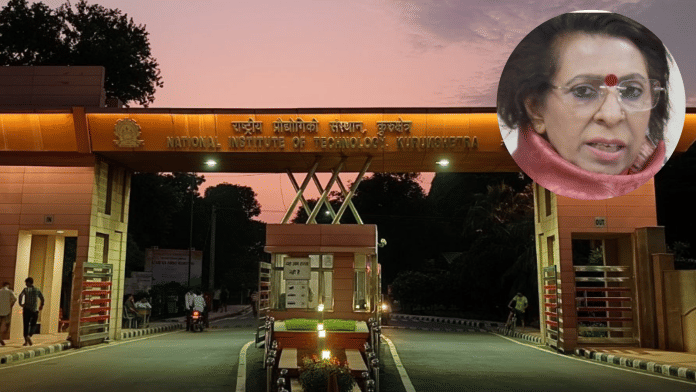

Gurugram: Students of Kurukshetra’s National Institute of Technology (NIT) are being ensnared in online gambling and credit card debt, leading to financial desperation that has resulted in at least two suicides, Haryana State Commission for Women chairperson Renu Bhatia told ThePrint after visiting the campus Tuesday.
The institute has seen four student deaths (one of them a young woman), allegedly by suicide, in the past two and a half months.
Another female student also tried to take her own life around 10 days ago, according to the police. The spate of tragedies has prompted the government-run institute to declare early vacation and close hostels.
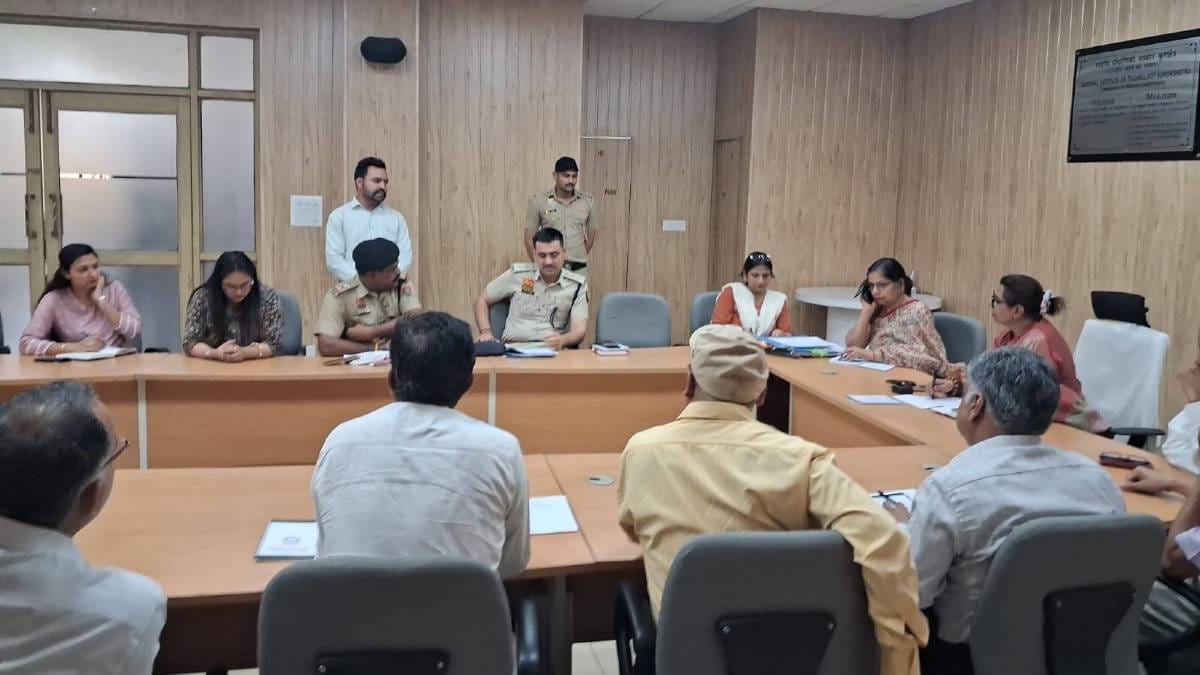
On Tuesday, Haryana women’s commission chief Bhatia talked to the NIT administration, staff and police to probe the cases of the two young women—one who died, and another who nearly did.
Speaking to ThePrint Wednesday, she also flagged the role of a private bank regarding issuance of credit cards to students.
“Based on my observation, I have flagged the functioning of a private bank, ICICI Bank, which has been liberally issuing credit cards to students. If you or I need a loan, they demand a plethora of documents. But to students aged 18-20, they are issuing credit cards with just an identity card and a home address, charging 36% interest, without permission from the NIT authorities or parents,” claimed Bhatia.
She further alleged that students were being pulled into these arrangements through a WhatsApp group, and once trapped in the high-interest cycle, many were turning to private moneylenders, borrowing from one to pay another, until there was no way out.
ThePrint has sent a detailed questionnaire to Sujit Ganguli, who handles press queries for ICICI Bank, outlining the allegations made by Haryana women’s commission chairperson. This report will be updated when a response is received.
ThePrint has also reached out to Professor Brahmjit Singh, officiating director of NIT Kurukshetra, for comment on these developments via call, text and email, and is awaiting a response.
Also Read: NIT-Kurukshetra orders students not to gate-crash weddings, threatens disciplinary action
‘Suicide notes mention financial pressure’
Bhatia’s allegations stem from the fact that in at least two of the four suicide cases on the NIT Kurukshetra campus in two months, financial distress has emerged on record.
“In the case of two of the boys who died by suicide, it has come on record that they were into gambling and had fallen into debt. Their suicide notes mention financial pressure,” Bhatia said.
A third student, she noted, had asked his father for Rs 6,000 shortly before his death. The father was unable to send money beyond what he already gave for routine expenses. The boy did not ask again.
Bhatia said she asked the institute authorities why a student at NIT would need credit at all, when it charges no tuition fee of the kind private colleges do. “There is no financial pressure from the institute,” she added. “Then why are they borrowing?”
The answer, she suggested, lies in online betting—a habit that appears to have quietly taken hold among a section of the student population, and which the private bank’s easy credit appears to have, at minimum, facilitated.
Girl who ‘couldn’t live up to expectations’
If the boys’ cases point to gambling and debt, the story of at least one of the two young women is rooted in something just as devastating.
Bhatia recounted the case of a girl whose parents had scolded her for scoring an 8.3 cumulative grade point average, less than what they “expected”. The girl wrote back to them—words that would later read as a farewell. She said she could not live up to their expectations. She is believed to have died by suicide.
Her story sits uncomfortably alongside that of another student, a 19-year-old who attempted to jump from the fifth floor of a hostel building and survived only because other students happened to be nearby.
After the incident, NIT sent her back to her home in Maharashtra, declared a vacation and ordered the hostels vacated, a sequence of events that students and observers have since read as an attempt to clear the campus of witnesses rather than address the underlying crisis.
The vacations were preponed from the routine date of 1 May, and the campus will now open on 15 July.
4 deaths in 2 months
Established in 1963, NIT Kurukshetra—considered Haryana’s first engineering college and one of India’s 31 NITs—has seen four student deaths, allegedly by suicide, since 16 February.
The first was of Angod Shiva, 19, from Telangana’s Rangareddy district, who was found hanging in his hostel room. Police at the time noted possible financial distress.
On 31 March, Pawan Kumar, 22, an Electrical Engineering student from Nuh district in Haryana, was found dead in his hostel room. A note was found but did not clearly spell out the reason.
On 8 April, Priyanshu Verma, 22, a third-year Civil Engineering student from Sirsa’s Sherpur village, was found hanging in his hostel room. No note was recovered.
On 16 April, Diksha Dubey, 19, from Buxar in Bihar and a student of Artificial Intelligence and Data Science, was found hanging in her hostel room.
Her death set off protests on campus, with students alleging institutional apathy and a near-total absence of mental health support.
Institute in administrative freefall
The crisis at NIT Kurukshetra goes beyond individual tragedies. It has triggered a cascade of institutional responses that suggest problems runs deeper.
As early as 29 March, the Ministry of Education had suspended the administrative and financial powers of Director Prof. B.V. Ramana Reddy. Around the same time, Registrar Gyana Ranjan Samantaray was removed from his post, with Prof. Brahmjit Singh stepping into the role.
After the student protests and ministry intervention, Singh was elevated to acting director, while Prof. Vinod Mittal was appointed the new registrar.
On 25 April, the day after a ministry team led by Higher Education Secretary Dr Vineet Joshi visited the campus, Samantaray was suspended, and Reddy’s resignation was accepted.
On 28 April, the government gave the charge of officiating director to Singh.
A review committee headed by National Assessment and Accreditation Council chairman Prof. Anil Sahasrabuddhe, which visited the campus last week, is also examining issues of recruitment, promotions, vacant faculty posts and the institute’s declining ranking.
(Edited by Nida Fatima Siddiqui)
Also Read: SC issues pan-India guidelines to protect mental health of students in colleges & coaching centres
The fee at NITs is very reasonable compared to private engineering colleges. And with peer pressure and gullible age group these students belong to, they are sure to fall into such traps easily too. Easy internet access has made it easier too. The first step can be blocking access to all betting sites on campus. The institute is well within its rights to restrict access to such sites keeping student well being in mind. Timely counselling is also very much needed and institute needs to make sure they hire right people for engaging the students effectively.