


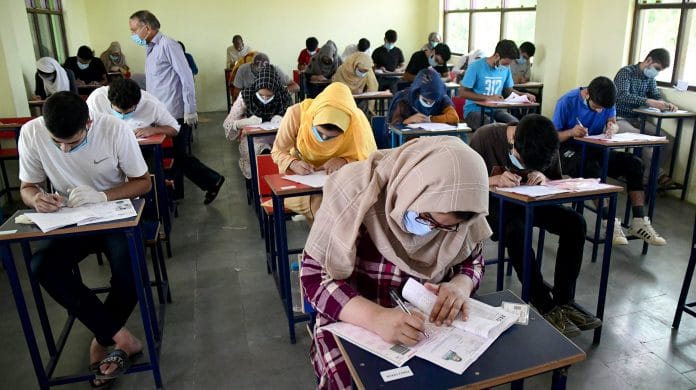
New Delhi: For next year’s NEET-UG exams, the Centre is considering giving candidates the option to choose between the CBT (Computer-Based Test) and pen-and-paper modes so that they have a “level playing field”, government sources told ThePrint.
All competitive exams, including NEET-UG, conducted by the National Testing Agency (NTA), will eventually move to 100 percent CBT mode, the sources added.
“Since the NEET-UG exams were being conducted in physical mode all this while, many of the students who will be appearing next year would be preparing accordingly. If we transition to full CBT mode next year, these students can claim that they are at a disadvantage. To give them a level playing field, the government is considering giving them the option to choose,” one of the sources said.
The Nandan Nilekani-led high-powered task force set up to reform competitive examinations is also in favour of giving candidates the option to choose between the CBT and pen-and-paper modes, the source said, adding that a similar approach was followed when JEE Main transitioned from pen-and-paper to CBT.
The transition for JEE Main was not immediate. The CBT format was first introduced as an option in 2011, alongside the offline mode, with both formats continuing for several years before the examination moved entirely to CBT in January 2019.
With 22.79 lakh students registering for NEET-UG 2026 and around 20 lakh appearing for the examination across more than 5,400 centres in 13 languages, conducting the test offline involves an enormous logistical exercise. The entire process, from printing question papers in multiple languages to transporting confidential packets to examination centres across the country, also creates multiple points of vulnerability to paper leaks.
“All competitive exams will have to move to online mode sooner rather than later. Not only are the chances of leaks minimal in CBT mode, but it is hassle-free for the students too, who need not travel long distances to sit for the exam. But the transition can’t happen at one go,” said the official quoted earlier.
The Nilekani panel was set up in July, following the NEET-UG paper leak controversy, which exposed gaps in examination security and centre-level monitoring. However, its mandate is broader than NEET-UG, covering reforms in the country’s overall competitive examination system, including entrance and recruitment tests.
Also Read: Exclusive: How NTA subject experts leaked NEET-UG paper—‘questions on chits, marked NCERT paras’
Investment required to ramp up CBT infra
Sources told ThePrint that the Nilekani panel has also stressed that, before the eventual shift to CBT, the government will have to invest in ramping up online infrastructure in government institutions.
“There has to be adequate choice available to students. Right now, government institutions are not that well equipped, and we are forced to rely on private players. A need for making more investment has been felt,” one of the officials said.
In meetings with the Nilekani panel, states have agreed to share the responsibility and invest in bolstering infrastructure in government institutions.
The source cited the example of the NEET-PG exam held this year. “Some 2.7 lakh candidates appeared for the exam, which had to be conducted in one shift. Before the exams shift to CBT mode, the supporting online infrastructure in the test centres must be ready,” the official said.
The NTA is also targeting at least one digital examination centre in every district, with new centres required to have a minimum of 285 functional computer workstations. The agency has already invited government, aided and private schools, colleges, universities, and institutions such as IITs, NITs, IIMs, IISERs, AIIMS and ITIs to serve as examination centres.
Besides, the Nilekani panel is also in the process of prescribing a framework for certifying and auditing all exam centres to ensure they are foolproof. “There is a general consensus that certification of all exam centres should be done periodically… maybe twice a year, while an audit of all centres should be carried out before the exams,” said the official.
The panel is currently visiting different states and meeting stakeholders to discuss how to strengthen the examination framework to avoid paper leaks. So far, the panel has visited eight states.
The panel is expected to submit its report to the Centre in January 2027.
(Edited by Chingkheinganbi Mayengbam)
Also Read: Why India’s NEET V2.0 exam should worry us all