



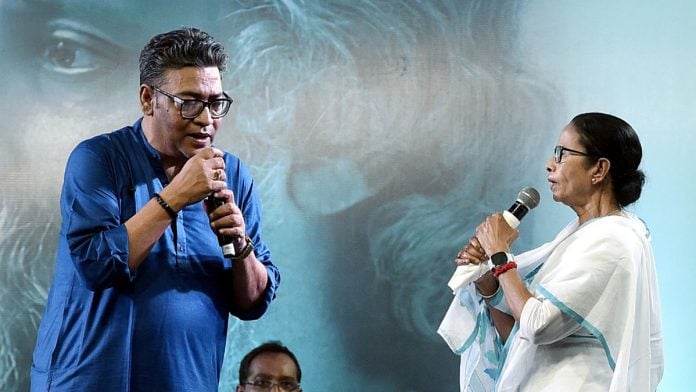
New Delhi: The Enforcement Directorate Thursday alleged a direct financial connection between former West Bengal chief minister Mamata Banerjee and the music company of former member of her Cabinet, Indranil Sen. In a statement, the agency said that there was a transaction of nearly Rs 30 lakh between Sen’s music label Octave Records and the bank account of the Trinamool Congress leader.
Sources in the agency, however, refused to call the transaction a transfer of proceeds of crime, and said that the “nature and kind” of transaction was yet to be ascertained.
“Investigation has revealed that more than Rs 3.8 crore in cash was deposited into the bank accounts of Indranil Sen and his proprietorship concern, M/S Octave Records, during his tenure. Also, from Octave Records’ bank account, nearly Rs 30 lakh was transferred via banking channels to Mamata Banerjee, then chief minister of West Bengal, which Indranil Sen has claimed was paid as royalty,” the agency spokesman said.
Sources in the agency said that during questioning, Sen submitted that the funds were transferred as a royalty fee to Banerjee for the songs and tunes she had composed and sold through his music label. However, they maintained that Sen failed to produce any documentary evidence to back his claim.
“He was questioned on the rationale and the reasoning behind the funds transfer, carried out in around half-a-dozen transactions, adding up to around Rs 30 lakh, and he said that it was repayment to her for the songs and tunes she composed and were later sold through his company,” an agency official said.
“However, he could not produce any agreement substantiating such arrangements or proof of the sale of those songs and tunes that led to generation of funds. The transaction has been established, but the nature and kind of the money transfer is yet to be done and hence either calling those funds as proceeds of crime or not part of the same would be premature,” the official further explained.
Trinamool national spokesperson Saket Gokhale rubbished the ED claims. “About 98 percent of ED cases against politicians were filed on Opposition leaders. The remaining are those who went and joined the BJP’s ‘washing machine’,” he told ThePrint. “In the last 11 years, a total of 5,297 cases were filed by ED. How many were taken to court for trial? Ony 47,” he said.
“The conviction rate of ED is 0.7 percent. That means out of every 1,000 cases filed, accused were found guilty in only seven cases. Therefore, out of every 100 cases filed by the ED, only one actually makes it to court. And out of 1,000 people jailed, only seven are found guilty,” Gokhale elaborated.
The agency issued a statement after the culmination of searches at the premises of Sen, tourism minister in the Banerjee-led government, as part of a probe into the misappropriation of funds generated from devotees for personal use.
The agency’s money laundering probe stems from a First Information Report (FIR) filed by the Kolkata Police on the allegations that Sen, his wife Madhuchhanda Sen, the president of Mahanirban Road Mass Art Society (MassArt) and other office-bearers of the cultural organisation collected massive sums of money through MassArt between 2022 and 2025 from the public by falsely claiming to be a UNESCO-sponsored entity, subsequently utilising those funds for personal gain.
The agency alleged that MassArt “systematically commercialised” Durga Puja viewing, effectively converting a public festival into a commercial enterprise and selling tickets to the general public for Preview Shows ranging from Rs 1,749 to Rs 5,499 across 24 selected Durga Puja pandals in Kolkata.
“A core element of this fraudulent scheme was MassArt’s deceptive and unauthorised exploitation of the official name, goodwill, and logo of UNESCO for commercial purposes,” the agency spokesman said.
“The investigation has revealed that over a two-year period (2023 and 2024) alone, more than one lakh such tickets were issued. The proceeds from the ticket sales were subsequently siphoned off, either through cash withdrawals from bank accounts or by being written off as miscellaneous expenses.”
(Edited by Nardeep Singh Dahiya)