



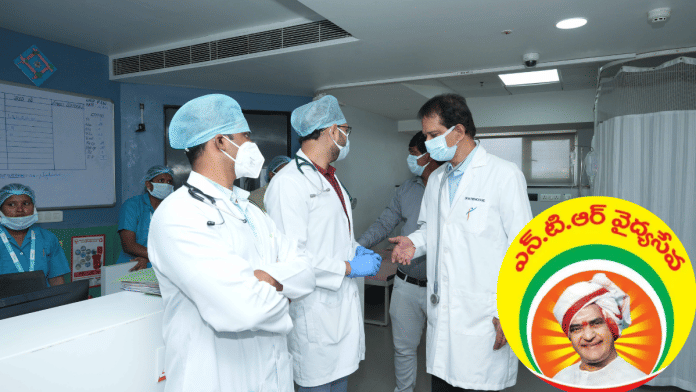
Hyderabad: The cash-strapped Andhra Pradesh government has “pushed” a network of about 600 private hospitals in the state into agreeing to a “bizarre” arrangement to clear their dues for subsidised public healthcare, a move that requires them to repay the interest on money borrowed by the government.
The Chandrababu Naidu-led Telugu Desam Party (TDP) government owes Rs 3,200 crore to both government and private hospitals for medical interventions performed and billed under the flagship NT Rama Rao Vaidya Seva scheme by the empanelled hospitals across the state since 2024.
Much of this, about Rs 2,200 crore, is owed to private facilities.
However, starved of funds, the government has facilitated a part payment of Rs 1,000 crore by borrowing the amount from the AP Power Finance Corporation Limited (APPFCL) at an interest rate of 8.6 percent per annum. The hospitals, have to pay the interest component.
The tripartite agreement between the government, APPFCL, and the hospitals was signed earlier this week. A copy of this agreement is with ThePrint.
Under the agreement, the 600-odd hospitals will receive Rs 1,000 crore as part payment, with the final disbursal adjusted after deducting the 8 percent interest component.
“We have never witnessed such a bizarre settlement of payments as this,” said Dr Narendra Reddy, a senior orthopaedic doctor at Sai Bhaskar Hospitals in Guntur.
“For the (first) time in the state’s history, the creditor is made out to be the debtor. The AP government, led by the Telugu Desam Party (TDP), has been pushing pending payments since it came to power two years ago. With our operations being hit severely because of rolling over payments, the government has compelled us to accept this kind of a settlement,” he told ThePrint.
His hospital is among the 600 empanelled facilities to provide nearly 3,000 medical services at subsidised costs under the NTR Vaidya Seva Trust, which runs the scheme.
ThePrint reached out to Health Secretary Saurabh Gaur, but he declined to comment. APPFCL MD K Vijayanand also refused to comment. Finance Secretary Ronald Rose was not reachable.
The state government established the NTR Vaidya Seva Trust under the chairmanship of the chief minister, and it is administered by a chief executive officer who is an IAS officer. The trust, in consultation with specialists from insurance and healthcare fields, runs the scheme.
The private hospitals and doctors are enraged by this agreement, where Rs 1,000 crore owed to them has been lent by the APPFC to the hospitals instead of being settled as dues.
With no commitment from the government on further payments after the first tranche, doctors ThePrint spoke to say they were compelled to accept these terms under financial duress.
“The government has pushed us into a corner, and they are not allowing us to do our business. We have been unable to maintain the quality of healthcare because we are running out of working capital,” said Dr K Vijay Kumar, the president of the Association of Super Speciality Hospitals of Andhra (ASHA).
Dr Kumar is a robotic joint replacement surgeon in Rajamundhry.
After nearly six months of protests by ASHA and the Andhra Pradesh Private Nursing Homes Association (APNA), the government has agreed to release the first tranche of Rs 1,000 crore. Doctors from ASHA and APNA protested in November last year, with hospitals under their associations closing operations for a month.
However, with treatments disrupted and costs associated with the near-shutdown of healthcare in Andhra, the doctors called off their strike after the government promised to pay the hospitals on a timely basis.
But with no respite, ASHA approached the Andhra Pradesh High Court in January, filing a writ petition. “It asked the government to look into our payments,” Vijay Kumar said.
Doctors fear that the state’s financial distress could adversely impact the quality of healthcare, which could ricochet through the economy more dangerously, with people’s health at stake.
They blame the increase in the number of surgical and non-surgical interventions included in the NTR Vaidya Seva scheme by successive governments since 2014.
“When Dr YS Rajasekhara Reddy introduced Aarogyasri (in 2007), only 300 procedures were part of it. Now, there are 3,000 procedures under the NTR Vaidya Seva scheme, which is why this has become untenable,” said Dr Avinash Chilukuri, Secretary, ASHA, who runs Usha Prime Hospitals in Anakapalle near Vizag.
The Dr NTR Vaidya Seva Trust was rebranded by the TDP-led government in 2014 after Andhra and Telangana were bifurcated. It was officially established, registered, and recognised in 2015 when a Government Order was passed, renaming the Rajiv Aarogyasri Health Care Trust established in 2007 by the late chief minister Y.S. Rajashekhara Reddy.
While the Aarogyasri scheme was originally introduced to cover patients in the Below Poverty Line (BPL) category, the current NTR-TDP scheme covers 93.5 percent of Andhra’s population, leading to budget delays and mismatched financial obligations.
The private hospitals offer services worth Rs 250 crore each month under the scheme and have thus far only been partially compensated for the procedures.
Also Read: Andhra proposes Rs 100-cr wealth fund, eyes Norway-style sovereign fund model to drive growth
‘Fiscal optics, not financing efficiency’
The current payment arrangement has been severely criticised by economists and the opposition, given APPFCL’s poor rating. The power sector lender has been rated ‘D’ by both of India’s premier agencies, ICRA and CRISIL, indicating that the lender is a defaulter.
As per CRISIL’s most recent rationale (August 19, 2025), APPFCL has approximately Rs 2,996.8 crore of outstanding bonds, all of which carry a CRISIL D rating (i.e., default category), and the issuer has been migrated to “Issuer Not Cooperating” status because management stopped responding to the rating agency.
“On its face, picking a CRISIL D-rated, RBI ‘non-cooperating’ NBFC whose statutory mandate is power sector reform to front-end a healthcare scheme is nonsensical,” an economist from Andhra Pradesh told ThePrint.
“That is precisely why it is the optimal vehicle if the design objective is fiscal optics rather than financing efficiency. The selection logic, stripped of official justification, looks like this: Borrowings by an SPSE do not appear in the state’s fiscal deficit computation even when backed by a state guarantee,” he said.
“CAG’s own FY24 report flagged Rs 10,037 cr of AP off-budget borrowings as requiring confirmation. A scheme routed through APPFCL sits in this grey zone by construction.”
Seediri Appalaraju, a YSR Congress Party leader, criticised the TDP government’s attitude towards healing with the healthcare sector, saying that in the nearly 20 years of Aarogyasri’s existence, it has never suffered such setbacks as under the coalition government, noting that services were disrupted on two occasions, forcing the state to come up with a one-time settlement plan through the tripartite agreement.
(Edited Ajeet Tiwari)
Also Read: Centre backs Andhra’s PPP push to build new medical colleges—the model & political row over it