


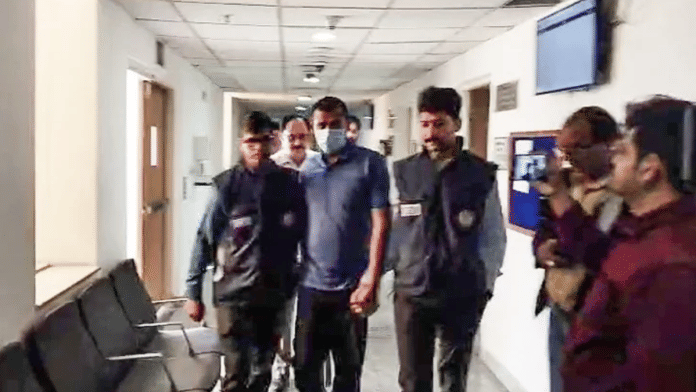
New Delhi: After nearly a full day of hearing, during which the court heard elaborate arguments from his counsel challenging his arrest by the Central Bureau of Investigation (CBI), a Delhi court Monday granted a two-day transit remand of Mahadev Online Book founder Sourabh Chandrakar.
Wanted in two CBI cases and a money-laundering case lodged by the Enforcement Directorate (ED), Chandrakar was taken into custody Sunday evening after a CBI team brought him to India from Oman following his extradition.
The CBI produced Chandrakar before Principal District and Sessions Judge Nikhil Chopra of the Rouse Avenue Court, seeking a two-day transit remand to produce him before a Special Court in Raipur, where the Mahadev Online case is underway.
However, Chandrakar’s counsel Tushar Giri challenged the arrest, arguing that the extradition order was passed based on a Government of India undertaking that Chandrakar would not face trial in any other case, except the ED’s money laundering case, mentioned in the extradition order passed in Oman.
“The Omani court extradition order doesn’t mention the CBI case at all,” Giri argued before the court, challenging CBI’s jurisdiction to arrest his client. “I am just arguing on the legality of the arrest… Not disputing ED’s right to arrest. I am not saying ED can’t take him into custody, but for the CBI to do so when its extradition request did not culminate in a judicial order is teeth in the law,” Giri said.
Appearing for the CBI, a team of Special Public Prosecutor V K Pathak and Naveen Nischal argued that the CBI had effected the arrest only by executing a warrant issued by the court in Raipur. “This is not a violation of Article 21 of the Extradition Act. There cannot be a bar on arrest or trial against a judicial order passed by a court in Raipur if there is no condition by Oman. We have just produced him after executing an arrest warrant, which is a judicial order,” Pathak told the court during the hearing in the second half of the day.
Additionally, he said that there was no bar to the CBI’s investigation, but also argued before the court that the points of jurisdiction and the “doctrine of speciality” can be raised before the Raipur court, where the matter is underway.
Taking into account arguments by all sides, including those of the ED, which had sent a full-fledged team of investigators as well as public prosecutors to press for Chandrakar’s custody in case the court denied the CBI transit remand, the court said it has to take into account that the money laundering case in which Chandrakar has been extradited rests on CBI’s case of gambling and cheating.
“While there cannot be any dispute that the doctrine of speciality would require that the accused is tried only for the offence in respect whereof the order of extradition is passed, the court cannot be oblivious of the fact that the proceedings of the ED case arise out of the predicate offence which is a subject matter of RC No.RPZO/10/2022,” Judge Nikhil Chopra said in the order.
The doctrine of speciality governs extradition between countries and establishes that a person extradited from one country to another can only be tried, sentenced, or detained for the specific crimes listed in the extradition request and approved by the surrendering state.
“Although it cannot be disputed that the role of the court, while considering transit remand, includes insight into the validity of the arrest, having regard to the fact that Section 21 of the Extradition Act also provides for certain exceptions, the question of whether or not the present case falls within the said exceptions cannot be determined at this stage, nor would it fall within the jurisdictional confines of this court,” the judge further observed.
During the course of proceedings, the CBI counsels had also sought the court’s nod to take Chandrakar to Raipur in handcuffs on grounds that “so many big people are involved” and that “this is a high-profile case”. Special Judge Chopra asked the agency if it did not trust its own officers who were taking him to Raipur. The written order however had no mention if that request was rejected by the court.
(Edited by Gitanjali Das)