





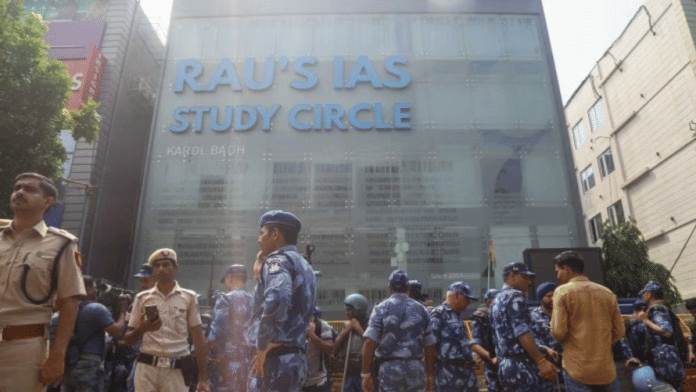


New Delhi: The CBI has cleared an IAS officer of criminal negligence in connection with the July 2024 drowning of three UPSC aspirants in the flooded basement of the Rau’s IAS Academy in Delhi’s Old Rajender Nagar.
Kumar Abhishek was then a deputy commissioner of the MCD and the area fell under his jurisdiction.
In its supplementary chargesheet filed before a special CBI court last week, the agency submitted that the officer from the 2016 batch of the Indian Administrative Service had issued a show-cause notice (SCN) against the building owners, but he was not alerted about “specific misuse of the basement as an exam hall or library” by his subordinates.
Moreover, the agency documented that he was not alerted to the violation by his subordinates, even in the detailed inspection reports submitted to him during hearings he conducted in his quasi-judicial capacity.
Deputy commissioners act as a quasi-judicial authority during hearings in a Show Cause Notice (SCN) for matters like unauthorised construction or property sealing.
The CBI had taken over the probe from the Delhi Police on the order from the High Court and had found after an initial inquiry that the coaching institute had flouted several safety norms that led to the drowning of the three students—25-year-old Shreya Yadav from Uttar Pradesh, 25-year-old Tanya Soni from Telangana, and 24-year-old Nevin Delvin from Kerala in July 2024.
In addition, around 30 students were trapped in the basement after its steel gate collapsed, allowing floodwater from the rain-swollen road to gush inside.
‘Nothing on record to indicate negligence’
A total of seven people were arrested in connection with charges of criminal conspiracy and culpable homicide not amounting to murder. Those arrested included the institute’s CEO Abhishek Gupta, coordinator Deshpal Singh, and the building’s co-owners—Parvinder, Harvinder, Sarabjit and Tajinder Singh.
The arrested people also included the driver of an SUV for allegedly driving his Force Gurkha recklessly on the flooded road, that allegedly led to the water slamming the building’s gate with force, knocking it down, leading to the flooding of the basement. He was later released on bail and was not charged by the CBI.
Apart from the six initially arrested and charged, the CBI also charged Ashok Narang, a consultant with the institute, and three government officials, including Arnav Kumar Datta, Udai Veer Singh, and Vedpal, in its supplementary chargesheet filed in April last year.
Datta was then a junior engineer of the Karol Bagh Zone, Udai Vir Singh, and Vedpal were Assistant Divisional Officer and a Divisional Officer, respectively, with the Delhi Fire Service.
“Investigation further revealed that the file was placed before the then Deputy Commissioner, MCD, Karol Bagh Zone, Sh. Kumar Abhishek for issuance of the Show Cause Notice under Section 345A read with Section 347 of the DMC Act for violations of the provisions of MPD-2021,” the agency submitted in its supplementary chargesheet filed last week.
“At that stage, no specific misuse of the basement as an exam hall or library was reported by the Subordinate Officer(s). During the subsequent personal hearings conducted in his quasi-judicial capacity, he directed examination of the documents and submission of a detailed inspection report,” it further said.
“However, even in the reports thereafter placed before him, no violation relating to the use of the basement was brought to his notice. Accordingly, there is nothing on record to indicate any negligence, lapse, or dereliction of duty on his part, who acted on the basis of the reports and information provided by the subordinate officers.”
In the same chargesheet, the agency, however, alleged dereliction of duty in part of Rajeev Kumar Jain, the then Assistant Engineer, and Kumar Mahendra, the then Executive Engineer, of the Karol Bagh zone.
The agency informed the court that departmental proceedings were already underway against them on the CBI’s recommendations.
The agency was examining the specific roles of the IAS officer and Superintending Engineer Ajay Nagpal in the tragedy at Rau’s IAS Academy on the court’s order. The court had, in March this year, directed the agency to probe probable dereliction of duties by the MCD officials, which led to the institute continuing its illegal use of the basement, leading to inundation and death of students.
The court had ordered a further investigation based on a protest petition filed by advocate Abhijit Anand, who was appearing for Nevin Dalvin’s father.
Responding to the exoneration of the IAS officer and the lack of mention of officials from other departments, Anand said he would move the Delhi High Court to seek appropriate instructions for the CBI.
During the hearing of the protest petition filed by J Dalvin Suresh, Nevin’s father, the court had observed that it was “difficult to believe” that none of the supervisory officers of the junior engineer charged in the case was aware of the illegal and unauthorised use of basement or even of the proceedings and inspections being carried out by their junior in compliance of directions of the Hon’ble High Court.
“Prosecution has filed a chargesheet and supplementary chargesheet naming JE of the Karol Bagh Zone as accused along with other persons. However, IO did not find any dereliction of duty/corrupt practice on part of any other superior official. Given the background of the case where a huge structure consisting of more than 6 floors catering to hundreds of students was operational for numbers of years, could not have gone unnoticed by the civic authorities who have a duty to report any noncompliance or violation of laws on day to day basis,” the court had said in March this year.
“It is thus very difficult to believe that none of the supervisory officers of the said JE could have been aware of the illegal and unauthorised use of basement or even of the proceedings and inspections being carried out by their junior in compliance of directions of the Hon’ble High Court. There could possibly be a conscious effort to ignore or permit the illegal use of the basement of the said coaching institute,” it had further said.
(Edited by Ajeet Tiwari)
Also Read: Rau’s IAS was an elite, small-batch institute. Then, competition led to rapid expansion