



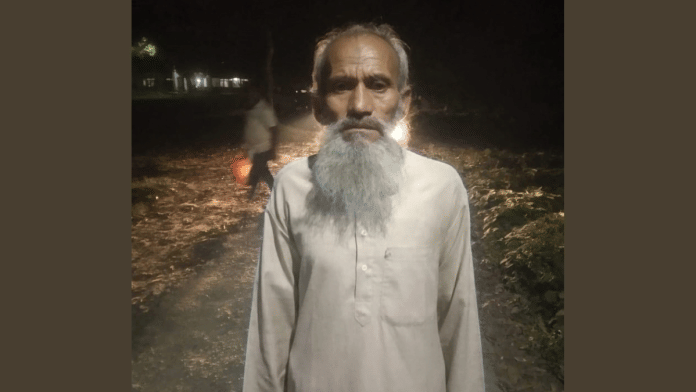
New Delhi: Around 11 pm 19 June, 66-year-old Jalil Akhtar, a resident of West Bengal’s Uttar Dinajpur district was woken up by a loud knock on his door. “When I opened the door, a bunch of policemen were standing who wanted my help to find the house of a local who was involved in a fight,” Akhtar said. But in a few minutes, it was Akhtar whom the police picked him and allegedly threatened him with severe action if he raised an alarm.
That was the beginning of Akhtar’s three-month ordeal during which he was labelled a “Bangladeshi national”, allegedly taken twice to the India-Bangladesh border to “push” him across.
Finally Tuesday night, Akhtar, whose name was in the 2002 voters’ list and the 2026 SIR exercise, was released from the Islampur jail and reunited with his family.
When Taufa Bibi, Akhtar’s wife, found his cot empty 20 June morning, she thought he had stepped out for Namaz. However, as the day progressed, she began to get worried. “When I saw his kurta hanging in the closet several hours later, I began to panic,” she told ThePrint.
Finally Taufa Bibi reached out to Akhtar’s cousin Moti-ur Rehman (62). Rehman and the locals scoured through the village and the adjoining forest, but were unable to find Akhtar. “Then one local told me that he had seen a police van outside Akhtar’s house the previous night,” Rehman told ThePrint.
When Rehman reached the local police station to enquire about his cousin, he was allegedly mocked and told that “the government has changed”.
“The government in West Bengal has changed, but has the Constitution and the law also changed? Why will an Indian citizen be kidnapped in such a fashion?” Rehman says he asked the police.
Akhtar describes his ordeal
After the police allegedly picked up Akhtar, they took him to Dalkhola police station, he said later. “At Dalkhola police station, when I repeatedly asked them why I had been picked up they told me that I was a Bangladeshi and had no place here,” he told ThePrint over a call.
The next morning, 20 June, Akhtar was taken to the Superintendent of Police’s office in Islampur following which he was put in a holding centre, he said. “They kept me in the holding centre for 15 days along with seven more people and then took us to the border,” he said.
At the border, while six others were “pushed back”, Akhtar said he was kept at a BSF camp for five days while BSF officials were verifying his ‘Bangladeshi’ identity. “The BSF officers told the police that I was not a Bangladeshi national,” Akhtar said.
Despite this confirmation of his nationality, Akhtar’s ordeal was far from over. From the BSF camp, Akhtar was taken back to the holding center in Chakulia, Uttar Dinajpur where he was kept for another week, he said.
“I was again taken to the border a second time where they wanted to “push” me into Bangladesh,” he said. After another day at the BSF camp, the 66-year-old was subsequently again taken back to the holding center where he was kept for yet another week before being sent to the jail in Islampur. “I spent close to two months in Islampur jail not knowing what my fault was. I possess all Indian documents and all my ancestors are from India. I still have a kaki (aunt) who is 99 years old and was born and brought up in India,” he added.
Getting emotional, Akhtar told ThePrint, that in those months he didn’t know what was awaiting him. “I have lived in this country since my birth, so has my father and his father. Why do I have to prove it? Is it because I am a Muslim?” he asked.
Speaking to ThePrint, SP (Islampur) Rakesh Singh said that the police action was based on “intelligence” they had received regarding Akhtar’s Bangladeshi nationality. “Today many people have Indian documents which are falsely procured. The investigation is still going on and we will charge sheet him soon. He might have got bail but he has not been absolved yet,” Singh said.
What the courts said
According to the FIR filed by the police, Akhtar and three others from the Andharahmatpur village of Thakurgaon had crossed over the Hili-Malda border 24 years ago. It further claimed that Akhtar, during interrogation, informed the police about it.
Contradicting their claims in the FIR, the police on 5 August submitted a case diary where they noted that “locals” during investigation told them that Akhtar moved to Uttar Dinajpur in 1982 (44 years ago) and began working as a rickshaw puller in Delhi and does not speak Bengali.
However, the defence counsel submitted three documents—Akhtar’s name on the 1995 voter list, and his name on the 2002 and 2026 SIR list. The SIR exercise was carried out to weed out “illegal residents”.
The police also claimed that Akhtar was born in 1959-1960 and has legal records showed his citizenship before 1982. They further told the court that Akhtar had not been able to establish a “credible link” with Raushan Ali, who he claimed was his father. However, as per the Indian Citizenship Act, a person born before 1987 does not need to show the birth records of their parents to prove their Indian citizenship.
Before the 2 September bail hearing, the police asked for more time four times to verify his documents. On 2 September, Akhtar was produced before Additional Chief Judicial Magistrate (ACJM) of Islampur court, where the investigating officer of the case gave a written declaration that identity documents submitted by Akhtar were valid.
At the next hearing on 14 September, opposing Akhtar’s bail plea, Assistant Public Prosecutor (APP) Sanjay Bhawal submitted in court that Akhtar’s bail may pose “a potential threat to the security interests of the state”.
However, Akhtar’s legal counsels Syed Nafirul Islam and Firoz Ahmed argued that the investigators were unable to prove the documents relied upon by the accused were fabricated.
Taking cognisance of all matters, ACJM Jamshed Shaikh said that: “The APP himself fairly submits that there is no single document which, in every case, can conclusively establish citizenship by birth.” The court also acknowledged that the victim holds valid documents proving his nationality and therefore granted him bail.
(Edited by Viny Mishra)
Also read Bengali-speaking Indians not same as Bangladeshi infiltrators: Shah