



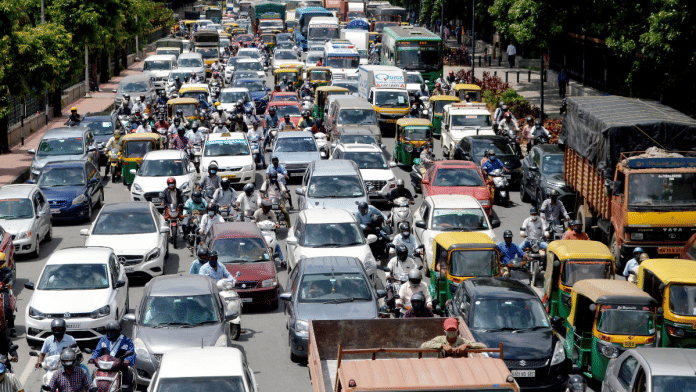
Bengaluru: Six years after Bengaluru’s Comprehensive Mobility Plan (CMP) was unveiled, the city’s transport authorities are restructuring their approach by linking it with the city’s broader master plan, ThePrint has learnt.
Planners, officials and consultants across departments have now combined efforts to align key city planning frameworks like the CMP and Revised Master Plan (RMP) to introduce more synchronised solutions that will have a longer-term impact on decongesting India’s infotech capital.
The 2020 CMP outlined a 15-year strategy across three phases, extending through to 2035, and featuring 92 km of elevated corridors, transit-oriented development, and a substantially larger role of public transport.
“Since the RMP and CMP are being revamped simultaneously, we want to look at aspects that will go into both (plans)—a confluence of sorts. This will include working with various authorities in Bengaluru,” a senior transport department official told ThePrint on condition of anonymity.
The official said this would include collaboration between the Department of Urban Land Transport (DULT), Bengaluru Metropolitan Region, Greater Bengaluru Authority (GBA), Bengaluru Development Authority, K-Ride, Metro rail, National Highways and others.
The new CMP will also look at options to move large truck and bus terminals as well as every possible unit that attracts heavy traffic inflows, out of the city to decongest it, the official said.
The GBA replaced the Bruhat Bengaluru Mahanagara Palike (BBMP, the city’s civic body), effectively doubling the city’s earlier 800 square km area that has largely been left out of the process but continues to be part of the larger Bengaluru ecosystem.
For decades, Bengaluru’s civic agencies worked in silos, announcing new infrastructure projects and other works that often proved counterproductive in solving the city’s intensifying congestion problems.
The official said that the new CMP will look at Bengaluru as a larger entity, including the metropolitan region, the city’s outer peripheries, satellite towns and upcoming corridors. “Surveys have started and we can possibly see the new CMP early next year,” the official said.
As one of India’s biggest growth engines and largest urban centres, Bengaluru has seen the quality of life decline at a steady pace due to crumbling infrastructure, lack of planning and regulations, alleged widespread corruption and several other factors.
That a city of Bengaluru’s stature is without an elected council since September 2020, leaves most of the planning with the state government. And that is where the problem lies, urban experts say.
Also Read: Bengaluru and its inspired incompetence in running things
‘Cart before the horse’
Urban experts say that barely 20-30 percent of the objectives of the 2020 CMP were actually met. The grand plans for a parking policy, 50 km of TenderSure roads, bus priority lanes, hundreds of kilometres of footpaths and cycle tracks and other initiatives remained largely on paper or were ceremonial in only a few stretches in the central part of the city.
In August, the DK Shivakumar-led Karnataka government amended the Bengaluru Metropolitan Land Transport Authority (BMLTA) bills, which would effectively curtail the body’s power to scrutinise big-ticket infrastructure projects like the tunnel road and other works, totalling about Rs 1.5 lakh-crore.
“Since the government has already approved these big-ticket projects, the CMP has to assume that they have been approved and then plan around it which is counterintuitive to the whole purpose,” Satya Arikuthram, an independent mobility consultant who formerly served as the chief technical advisor to the DULT, told ThePrint.
Arikuthram said that the already approved government projects would force the new CMP to “retrofit” these big-ticket infrastructure projects. “It’s like putting the cart before the horse. It will be a suboptimal solution without the power to scrutinise,” he added.
The city and its planners, irrespective of the party in power, have followed the same template to decongestion: flyovers, tunnel roads, ‘magic boxes,’ and other solutions that have increased dependency on private vehicles.
In June 2026 alone, 78,084 new vehicles were registered in Bengaluru, taking the total number in the city from 1,27,32,832 to 1,28,10,916. The figure includes two-wheelers, cars, tractors, taxis and other motor vehicles. Bengaluru’s population is around 1.4 crore; that would mean almost one vehicle per person in terms of ratio for a city where road networks are very limited.
In an earlier interaction with ThePrint, Bengaluru district in-charge Minister Krishna Byre Gowda said that the city’s road-to-city ratio is around 8 per cent which is about half of the 15 per cent required, making it one of the densest in the country.
Ashwin Mahesh, an urban planner summed up the road network in a social media post.
“Every 60-foot road in the city should connect at its ends to another 60-foot (or wider) road. This is how a network gets built. We have too many situations in which roads taper off or end abruptly without this network value. That has made them not very different from the arterial roads. And as a result, the public doesn’t see the benefit of taking a ‘major’ road instead of a neighbourhood route. And the residential neighbourhoods increasingly look not-that-residential,” he said.
(Edited by Nardeep Singh Dahiya)