





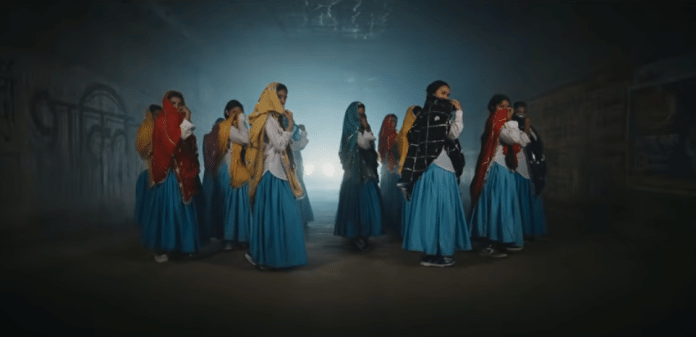


Gurugram: Badshah is back with ‘Tateeree’, minus the parts that landed him in a police station, and a new title, ‘Tateeree Fir Se’.
The Bollywood rapper-singer has re-released the Haryanvi folk song, scrubbed of the lyrics and visuals that triggered three FIRs, a near-arrest, and an appearance before the National Commission for Women.
The song, pulled from YouTube last month, following a storm of complaints, has already clocked a million views in its sanitised avatar in less than 24 hours.
The most contentious rap lines are gone. In their place sits a couplet. It reads as something between a comeback declaration and a chest-thump: ‘Aaya Badshah rang jamane, phir se jalwa dikhane/Ho mushkil waqt to banda sakht, hum fir aaye scene banane’. Roughly translated: ‘The king has come to set the stage, to dazzle once more/When times get tough, a man gets tougher—we’re back to own the scene’.
It is hard to miss the self-referential undercurrent. Badshah is not just singing about returning; he is narrating his own rehabilitation.
The song’s folk soul, however, remains intact. The chorus—drawn from the original Haryanvi composition recorded three years ago—still carries the lilting refrain: ‘Ghuti kyun ghuti kyun kare Tateeree/Mhare ri mandere pe boliye Tateeree,’ which translates to ‘Why does the Tateeree bird coo so restlessly? Let it sing at our doorstep’.
The tateeree, a lapwing bird common to the Haryanvi countryside, has traditionally served as a folk metaphor—its call at the threshold of a home associated with auspicious tidings and rhythms of village life.
The original video carried sequences shot near a school—identified as Badshala school—which drew particular outrage, given the setting’s proximity to children.
That footage is gone entirely. As is the sequence in which women were depicted in a Haryana Roadways bus in a manner that many found objectionable.
Both have been replaced with a sequence of girls dancing inside an underpass, dressed in a ‘daman-kurti’—the traditional Haryanvi ensemble consisting of a long flared skirt with a tunic—which reads almost like deliberate visual restitution.
A few elders with hookahs also make a cameo, adding a layer of folk authenticity that the original was accused of squandering.
How the original version created troubles for Badshah
The original, released on 1 March, set off a chain of events that Badshah could not have anticipated.
Social organisations objected almost immediately.
Savita Arya of Panipat’s ‘Nari Tu Narayani Utthan Samiti’ filed a complaint with the State Women’s Commission. Three FIRs were eventually filed in Jind and Panchkula. The Panchkula police had the song taken down from YouTube.
Things escalated quickly. When Badshah sent lawyers—instead of showing up—before the Haryana Women’s Commission in Panipat, chairperson Renu Bhatia directed the Panchkula and Panipat SPs to arrest him and seize his passport.
‘He then presented himself at the Panchkula police station, was questioned for about an hour, and released on bail—all charges, the cyber thana SHO noted, being bailable.
The NCW subsequently weighed in, calling the content an affront to women’s dignity. On 7 April, Badshah, director Joban Sandhu, Mahavir Singh, and producer Hiten appeared before the commission in New Delhi. Badshah apologised and committed to releasing a “good song” within four months and funding the education of fifty girls from poor families.
Before that, he posted a video apology. “Since my ‘Tateeree’ song was released, the lyrics and visual representation in one part have hurt people’s sentiments,” he said. “I never intended to say anything indecent about any child or woman. I hope they will forgive me, considering me a son of Haryana.”
The female vocals on the track are of Simran Jaglan of Kaithal, the daughter of Haryanvi singer Karmabir Fauji. She had found fame with ‘Paani Aali Paani Pyade’.
Simran is also a state boxing champion, a detail that carries its own quiet irony, given the song’s bruising journey through controversy.
Badshah had earlier come across the original ‘Tateeree’ and decided to do a remix.
The folk roots were always there. The trouble was in what got added around them.
(Edited by Madhurita Goswami)