





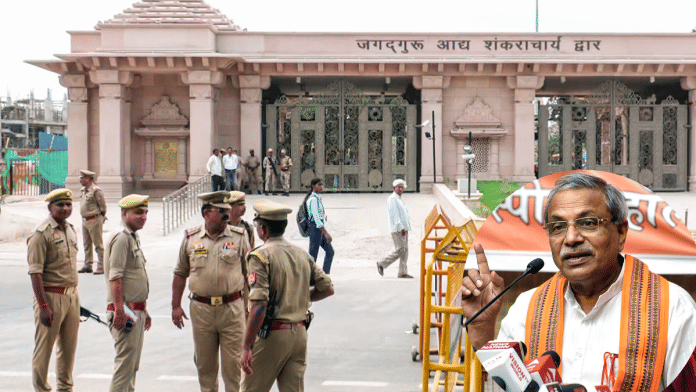

New Delhi: On the day the Shri Ram Janmabhoomi Teerth Kshetra Trust accepted the resignation of its general secretary Champat Rai amid allegations of donation theft, the Vishva Hindu Parishad Monday said the government should not step in to run the shrine’s affairs, reiterating their longstanding demand that temples should not be controlled by governments.
Some members of the Ram Janmabhoomi Teerth Kshetra Trust, an autonomous body constituted by the Centre in 2020 pursuant to the Supreme Court order to manage the Ram temple affairs, are currently under the scanner of the Special Investigation Team.
With roles of some Trust office-bearers under probe, there has been suggestions and media commentary supporting greater government control in running the temple.
Earlier in the day, the Shri Ram Janmabhoomi Teerth Kshetra Trust officially accepted the resignation of Champat Rai and trustee Anil Mishra.
“We are against governmentalisation – government control of the Ram Mandir. We will not allow it at any cost. This has been our stance since the beginning, not only for the Ram Mandir but for any other Hindu temples too,” said Surendra Jain, international joint general secretary of the VHP.
However, Jain said the VHP is not against appointing a professional Chief Executive Officer (CEO).
“We are not against appointing a professional to manage the day-to-day affairs of the Ram Mandir but the person must not be a serving bureaucrat and should be accountable to the Trust, not to the government,” Jain told ThePrint, stressing that the CEO must be appointed by the Trust, not the government.
He cited the case of Sabarimala Temple, which is run by the government, that reported an alleged gold theft which is currently under investigation by an SIT.
“There are lakhs of temples run and managed well by people; at the same time see how those under government control have fared,” he told ThePrint.
Several states including Andhra Pradesh, Tamil Nadu, Karnataka, and Kerala, have laws governing temple management. A number of BJP-ruled states including Madhya Pradesh, Rajasthan, and Bihar, also have laws allowing the government to exercise control over the management of temples.
The VHP has been running a campaign across the country since 2021 to free Hindu temples from government control. At that time, the VHP claimed that between 20,000 and 50,000 temples were under government control.
However, the donation theft scam at Ram Mandir gave much ammunition to the Opposition and a section of experts to argue for government control of the temple. In an interview with ThePrint, Ram Mandir Construction Committee chairperson Nripendra Misra advocated for a Tirupati model and a CEO to manage the Temple’s day-to-day affairs.
“And, the CEO should work with the trust (Ram Janmabhoomi Teerth Kshetra Trust). No one is asking that the articles or bylaws should be changed, but there must be a CEO with experience working in Uttar Pradesh,” Misra told ThePrint.
In 2024, the VHP had set up a think-tank comprising retired judges of the Supreme Court and high courts, eminent lawyers, Hindu seers to suggest measures to free temples from government control.
In the past, the VHP also submitted a memorandum to the governors of all states, requesting governments to withdraw from temple management.
Also Read: As Ayodhya row rages, theft allegations at Badrinath as BJP-ruled Uttarakhand heads for polls
The ISKCON example
The VHP has argued that many temples across the country are run efficiently by private trusts, including the Jhandewalan Mandir and the International Society for Krishna Consciousness (ISKCON) temple network.
Jain also defended Champat Rai and said a fundamental principle of the Indian Constitution is that no one should be treated as guilty until proven so.
“Where has Champat Ji’s (Rai) guilt been established? Should investigating agencies not be allowed to do their job? One must wait for the outcome of the investigation?,” Jain said.
“Soon after the allegations surfaced, some people were ready to declare him guilty and demand the harshest punishment. However, many of those allegations have since been proven wrong, which is why the narrative keeps changing. Yes, allegations have been made against Champat Ji, but he has neither fled nor avoided scrutiny,” he added.
For the first time in India’s history, an accused person has himself demanded the constitution of an SIT, Jain said.
“Not only that, whenever the SIT has summoned him, he has appeared and answered every question… We have seen instances where political leaders have resisted investigative agencies instead of cooperating with them,” he said.
(Edited by Ajeet Tiwari)
For millions of devout Hindus, who runs the Ram Temple trust is a matter of detail. What is non negotiable is that it should observe the highest standards of transparency and ethics. What in business – and very large sums are involved – would be called corporate governance.