



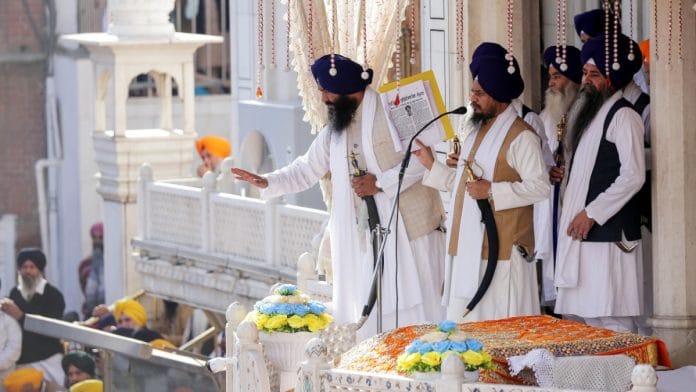

Chandigarh: Three days after Kultar Singh Sandhwan, Speaker of the Punjab Vidhan Sabha, appeared before the Akal Takht to explain the passing of amendments to the Jaagat Jot Sri Guru Granth Sahib Satkar Act, 2008, the Akal Takht ordered him Monday to undo some of the amendments.
A directive issued by its secretariat asserted that the said amendments must be rolled back within 15 days. Otherwise, the high priests of the five takhts (seats of power) will meet and initiate action against the Speaker for non-compliance. Akal Takht is the highest temporal body of the Sikhs, and its directives, known as hukumnamas, are binding on Sikhs.
Sandhwan appeared before the Akal Takht on 8 May after the jathedar of the Akal Takht summoned him. At the meeting, Sandhwan explained that the Act had been amended to provide strict punishment for acts of sacrilege committed against the Guru Granth Sahib, which Sikhs consider a living guru.
The Punjab Assembly, on 13 April, in a special session called on Baisakhi, passed the Jaagat Jot Sri Guru Granth Sahib Satkar (Amendment) Bill, 2026, which provides for strict punishments for acts of sacrilege. A week later, the Governor gave his to the Bill.
Since the Act have already received the Governor’s assent, only the Assembly can introduce any amendments to it.
So far, neither the government nor the Speaker has issued any statement regarding the ultimatum from the Akal Takht.
The Act was passed “completely bypassing” the Akal Takht, even as it, along with the Shiromani Gurdwara Parbandhak Committee (SGPC), remains the representative body for Sikhs, the directive by the Akal Takht further stated.
The original 2008 Act was largely regulatory in nature, aimed at controlling the printing and distribution of the Guru Granth Sahib by anyone other than the SGPC. The 2026 amendment transforms it into a penal statute to deter anyone from disrespecting it.
The original Act was notified in June 2008 when the Shiromani Akali Dal-BJP combine was in power in the state. It provided for the prevention of “printing, publication, storage, distribution, or supply of the Guru Granth Sahib by any authority or body beyond the SGPC”. The only penalty provided for any violation in the Act was a two-year jail term, along with fines, for anyone who printed or distributed the Guru Granth Sahib.
The amended law introduced the element of sacrilege, prescribing a graduated but severe punishment regime with penalties ranging from seven years in prison, along with fines, ranging from Rs two lakh to Rs 25 lakh.
“The Akal Takht has no objection to the government making strict provisions for punishment to those responsible for the sacrilege of the Guru Granth Sahib. However, there are some clauses in the amended Act which are directed against the Sikhs who are serving the Guru Granth Sahib. These changes are completely unacceptable,” read the Akal Takht directive.
The Akal Takht has listed multiple objections. To begin with, it has objected to the replacement of the word “bir” with “saroop” to refer to the Guru Granth Sahib. “The bir is a word of great antiquity, and it has been used to refer to the Guru Granth Sahib for centuries. Replacing this word with saroop is not appropriate. Saroop word can be used along with bir but cannot replace it,” stated its directive.
The Akal Takht also objected to the introduction of a system of custodial responsibility, while defining “custodian” as any individual or institution responsible for the care of a saroop (authorised copy) of the Guru Granth Sahib, thereby imposing a legal duty to ensure its protection.
“Nobody can be the custodian of the Guru. He is our custodian. We are only sewadars. Moreover, anybody who is involved in the sewa of Guru Granth Sahib or booklets and literature derived from is predominantly going to be a Sikh. To hold the custodian responsible through these amendments is essentially directing these provisions against the Sikhs themselves. Scores of institutions and individuals are contacting us as they intend to return the Guru Granth Sahib or booklets and literature derived from it, because of fear that action will be taken against them under the custodian clause. This is hugely detrimental to the spread of the Sikh religion,” read the directive.
Also Read: Sikh apex body demands reopening of Kartarpur Corridor, also calls on govt to bring in AI regulation
Objections raised by Akal Takht
The Akal Takht has also objected to a provision in the amended Act that makes it binding on the SGPC to maintain a central registry of all those to whom the Guru Granth Sahib has been given, along with a responsibility to make the list public by putting it on the SGPC website. The Act also provides that this list should be updated regularly.
“The SGPC is already maintaining a central registry of those to whom the Guru Granth Sahib is given. However, this list cannot be put in the public domain because that will lead to everyone knowing who has the Guru Granth Sahib, which can further lead to negative consequences,” stated the directive.
The Akal Takht pointed out that during the 1984 anti-Sikh riots, the voters’ list was used to identify houses of Sikhs by the rioters before targeting them.
The directive also objected to the amended act’s provision of electronically marking every Guru Granth Sahib with a unique identification number.
“This will amount to tampering with the form and structure of the Guru Granth Sahib, which is not allowed. Moreover, the responsibility of care and sewa of the Guru Granth Sahib is done following the code of conduct by the representative body of the Sikhs, and governments have no role to play in it,” said the directive. “Any such move will be considered to be a direct interference in Sikh affairs by the government.”
Akal Takht also pointed out that besides the SGPC in Amritsar, the Delhi Sikh Gurudwara Management Committee also prints the Guru Granth Sahib after due permission from SGPC. “The Guru Granth Sahib is present at multiple places outside Punjab, including in gurdwaras in foreign countries. How will this act be applicable to the care of Guru Granth Sahib outside Punjab,” it asked.
It objected to another clause that provides for punishment up to five years to anyone who violates the various clauses of the Act. This punishment is applicable to those who, otherwise, are not involved in the act of sacrilege but violate other provisions of the Act.
“This provision is also directed against the Sikhs themselves because apart from the clauses which relate to sacrilege, the rest of these deal with the care and sewa of the Guru Granth Sahib,” said the Akal Takht.
The amended Act, it further pointed out, used words such as “store”, “storage” and “supply” in reference to the Guru Granth Sahib, which it called unacceptable. It stressed that those words should be replaced with “sewa sambhal”.
The Akal Takht also asked the Speaker to ensure that the rules under the Act were not framed until consultations with the representative body of the Sikhs.
The passing of the amendment was hailed as a “game changer” by the ruling Aam Aadmi Party (AAP), ahead of the assembly elections, expected early next year. During the special session of the Vidhan Sabha held on 1 May, the treasury benches, led by CM Bhagwant Mann, passed a resolution, patting their own backs for having successfully legislated against sacrilege—an issue that has dominated Punjab’s politics for over a decade.
(Edited by Madhurita Goswami)
Also Read: An ‘admission’, a denial: What happened at Bhagwant Mann’s meeting with Akal Takht