





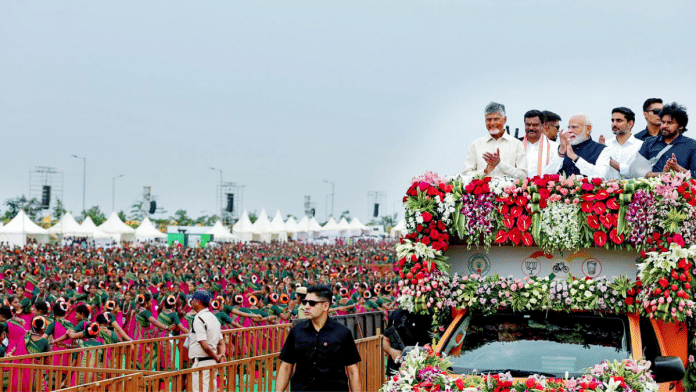

Hyderabad: Andhra Pradesh’s new Bhogapuram airport isn’t just for passenger flights. It is also getting ready to fly tuna fish caught off the Andhra coast to overseas markets as Chief Minister N. Chandrababu Naidu looks to turn the facility into an air freight hub at par with Hyderabad and Bengaluru.
With Andhra Pradesh being India’s largest seafood producer and the Indian Ocean region considered the world’s second-largest tuna producer, air exports of tuna to China, Europe and the US are on the anvil, Additional Commissioner, Customs and Central GST, N. Balram, told ThePrint.
“Now that the Alluri Sitaramaraju International Airport (Bhogapuram airport) has been inaugurated, the chief minister has already asked for a proposal on when we can commence exports. He is keen on exporting seafood by air since there is already a large captive market,” Balram said.
“We have begun contacting freighters and are working closely with GMR Airports even as the other government departments are ensuring the multimodal logistics network functions smoothly,” he added.
GMR Airports Limited (GAL), part of GMR Airports Infrastructure Limited, built the Hyderabad airport in 2008 when India decided to privatise airport infrastructure creation. At the time, Andhra Pradesh was not bifurcated.
Over the years, with much of the pharmaceutical and aerospace cargo currently transported through the Rajiv Gandhi International Airport (RGIA) in Hyderabad, CM Naidu is said to have told officials to ensure Visakhapatnam becomes the gateway for air exports along India’s eastern coast.
“No sooner than the inauguration of the Bhogapuram airport was over, the CM turned to me and asked for a comprehensive plan on all products that could be exported from the new Bhogapuram airport,” a senior IAS officer, who did not wish to be identified, told ThePrint.
With this goal in mind, the chief minister released Andhra Pradesh’s Aviation Policy 2026-31, which says Andhra Pradesh’s aim is to scale up air cargo volumes from 6,240 metric tonnes to 4.27 lakh metric tonnes by 2035.
Gateway to East and Southeast Asia
The Bhogapuram airport, which began commercial operations on 17 August, features a large code 4E runway designed to accommodate wide-bodied aircraft, allowing the airport to significantly scale regional cargo and logistics operations.
“Tuna could be the first choice for airfreight for more reasons than one. Tuna fish production in the state centres heavily on Visakhapatnam, which acts as a primary hub alongside Kakinada and Pudimadaka,” a Sandhya Marines official told ThePrint.
“With much of the operations at sea and the aqua producers mechanised, both the central and state governments have launched targeted initiatives to transform the Vizag region into a formal, value-driven tuna export hub,” the official added.
India’s tuna fish production centres on coastal and oceanic exploitation within its vast Exclusive Economic Zone (EEZ), with total marine fish catches scaling up significantly under flagship schemes such as the Pradhan Mantri Matsya Sampada Yojana (PMMSY).
Official figures placed on the floor of Parliament show that Andhra Pradesh is among the top states to receive a grant under the PMMSY. Most of these grants have been used to develop coastal fisheries networks to traditionally capture neritic tuna species, while oceanic resources like yellowfin and skipjack remain a key focus for expanded deep-sea harvesting and export clustering.
According to a concept note prepared by the Fisheries Department, Ministry of Animal Husbandry, Fisheries and Dairying, the global tuna market is valued at $41.94 billion, and the Indian Ocean Region (IOR) produces 21 percent of the world’s tuna.
Tuna exports recorded a 14.6 percent increase in quantity in FY 2026, although seafood exporters were hit by the war in the Middle East and US tariffs, according to the Marine Products Exports Development Association.
However, both seafood exporters and aviation experts ThePrint spoke to pointed to two concerns: One, the lack of adequate cold-chain facilities that keep perishable produce at adequate temperatures, and second, the high cost of shipping overseas.
But with premium-grade tuna expected to fetch high prices when flown fresh and chilled, the exporters believe the increase in export volumes will make up for the higher cost.
To address the logistics concerns, the state intends to strengthen its multimodal connectivity.
“With airport access planned within a 150-kilometre radius across the state and the addition of 10 proposed waterdromes, we are positioning our state to become one of India’s most connected transportation and logistics hubs, supporting economic growth and enhancing supply chain resilience across southern India,” the IAS officer said.
Given Vizag’s potential, Andhra Pradesh launched the Air Cargo Forum India (ACFI) in December last year, setting up a chapter in Vizag to develop the state as a key air cargo hub, aiming to decentralise India’s logistics network, reduce congestion at metro airports, and support the country’s goal of $2 trillion in exports by 2030.
Delhi and Mumbai account for 45 percent of India’s airfreight, with the concentration leading to congestion, limited capacity, and increased dependence on transshipment hubs in the Gulf and Southeast Asia.
“Vizag can offer a good alternative. We are India’s third-largest port city, and the location along the Bay of Bengal makes it a natural gateway to East and Southeast Asia,” Balram said.
(Edited by Sugita Katyal)
Also read: How 92-yr-old Vizag Port defied global trade headwinds to net 50% of India’s seafood exports