




A little under a year ago, I argued that India’s developmental ambitions would be achieved when our country’s thinkers, doers, and funders were united not only by goodwill but by ‘alignment infrastructure’ that is built and maintained with intention. What I mean by ‘alignment infrastructure’ is strengthening the capacity for samaaj, sarkar, and bazaar to diagnose problems, share learnings, and build solutions that outlast funding cycles and electoral results.
But this year, I want to go beyond naming the problem to ask why true consensus is so hard to achieve even when every stakeholder in the room desires it.
The problem might just be that representatives from government, civil society, foundations and enterprises at times confuse better coordination with achieving alignment. While more platforms and a shared language have eased our ability to speak to each other, arriving at a shared understanding of foundational problems remains far more elusive.
Two organisations can coordinate perfectly, sequence their activities, avoid duplication, share a dashboard, and still be solving for two different definitions of success. A skilling programme can run flawlessly alongside an employer’s hiring drive and still miss the mark, because one is optimising for the number of people trained and the other for the roles actually filled. The activity lines up. The intent does not. And it is the intent, not the activity, that eventually decides whether anything lasts.
Nowhere will this be tested harder in the coming decade than in how we adopt artificial intelligence. While roads expanded commerce, electricity expanded productivity, and digital public infrastructure expanded participation, AI is doing something others did not. By offering us more information to guide our actions, it is expanding the very notion of intelligence. But as India adopts AI, it remains to be seen whether we build intelligence as a private advantage or as public infrastructure.
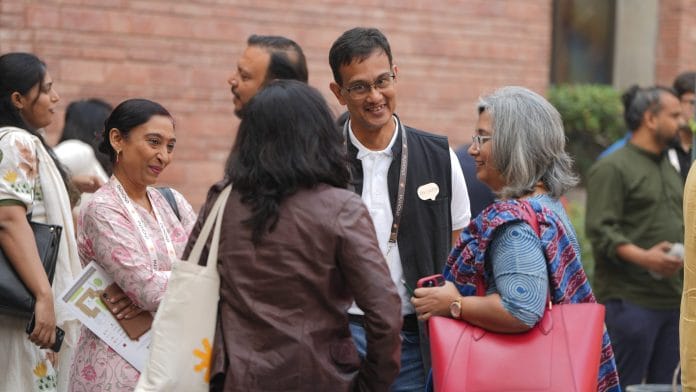
As we come together to respond to the most central question of the upcoming decade, rooms like charcha 2026 bring together technologists, central and state governments, philanthropists, and social sector innovators to formulate a cogent response. And in my experience, building the technology model is perhaps 30% of the work. The other 70% of the work rests on building trust through the right language and local intermediaries, and on designing a workflow and financing models that ensure these solutions impact the lives of the people who need them most. While generating information is no longer the hard problem, distribution is. Making sure the rural woman who needs this intelligence can actually access it will make all the difference.
This is why I have come to see intelligence infrastructure and alignment infrastructure as the same problem in different clothes. That harder 70% is not a technical layer. It is a coordination one, a question of whether the builders, the communities whose data trains the model, and the funders behind it are all working toward the same end. Get it right and intelligence reaches a household. Get it wrong and the technology still advances, but its benefit flows past the very people who made it possible.
We have learned to say that AI must be built with people, not merely for them. While that is a start, it is not enough. You can design with people and still fall short if the funder measures a different outcome or the community is brought in only after the real decisions have been made. Inclusion makes sure the right people are present in the room. Alignment is what makes the space come alive. Again, no single actor can build this alone. The government brings population scale, reach and fiscal muscle. Markets bring efficiency, capital and discipline. Civil society brings ground-level trust. Each is strong exactly where the others may not be. Capability that reaches the last household has never been delivered by any sector alone, and intelligence infrastructure, like anything of consequence, is built only at the intersection of the three.
Alignment is not built in a room but by an ecosystem over time. A convening like charcha 2026 captures the moment it happens: the full hall, the energy, a sense that something shifted. But convening is a hinge, not the whole mechanism. The real work sits in the follow-through—in what each person and institution carries back into its own systems and acts on weeks and months later. From my time in the sector and putting together many editions of charcha, I’ve seen that we invest heavily in building standalone institutions but almost nothing in strengthening the connective tissue between them. Year on year, at the*spark forum, we build the habit of bringing together the entire ecosystem, so we can align before we act, not after.
To me, this is the work of the next decade. India has no shortage of intent, capital or capability. What it still needs is the connective tissue that lets these three move as one—to reach a farmer, anganwadi worker or young Indian so they can access services suited to their context and need. The next decade will be a transformative and telling one, and I invite us all to align with intent to achieve our collective goals sustainably.
charcha 2026, an initiative by the*spark forum, will be held at India Habitat Centre, New Delhi, on September 15-16, 2026. To know more, visit: https://charcha26.thespark.org.in/
Jerold Pereira is Managing Director, the*spark forum. Views are personal. ThePrint is a media partner for charcha, organised by the*spark forum.
Also read: Viksit Bharat needs a ground-up reset. Bridge the gap between ambition and reality