







Thiruvananthapuram: A month after scrapping the previous LDF government’s K-Rail project, the Congress-led UDF Cabinet on Wednesday also decided to put on hold ‘Metroman’ E. Sreedharan’s proposed Rs 60,000-crore alternative high-speed railway corridor after an expert committee flagged the proposal for lacking environmental and social impact assessments.
The proposal envisaged a 473.2-km high-speed rail corridor connecting Thiruvananthapuram with Kannur, reducing the travel time between the state capital in south to northern districts to around 3.5 hours.
Currently, it takes around 7 hours in semi high-speed Vande Bharat trains, and around 12 hours on other express trains.
Sreedharan proposed the project as an alternative to the previous Left government’s K-Rail (SilverLine) project, which envisaged connecting Kerala’s southern and northern ends through a high-speed rail corridor.
While it was in Opposition, the Congress vehemently opposed the K-Rail project over environmental concerns. Within a week of assuming office in May, the Congress-led United Democratic Front (UDF) government scrapped the K-Rail project.
Also, the VD Satheesan-led government set up a four-member expert committee to examine the technical feasibility, financial viability and environmental impact of Sreedharan’s proposal.
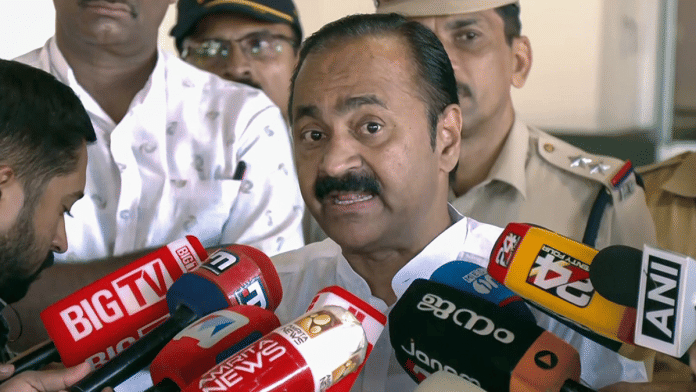
Addressing press persons Wednesday here after a Cabinet meeting, Chief Minister V.D. Satheesan said the expert panel found the interim report submitted on Sreedharan’s project to be incomplete.
“Considering Kerala’s limited financial resources and the absence of detailed projections on passenger demand and project scope, the government cannot take up the project in its present form. The committee has recommended against initiating any further preliminary work, including issuing land acquisition notifications,” Satheesan said.
He added the panel also cautioned against proceeding without a comprehensive environmental impact assessment, saying the previous government committed a mistake with the K-Rail project by initiating land acquisition before conducting detailed environmental studies and estimating passenger and freight demand.
Secretary, Transport (Railways), was the convenor of the committee, which also
comprised railway expert J.N. Vinayan, financial expert Dr C. Veeramani, environmental expert Sridhar Radhakrishnan and N.S.K. Umesh Kumar, Officer on Special Duty to the CM.
Satheesan said the project won’t be viable with income from ticket alone. The government would now independently examine how future projects are done so they make additional incomes through movement of goods, and are integrated with the state’s existing and future metro systems, ports and inland waterways.
“The government will once again look into it and find an alternative model. The committee had discussed many aspects with the DMRC. But the committee recommendation to the state government is to not make any decisions based on an incomplete report,” Satheesan said.
Long road to high-speed rail corridor
With Sreedharan’s proposal on hold, Kerala’s long-standing plan to build a dedicated high-speed rail corridor connecting the state’s southern and northern regions has once again hit a roadblock.
The idea was first conceived during the first Pinarayi Vijayan government in 2016 through the K-Rail or SilverLine project, which proposed reducing travel time between Thiruvananthapuram and Kasaragod from nearly 12 hours to around four hours.
The project faced stiff opposition from residents, environmental groups and political parties, including the Congress and the BJP, over concerns related to large-scale land acquisition and environmental impact. After the state government began land acquisition in 2022, protests intensified across Kerala under the leadership of then Leader of Opposition Satheesan.
The project eventually failed to secure the Centre’s approval, over “technical grounds”. Following that setback, the LDF government granted in-principle approval in February this year to a separate 583-km Regional Rapid Transit System (RRTS) proposal, just two months before the Assembly elections.
Sreedharan opposed the RRTS project, calling it financially unviable, and dismissing it as an “election stunt” and a “foolish venture.” He claimed he met Railway Minister Ashwini Vaishnaw in January regarding his proposal, calling it a viable alternative to the state government’s project.
He alleged that he had submitted his proposal to the Kerala government in early 2025, but the Pinarayi Vijayan-led state government deliberately delayed it.
Sreedharan subsequently opened a Delhi Metro Rail Corporation office in Ponnani in Malappuram district under the banner “Kerala High Speed Railway”, though the Centre never officially recognised the initiative.
Within a week of opening the office, the retired engineer unveiled a revised proposal. Of the total 473.2-km alignment, around 440 km was proposed to be elevated. The proposed corridor would have also connected Kerala’s three international airports at Thiruvananthapuram, Kochi and Kannur.
Sreedharan further claimed that ticket fares would have been lower than those of existing Vande Bharat trains. He also said the project approval from the centre would be incurred within three months if a government led by BJP comes to power in Kerala.
A native of Kerala’s Palakkad district, Sreedharan is best known for leading the construction of the Delhi Metro, the Konkan Railway and the Kochi Metro. After retirement, he briefly entered politics and unsuccessfully contested the 2021 Kerala Assembly election from Palakkad on a BJP ticket.
(Edited by Ajeet Tiwari)
Also Read: In 2nd Cabinet meet, Satheesan-led UDF govt scraps Pinarayi’s pet K-Rail project
there was a proposal for straightening the existing tracs and widening it and improving the communication systems. This project is not taking off. This should be the first priority. State govt may have to acquire and hand over land to railways for this work.
I suggest this work should go and a separate straight align route for a broadguage semi high speed line may go side by side.