





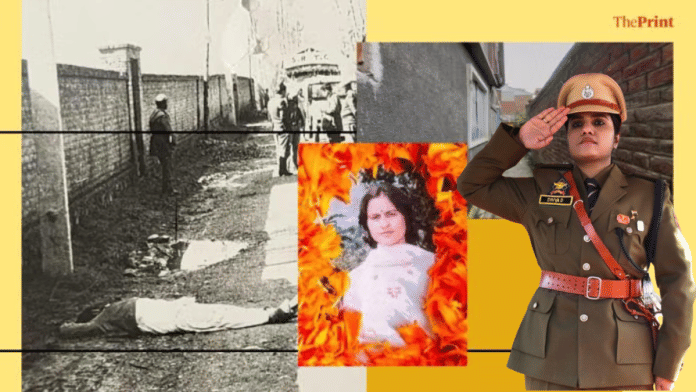


New Delhi: A murder that happened almost four decades ago. Witnesses mostly deceased, or very old. Conflicting reports. A shoddy police investigation. Cracking a case like this is nearly impossible. But that’s just what Divya D, Superintendent of Police (SP) at the State Investigation Agency (SIA) of Kashmir, did. Her year-long effort on the Sarla Bhat abduction and killing of 1990 has now culminated in a 737-page chargesheet filed before a special court in Srinagar on 29 June this year.
The story of how this IPS officer brought the case of the 27-year-old nurse killed by Jammu Kashmir Liberation Front (JKLF) in 1990, to justice begins last year. Bhat, a 27-year-old nurse, was among the first cases of targeted killing of Kashmiri Pandits in the Valley following the armed insurrection that began in 1989.
Bhat was abducted from the Sher-i-Kashmir Institute Medical Sciences (SKIMS), confined at a JKLF commander’s residence, and finally shot dead. Her bullet-ridden body was later dumped in downtown Srinagar with a note branding her as a mukhbir (informer) where it was found on 19 April 1990.
The police had filed a case for murder, criminal conspiracy and terrorism under the erstwhile Indian Penal Code and Terrorist and Disruptive Activities Act (TADA), but no real investigation was done in the case.
In March 2024, the case was transferred to the SIA by order of the Jammu and Kashmir police chief. “We began the investigation with just two images—one of Sarla Bhat, and another black and white photograph of the scene of crime,” said IPS officer Divya D.
What the officer needed was witnesses, and that was no ordinary challenge. Adding to her troubles was the intimidation that most investigators seemed to be affected by. “Before I faced the hurdle of finding witnesses for a 36-year-old case, I had to first build the morale of local officers. I had to tell them that we had the support of the government,” said the officer.
Finding witnesses
“We made an exhaustive list of possible witnesses consisting of people who worked alongside her at SKIMS, those who lived with her in the hostel and people who lived in the colonies near the area where she was shot,” said Divya. The list also contained former JKLF local commanders who were then called for “rigorous and sustained interrogation”. The local JKLF commanders later became witnesses in the case, she said. Some of the witnesses are in their 80s.
“At least eight witnesses crucial for the case were questioned by me,” said the officer. On sustained assurance that no harm would come the way of the witnesses, many of who resided outside Kashmir, they shared all that they remembered. “Be it eyewitnesses or JKLF local commanders—all had to be constantly assured that no harm would come their way,” Divya said.
Despite the years that have gone by, the sounds of gunshots while breaking the Ramadan fast have remained etched on the minds of several witnesses. For others, the words the accused had uttered before killing Bhat were unforgettable. Most of the other events were a shared blur, so the testimonies were recorded as quickly as possible before judicial officers in courts far away from Kashmir.
Also Read: 36 years later, probe into 1990 killing of Kashmiri Pandit writer Sarwanand Premi, son picks up pace
Murder weapon
“The police in 1990 had only the cartridges [casings], but were not able to find the weapon. However, upon questioning, we had found witnesses who were able to identify the type of weapon,” said the officer. The chargesheet says Bhat was shot with an automatic rifle at Omer Colony in Malbagh, Srinagar.
“Upon detailed questioning of eyewitnesses and former JKLF local commanders, the investigation found that the man who pulled the trigger was Khurshid Ahmad Chalkoo, now in Pakistan-occupied Kashmir (PoK),” the officer said.
She added that the sustained and rigorous investigation of all the former JKLF local commanders—all in their late 50s and 60s now—played an important role in the identification of the men involved in the crime. “They were initially hesitant in sharing names, and some were struggling with their fading memory, but continuous questioning over two months led to successful identification of the accused,” Divya said.
The investigators also sought permission from the court for a narco test on the former local commander of JKLF. “We wanted to ensure that they shared the entire truth with us and that there is nothing that remains uninvestigated. However, since the test requires permission from those who were to be interrogated, we did not receive it from them,” she said.
The investigation has found Yasin Malik, the chief of JKLF, along with Khurshid Ahmad Chalkoo, Abdul Hamid Sheikh, Mohammad Yousuf alias Idrees, and Ghulam Mohammad Taploo, to be involved in the planning and execution of the abduction and brutal killing of Bhat. While Sheikh, Idrees and Taploo are dead, Malik is behind bars in Delhi’s Tihar Jail in a separate case, and Chalkoo is still on the run, says an SIA statement.
Missing pieces
Speaking to ThePrint, SP Divya said that one of the biggest unexplored angles was the note that left on the pheran (woollen dress) Bhat was wearing. “The handwritten note had labelled Bhat as an ‘informer’. So when we reopened the case, we sent the note for a forensic test,” she said.
A forensic test of handwriting requires another handwritten sample for comparison, posing yet another big challenge before investigators. “We had zeroed in on 10 suspects and raided their residences from where we found incriminating evidence, including handwritten notes of JKLF members from the 1990s,” said SP Divya. The investigators subsequently sent both the handwritten note on Bhat’s body and these samples to the Forensic Science Laboratory in Delhi, which found matches.
As the investigators crossed one hurdle, another came by—a “missing post mortem report”. “At that time considering the fear of militants among local policemen, only a preliminary medical report was drawn up, and Bhat’s body was not sent for a post-mortem [examination],” said the officer.
Undeterred, the investigators analysed the preliminary medical report to conclude the time of death and the nature of torture. “We corroborated this estimated time inferred from the medical report with the oral testimonies of the eyewitnesses to reach a definitive conclusion,” said the officer.
Protecting witnesses
All witnesses in the case have been provided protection to ensure their safety. “The consistent issue we found was that of earning trust of both former JKLF commanders and those who witnessed the act or were associated with Bhat. So, our team ensured that the witnesses were protected,” SP Divya told ThePrint.
As the matter is sub judice, the team has ensured that witnesses are produced only in court, and their names and other details remain confidential.
“The primary reason for reopening this case and those of Justice Neelkanth Ganjoo, Tika Lal Taploo and the double murders of Sarwanand Koul Premi and his son Virender, was to build the narrative that all atrocities, no matter how old, will be brought to justice,” she said. SP Divya was transferred while Bhat’s chargesheet was being finalised in 2025, but she has also reopened the cases of several murders of Kashmiri Pandits from the 1990s.
(Edited by Nardeep Singh Dahiya)
Also Read: 36 yrs after Sarla Bhat murder, Yasin Malik named main accused in J&K SIA chargesheet