


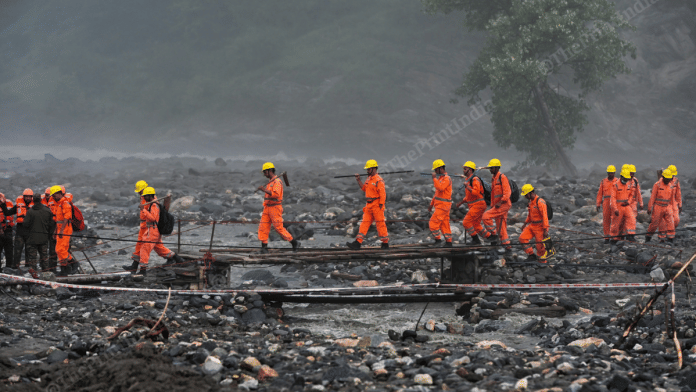
New Delhi: Two and a half years into its existence, the National Disaster Response Force (NDRF) faced its trial by fire. An overflowing Kosi River had burst through the eastern embankment about 13 km from the Kosi Barrage in Nepal in August 2008, and water had begun flooding several districts along the Nepal border. The NDRF sent its rescue teams, but they lacked a crucial piece of equipment—boats.
The deficiency had quickly turned into a major embarrassment, retired IPS officer K. M. Singh recalled in a conversation with ThePrint. But the situation was brought under control quickly, he said, recalling his days with the National Disaster Management Authority (NDMA), the parent body of the NDRF, which was overseeing the rescue operations.
“We ramped up production of boats at a facility in Greater Noida where workers worked 24×7 and produced more than 170 boats which were sent to Bihar, and people were rescued,” Singh remembers clearly even 14 years after hanging up his boots in 2014.
Since the ominous start after formalisation in early 2008, NDRF has come a long way, becoming India’s sole disaster response force.
Addressing the President’s Colour Award ceremony of the force earlier in May this year, Union Home Minister Amit Shah said the NDRF has earned the trust of 140 crore citizens through its successful operations during floods, earthquakes, cyclones and other disasters across the country over the last 20 years. The sight of the NDRF personnel, who have saved more than 1.5 lakh lives and evacuated over 9 lakh people to safer locations, inspires a strong sense of security and trust, Shah said
This is why the NDRF is part of ThePrint’s ‘Ideas That Worked’ series.

From NDA to UPA—coherence on disaster response
The seeds of the NDRF were sown back in 1999, Singh recalls, when the Atal Bihari Vajpayee-led government constituted a high-powered committee, chaired by retired IAS J. S. Pant in August 1999. While the committee was examining all aspects of the disaster in the country and steps to mitigate it, two massive disasters—Super Cyclone in 1999 and the Bhuj Earthquake in 2001—struck India.
As the government was concerned about the scale of those disasters, as well as the different causes and responses, it formed another committee headed by Prime Minister Vajpayee, with Sharad Pawar from the opposition benches serving as vice-chairman.
“These two committees came out with a very broad charter after examination of more than 30 disasters and subsequent responses,” Singh recalls, speaking of the policymaking in the early 2000s.
“One of the principal proposals was to set up an apex body for a nationwide framework on disaster management, since they had studied the charter and mandate of the Federal Emergency Management Agency (FEMA) in the United States,” he further recalls.
Once the government gave its go-ahead, another steering committee was formed under the then home secretary, N. Gopalaswami, and R. K. Singh, who later served in the Narendra Modi-led Union cabinet. This steering committee was the cornerstone of the NDRF, Singh said, recalling that during this meeting, which he also attended in his capacity as CISF DG at the time, they agreed on the number of NDRF battalions to begin with.
Based on the steering committee’s decision, the MHA sanctioned a total of eight battalions for the NDRF and Rs 310 crore for equipment procurement in 2004. All CPFs were asked to deploy forces for the NDRF, and initially two battalions each from four major Central Armed Police Forces—Border Security Force (BSF), Central Reserve Police Force (CRPF), Indo-Tibetan Border Police (ITBP) and Central Industrial Security Force (CISF)—were drawn for the NDRF.
Overcoming resistance & irrelevance
While the NDRF had been established in 2004 with makeshift arrangements from the CAPFs, formalisation was yet to take place, and a series of hurdles stood in the way, Singh told ThePrint. He returned from retirement to oversee a newly-formed body, the National Disaster Management Authority (NDMA).
However, the formalisation and empowerment were yet to take place. “The MHA had prepared a draft bill proposing the constitution of a disaster management body, within the MHA, headed by a Secretary-level officer,” Singh said.
“When the draft bill was put up before the Manmohan Singh-led cabinet, it was opposed by the then home minister Shivraj Patil and law minister H. R. Bhardwaj, who submitted before the PM that a body headed by a Secretary-level officer within the MHA will have no teeth to ensure compliance from state governments,” Singh said, adding that, during that cabinet meeting, the government decided to constitute NDMA as a statutory body, headed by the Prime Minister and drawing its power from an Act in the form of the Disaster Management Act, 2005.
While one hurdle regarding the powers of the NDRF was being addressed at the Union Cabinet level, the Ministry of Defence moved another proposal before the MHA—to hand over the eight battalions already raised as part of the dedicated disaster management force.
The proposal was compelling, Singh said, including the benefit of hindsight, but the then vice-chairman of the NDMA, General (Retired) Nirmal Chander Vij, trusted him and the already-established mechanism to continue.
The NDRF was further strengthened when the Manmohan Singh government notified the NDRF rules in January 2008, bringing all eight battalions under the NDRF’s command.
“The then NSA M. K. Narayanan proposed to the PM, the chairman of the NDMA, during a meeting in December 2007 that there were far too many diversions of the NDRF troops by their parent forces and that there had to be a dedicated policy on the mandate and terms of the NDRF,” Singh said, recalling details of the key meeting.
“The PM agreed with the idea and the NDRF rules were notified, formalising tenure of the troops in the NDRF, and they are not deployed on any other duties but disaster management,” Singh added.
Trial by fire ended in landmark operation
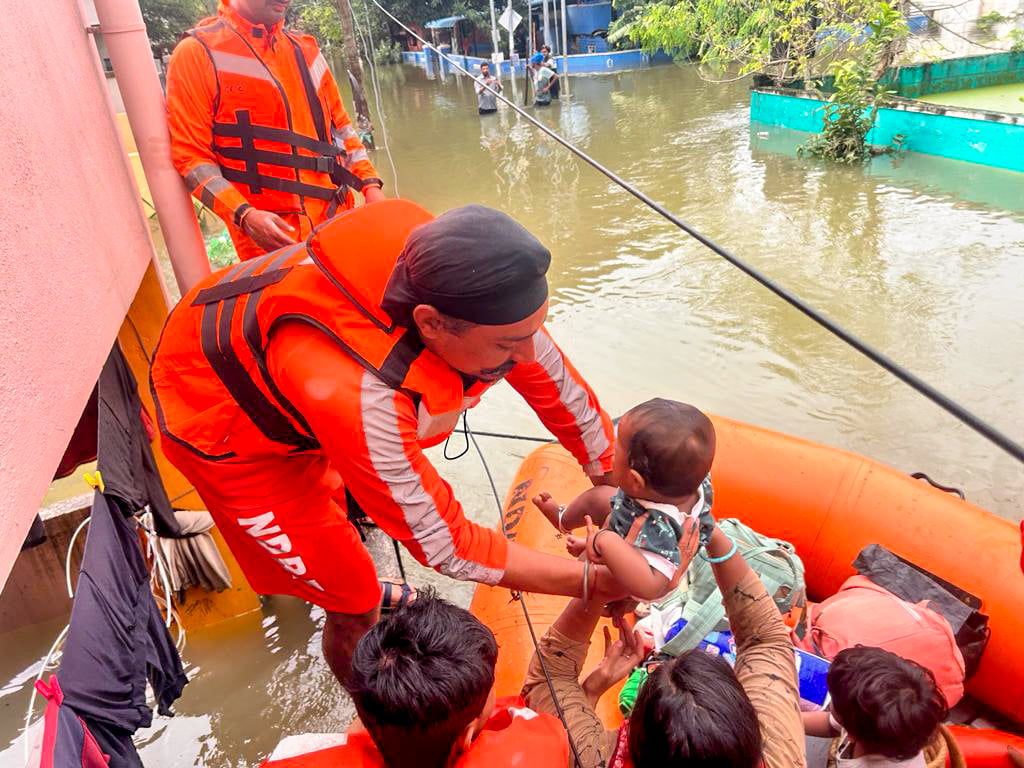
The force was only two and a half years old, and procurement and establishment had not been completed to launch a full-fledged evacuation and rescue operation, but that was when tragedy struck Bihar. The barrage over the Koshi River was breached by persistent rainfall and the river’s current, and districts along the dam were flooding.
While the NDRF had dispatched several teams, they did not have boats to rescue those stranded in floodwaters, bringing considerable embarrassment to the force brass in Delhi. However, the situation was gradually brought under control.
“We got 170 boats produced at a manufacturing plant in Greater Noida… and also brought in several boats from Odisha and other parts for a quick turnaround in the situation,” Singh explained.
As more boats arrived and the deployment increased significantly, the force went on to rescue and evacuate more than 1 lakh people in Bihar. The 2008 flood in Bihar was declared a national calamity, and after the force’s breakthrough in the flood, then Bihar chief minister Nitish Kumar secured an NDRF battalion in Patna, as did then CM Y. S. Rajasekhara Reddy in Andhra Pradesh.
“The work in Bihar raised the profile of NDRF and the state governments started taking it seriously, after several rounds of consultations on why NDRF was on a better footing compared to the civil administration,” Singh said.
Within three years of formalisation, the NDRF battalions increased from eight to 12, with new battalions coming up in Bihar, Uttarakhand, Andhra Pradesh and one in the North East.
An even bigger breakthrough came in 2011, when the NDRF team spent around a week in Japan during its trifecta of disasters, including damage from the Fukushima nuclear power plant, and rescued everyone in the vicinity.
“Each unit of the NDRF is trained with techniques and equipment for rescue of all sorts of disasters, including chemical, biological, radiological, or nuclear agents (CBRN), and it was on display in Japan, earning India goodwill and raising the global profile of the force,” Singh told ThePrint, without hiding his pride and personal satisfaction with the accomplishments of the force.
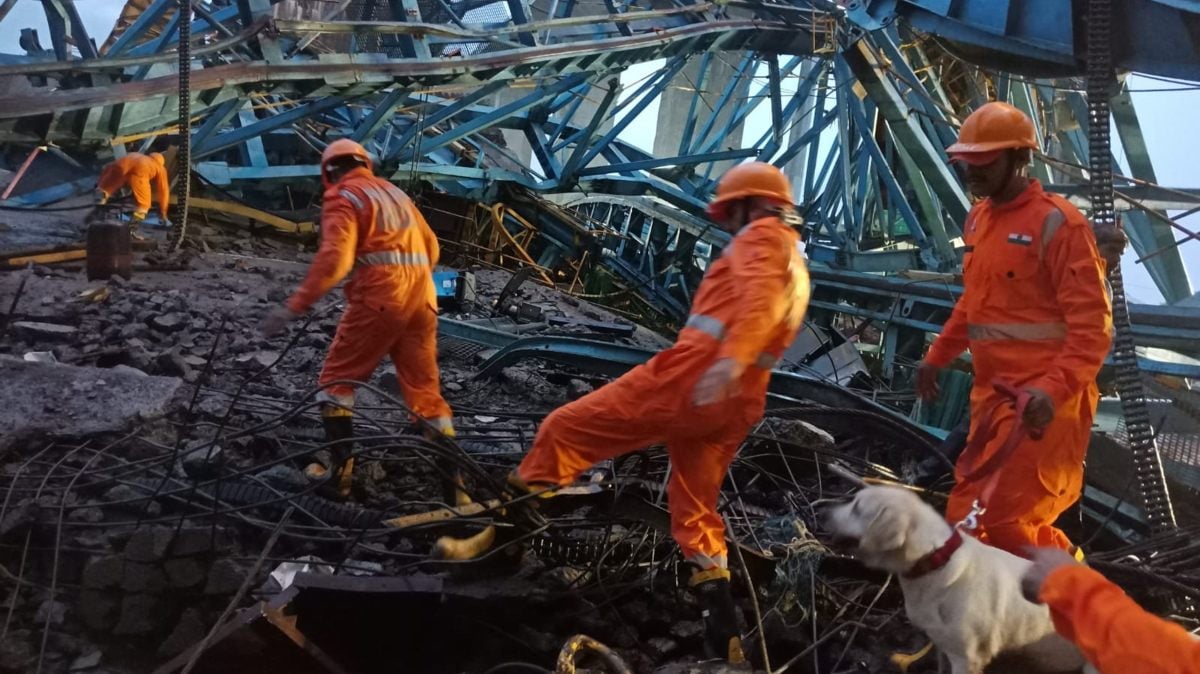
The Union Cabinet approved four more battalions in 2018, and the force now has 16 battalions, each with 1,149 personnel, scattered across four zones, covering all parts of the country. In each battalion, there are 18 self-sufficient specialised search-and-rescue teams of 47 personnel each, including structural engineers, technicians, electricians, dog handlers and medical/paramedic personnel, allowing them to operate independently at a disaster site.
NDRF officials say more battalions are in the pipeline and they would be raised and deployed in Karnataka, Madhya Pradesh and Kerala.
NDRF personnel have been imparted training in various forms of rescue operations, such as collapsed-structure search and rescue (CSSR), rope rescue, slithering, rock climbing and swimming, flood, cyclone, water rescue, firefighting basics, and medical first response.
Some teams are dedicated to CBRN disasters, and one such team is regularly deployed around Parliament House to respond to such emergencies. Some of these units were also deployed during the recently concluded BRICS summit and the G20 summits held in New Delhi in 2023.
A force of desperation to an institutional force
Similarly, the NDRF was deployed during the floods in June 2013 in Uttarakhand, where it was assigned the primary responsibility for rescuing people stranded in the Kedarnath valley.
Cut off by all land routes, as many as 14 NDRF teams were air-dropped at Kedarnath, where they carried out rescue operations in Kedarnath-Jungle Chatti, Gaurikund-Rambada-Bhairav Chatti, Guptkashi-Phata-Sonprayag-Gaurikund, and all areas at the top.
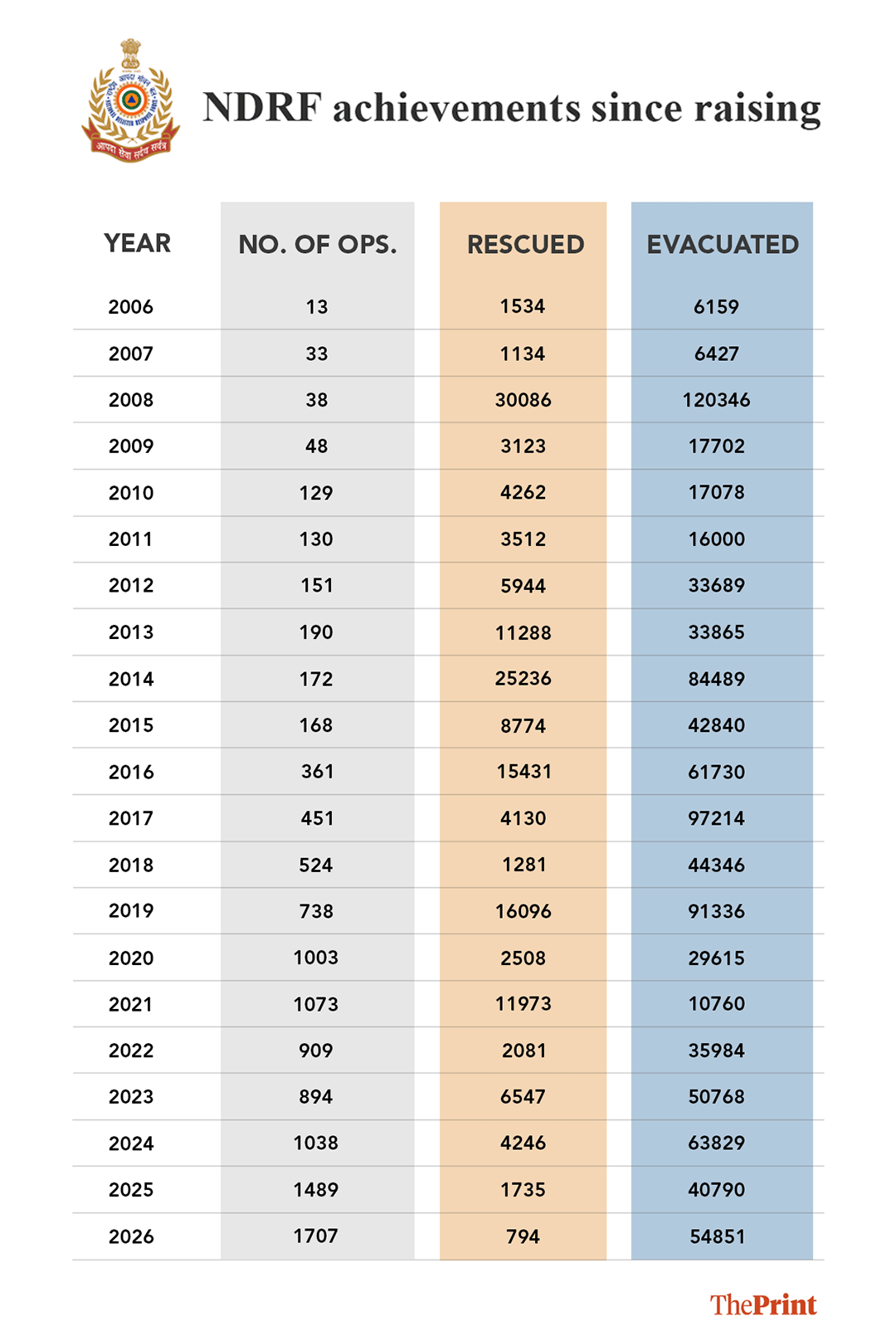
In a herculean relief and rescue operation that lasted for more than a month, NDRF personnel rescued 9,044 people from different affected areas of Kedarnath (1,053) and other adjoining areas on the mountain. As many as nine personnel of the force lost their lives in a helicopter crash of the Indian Air Force.
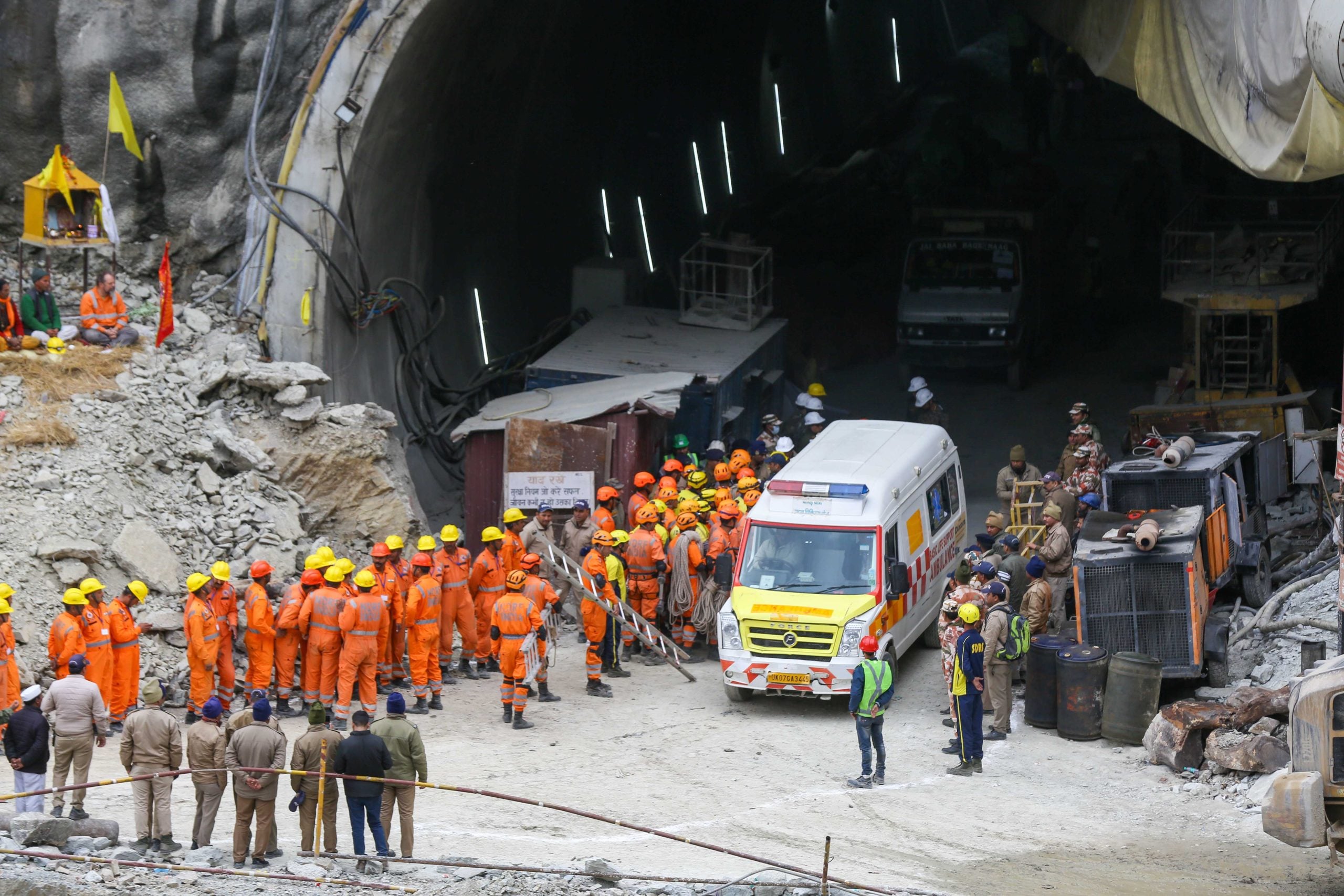
The Uttarakhand floods came just months after one of the worst urban disasters where a residential building collapse in Maharashtra’s Thane had left 74 people dead. A strategically deployed team in Pune was dispatched immediately for the rescue operation, which lasted more than 40 hours. Rescuers pulled out 62 people alive from under the debris, and recovered 72 bodies.
A massive team of around 700 personnel was also dispatched to Nepal in 2015 after the earthquake, while three teams with 152 rescuers were deployed to earthquake-hit Turkey and Syria in 2023.
Once the NDRF came into being and went from strength to strength, the focus of the force as well as the disaster management regime shifted to capacity building. The NDMA has advised all states to institute State Disaster Response Force (SDRF) on the lines of the NDRF.
Several states, such as Uttarakhand, Odisha, and Himachal Pradesh, have full-fledged SDRFs operating on the same modules and foundation of disaster management as those followed by the NDRF.
The training modules have been kept uniform for the NDRF and the SDRF to enable swift coordination between the forces on the ground. According to NDRF’s working methods, team deployment is coordinated with the NDMA, the affected state government, the district administration, and local response agencies immediately upon the occurrence of a disaster, such as a building collapse. For such incidents, teams are airlifted, moved by road/rail, or otherwise dispatched as quickly as possible.
“NDRF has recently conducted a training-needs analysis and, based on feedback, is continuously upgrading the skills of rescuers by providing the best training in India and abroad and equipping the force with the latest equipment,” NDRF DIG (Operations) Mohsen Shahedi told ThePrint.
On the other hand, for cyclones or floods, with enough advance notice, teams are deployed to pre-identified locations before landfall or flooding, he said.
However, the officials still maintain a limited presence across the country; hence, there has been a pivot towards further strengthening the disaster response forces’ capacity in the states.
“NDRF is a brand name today. The very presence at the disaster site draws confidence among victims. All the same, NDRF has a limited presence in the country at 69 locations,” Shahedi further said, adding that the force has “inculcated several good practices, such as pre-positioning teams in advance in the event of a developing disaster and working closely with expert agencies.”
(Edited by Viny Mishra)
Also read: Approve pending proposal for additional NDRF teams for forest fire duties: Parliament panel