



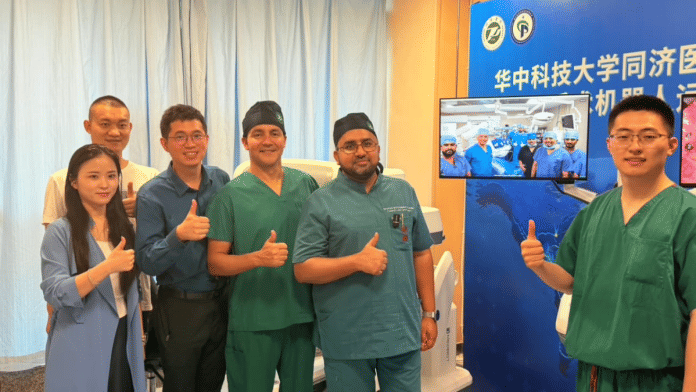
New Delhi: A woman in her 50s was admitted to the Asian Institute of Nephrology and Urology (AINU) in Hyderabad with a lower ureteral obstruction, blocking the tube connecting the kidney to the bladder. The tube needed to be detached and reattached to the bladder.
Her surgeon examined her, worked out a plan, and admitted her. Then he flew to Wuhan, in China’s Hubei province, for a surgical conference–from where he conducted the surgery remotely.
On 18 May, seated at a console inside Tongji Hospital in China, nearly 3,000 km from his patient, urologist Dr Syed Mohammed Ghouse guided robotic arms through her abdomen, watching a magnified, real-time 3D image of her insides through a binocular-style viewer.
The procedure took 90 minutes. When Dr Ghouse landed in Hyderabad the following day, he went directly to the ward, examined and discharged her.
The surgery, a tele-robotic ureteric reimplantation, is claimed by Dr Ghouse as the world’s first such procedure performed over such a distance.
The procedure was part of a series of 26 live surgeries conducted during the 10th Congress of the Chinese Chapter of the International Hepato-Pancreato-Biliary Association.
Five of those operations involved real-time international tele-surgical collaborations, with surgeons in countries including Brazil, Georgia, Greece, Uzbekistan and India remotely participating in procedures spanning urology, gastrointestinal, hepatobiliary and pancreatic surgery.
Dr Ghouse explained that the Hyderabad patient had a lower ureteric obstruction, a blockage in the bottom portion of the tube connecting the kidney to the bladder.
“The ureter is the tube that carries urine from the kidney to the bladder. When it gets blocked, it has to be surgically detached from the point of obstruction and reattached directly to the bladder,” Ghouse told The Print from Hyderabad.
“Ureteric re-implantation, robotically, nobody has done before,” he said, adding that the procedure was planned.
The console was in China. Everything else was the same. In robotic surgery, the underlying technology works on what surgeons call a master-slave model. The operator’s hand movements at a console are translated into precise instrument movements inside the patient’s body, relayed through a magnified 3D feed.
“The surgeon’s hands control every movement. The robot only translates those movements inside the body with greater precision,” Dr Hemanga Bhattacharjee, professor of surgery at AIIMS Delhi, told ThePrint earlier.
Dr Ghouse, who has been at AINU for 15 years, said robotic surgery is not new. What changed this time, he said, was the fact that the console was kept almost 3,000-4,000 km away from the OT.
“We do this day in and day out. We do a lot of robotic surgeries. Even today, we have three robotic surgeries,” he said.
Dr Ghouse noted that the lag in the procedure was less than 100 milliseconds. “We had connectivity from Wuhan via Singapore to India. What is really required is a good, stable broadband connection. 5G is one of the technologies that can transmit it across, but fundamentally, it is the internet connectivity that matters,” he said.
The surgery was performed using the Toumai Surgical Robot, a robotic surgery platform developed by Chinese company Shanghai MicroPort MedBot.
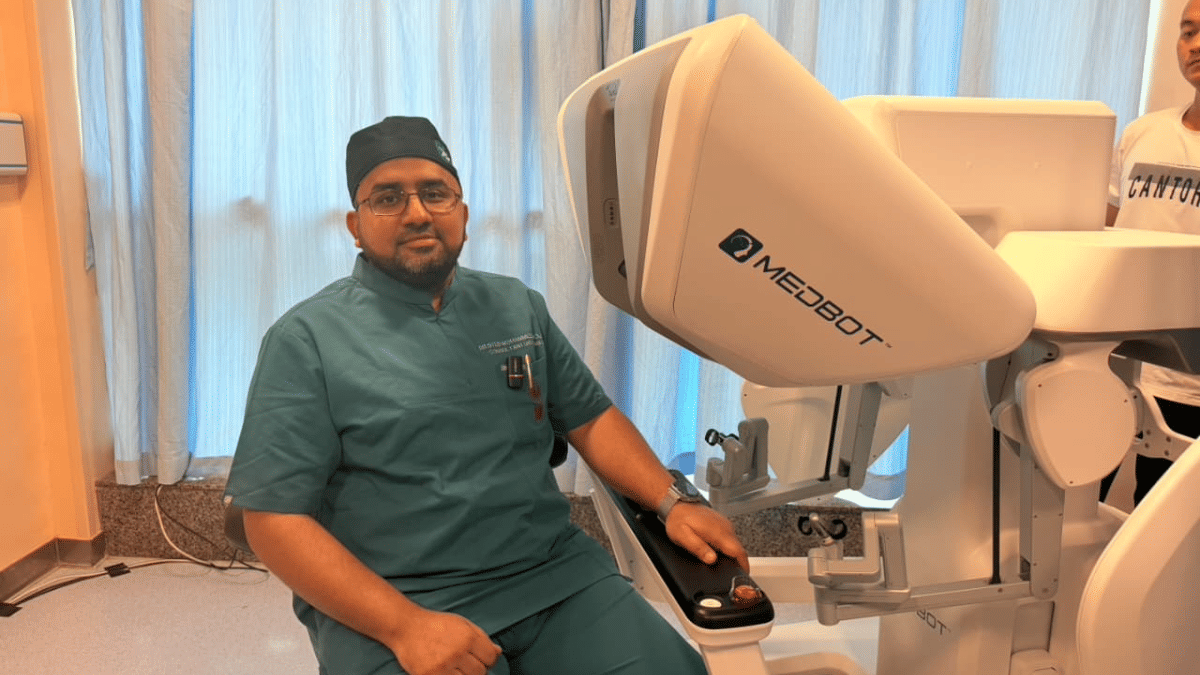
Currently, the AINU houses two robotic surgical systems: the Da Vinci Surgical System manufactured by US-based Intuitive Surgical, and the Chinese-developed Toumai Surgical Robot.
“I have performed over 2,000 procedures on Da Vinci and 70 procedures using the Chinese robot,” he told ThePrint.
Both ends of the surgery had to run the same system, as robots can only communicate with their own make. His regular team of doctors and nurses in Hyderabad stood by throughout, ready to take over manually if anything went wrong.
Also Read: From AIIMS to small town hospitals: How robotic surgeries are becoming common across operating rooms
A growing series of firsts
The Wuhan-Hyderabad surgery is the latest in a rapid succession of cross-border robotic procedures involving Indian surgeons.
In December 2025 and April 2026, Kokilaben Dhirubhai Ambani Hospital in Mumbai performed what it described as India’s first international remote robotic surgeries.
Dr T.B. Yuvaraja, director of Uro-Oncology and Robotic Surgery at the hospital, conducted a robot-assisted radical prostatectomy in Mumbai while operating remotely from over 5,000 km in Shanghai, using the Central Drugs Standard Control Organisation (CDSCO)-approved Toumai system.
According to the hospital, the platform is currently the only robotic surgical system cleared by the US FDA for investigational studies in telesurgery.
The procedure operated with a bidirectional latency—the round-trip delay between the surgeon’s movements and the robot’s response—of 132 milliseconds.
In April 2026, Dr Yuvaraja remotely carried out a robotic radical nephrectomy, a procedure involving the complete removal of a kidney, on a 55-year-old patient at Muscat’s Medical City Hospital while operating from Mumbai.
Robotic surgery is already mainstream, just unevenly so. India now performs an estimated 50,000 to 60,000 robot-assisted surgeries annually, with more than 100 surgical robots operational across hospitals.
But around 90 percent of surgical robots are housed in private hospitals. Government institutions, despite growing adoption at AIIMS Delhi, PGI Chandigarh, SGPGI Lucknow, JIPMER Puducherry and a handful of other public centres, account for just 10 percent of systems. The reasons are capital costs and procurement hurdles.
“The biggest hurdle is the cost involved,” Dr Ghouse said. A high-end surgical robot costs around Rs 15 crore; an entry-level model is about Rs 7.5 crore.
“Besides, you need a lot of infrastructure to establish a robotic system in the hospital. Only bigger hospitals have it at the moment. Probably down the line, smaller hospitals will also get it. But, it will take some time,” Dr Ghouse said.
Robotic surgery does not come cheap. The cost of high-end surgical robots is passed on to patients. So, a gallbladder surgery that costs Rs 10,000 to Rs 15,000 as an open procedure can attract an additional Rs 1 lakh when done robotically.
(Edited by Sugita Katyal)
Also Read: Indigenous, affordable, how robot-assisted surgeries are finding takers in smaller Indian cities