







New Delhi: A woman being treated for breast cancer at a tertiary hospital in India may have her pathology reports with one doctor, radiology scans with another, blood-marker results in a separate file, and her clinical history with an oncologist who has only a few minutes to spend with each patient in a crowded outpatient department. Rarely does a single clinician have the complete picture at one glance.
The challenge is not only speed but certainty. Cancer diagnosis often requires multiple specialists to interpret different pieces of evidence, and variations in assessment can delay treatment decisions. In a disease where outcomes are closely tied to how quickly and accurately it is diagnosed, those delays can make all the difference.
Researchers at the Centre for Development of Advanced Computing (C-DAC), Pune, and the All India Institute of Medical Sciences (AIIMS), New Delhi, are attempting to address this gap through an artificial intelligence platform called iOncology.ai.
Funded by the Ministry of Electronics and Information Technology (MeitY), and currently in testing and research mode, the platform is built on Indian supercomputing infrastructure and is being trained on Indian patient datasets.
It currently focuses on breast and ovarian cancers, two of the most common and deadly cancers affecting Indian women, often diagnosed at advanced stages.
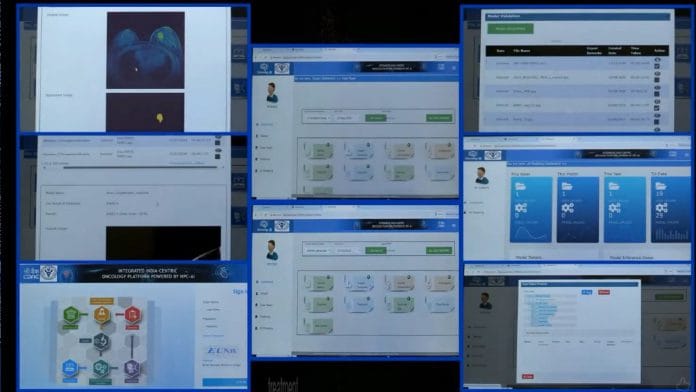
The platform brings a patient’s records into a single AI-powered dashboard, allowing pathologists, radiologists and oncologists to access the same information simultaneously.
It integrates pathology findings, imaging data, laboratory results and clinical history, and then analyses the combined dataset to identify patterns that may otherwise be missed. The goal is to support faster and more confident clinical decision-making.
“There are cases where two pathologists may look at the same slide and disagree on the grade of the cancer,” said Professor Ashok Sharma, principal investigator of the project and Additional Professor in the Department of Biochemistry at AIIMS New Delhi.
“When all the information is fed into the software, it aggregates inputs from multiple specialists, analyses them through the model, and generates a recommendation. The final decision, however, always rests with the clinician,” he added.
Breast cancer is currently the most common cancer among Indian women, accounting for about 27 percent of all female cancers in the country. It has overtaken cervical cancer as the leading cause of cancer-related deaths among women. Ovarian cancer, meanwhile, remains among the deadliest because it is often diagnosed late.
“While cervical cancer now has effective vaccines, breast and ovarian cancers continue to pose major challenges because they often develop silently,” Professor Sharma said.
“Their symptoms can be subtle, vague or easily overlooked. Ovarian cancer in particular is usually detected at an advanced stage, by which time the disease may have become aggressive. That is the key reason we chose to focus on breast and ovarian cancers in the first phase of this project,” he added.
What tool does & why Indian data matters
At its core, iOncology.ai functions as a unified clinical dashboard.
A pathologist can upload images of tumour tissue, a radiologist can feed in CT scans, MRIs or mammograms and a clinician can add laboratory results and patient history—all into the same system, accessible simultaneously by each specialist.
The platform then analyses the combined dataset and generates recommendations on tumour grade, stage and possible treatment pathways.
“Role-based access to the dashboard ensures that each specialist sees what is relevant to their domain, while the treating oncologist retains the final word,” said Professor Sharma.
He explained that the tool also integrates with the Ayushman Bharat Digital Mission (ABDM), allowing patient records to move across facilities without getting lost between departments. Usually, patients visit multiple district hospitals, state referral centres, and tertiary institutions before receiving a confirmed diagnosis.
“Under the conventional clinical system, arriving at a complete cancer diagnosis can take anywhere from 7 to 10 days,” said Dr Fouzia Siraj, Scientist E and Head of the Department of Pathology at the Indian Council of Medical Research (ICMR) Centre for Cancer Pathology.
Siraj has been involved in annotating pathology slides for the platform. This process involves marking cancerous and non-cancerous cells on digital tissue images so the AI model can learn to recognise them accurately.
She noted that AI-assisted analysis could meaningfully compress that window, particularly in grey-zone cases where a second opinion or additional investigation is typically sought.
But, the question of what data the model learns from is, in many ways, as important as what the model does.
Professor Sharma explained that when the team initially trained iOncology.ai on open-source datasets, predominantly sourced from Western populations, its diagnostic accuracy hovered around 49 percent.
However, after the model was retrained on approximately 3,800 cases drawn from Indian patients at AIIMS New Delhi, both prospective and retrospective, accuracy climbed to around 79 percent.
“Our Indian patients’ data is totally different from Western countries,” Sharma said. “So our data is more suited for us.” He explained that the algorithms trained predominantly on data from Europe or North America often underperform when applied to Indian patients, whose disease presentations, genetic profiles and demographic patterns can differ substantially.
Tumour morphology (physical shape, structure, and cellular characteristics of a tumor) in Indian breast cancer patients, for instance, does not always mirror the patterns that dominate global training datasets.
Lakshmi Panat, programme director of the AI and Quantum Technology Group at C-DAC, described iOncology.ai as a tool of “augmented intelligence” rather than artificial intelligence.
“We have designed models for screening, diagnosis, treatment and monitoring,” she said, emphasising that the platform is designed to assist an overstretched medical workforce, not to substitute it. “Our mix of population is such that the doctors are very few compared to the large number of patients,” she said. The platform runs on the Param AIRAWAT (AI Research Analytics and Knowledge Dissemination Platform) system, India’s most powerful supercomputer, built by C-DAC under the National Supercomputing Mission.
The data problem no one has fully solved
Behind almost every discussion of AI in Indian cancer care lies an obstacle that neither government institutions nor private startups have managed to fully get around. India does not have enough organised, annotated, and ethically sourced clinical imaging data.
Clinical records in India have historically been handwritten, siloed, and unstandardised.
Dr Siraj said that while digitisation has picked up since 2017 and the ABDM is helping build structured health records, there is still a shortage of high-quality, annotated Indian medical imaging data. Without enough such data, AI models cannot achieve the level of accuracy needed for use in clinical settings.
The private sector is running into the same wall.
Pranay Agarwal, founder of the AI diagnostics startup Diagno+, which has received support from Blockchain For Impact (BFI), a nonprofit that funds public health and health-tech initiatives, told ThePrint he had achieved 99 percent accuracy on global open-source datasets for brain tumours.
However, he noted that the data was in JPEG format, which is much easier to process than the files generated by clinical MRI machines, and had not been validated on Indian patients.
“I have been at this for 1.5 years and still struggling to ethically source data,” he said.
Several private startups have been working on AI-based cancer diagnostics and medical imaging tools. However, most train their models on open-source global datasets from platforms such as The Cancer Imaging Archive (TCIA), The Cancer Genome Atlas (TCGA), and other publicly available international repositories.
Towards ‘Digital Twins’ and precision treatment
The current iteration of iOncology.ai handles pathology, radiology, and clinical data. However, what the researchers are building toward is considerably more ambitious.
The next phase would involve integrating multi-omics data—genomic, epigenomic, and proteomic information layered on top of what the platform already processes.
Put simply, this would take the platform beyond what a tumour looks like on a scan or under a microscope, toward understanding the complete biological and genetic profile of that particular cancer in that individual patient.
“When you have genomic, epigenomic, and proteomic data together, this is a multiomic approach,” explained Dr Siraj. “That is the future.”
The team will be working towards what they call a ‘Digital Twin’ or a computational model of an individual patient.
The idea is that before a treatment is chosen, clinicians would run a simulation. The platform would take the patient’s complete clinical, molecular, and genetic profile and predict, based on outcomes from thousands of comparable patients, how that individual is likely to respond to a specific drug or protocol.
“Instead of giving treatment in real time and waiting to see the result, you first see it in virtual mode,” said Professor Sharma. “The computer already has data of thousands of patients. It matches your patient’s profile and tells you, for this type of patient, with this cancer, this treatment had better survival and fewer side effects.”
He explained that the logic is a shift from cancer-specific treatment, where patients with the same diagnosis receive broadly the same protocol, toward biology-specific, person-specific care.
“This is what oncologists refer to as precision medicine, and this is where the field globally is headed,” he added.
(Edited by Sugita Katyal)
Also Read: AI mammograms detect more cancers, cut later diagnoses by 12%—Swedish trial of 1 lakh women