



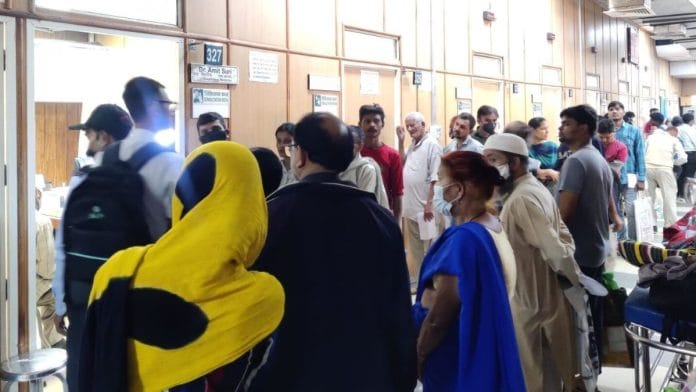
New Delhi: Hospital OPDs across cities are seeing a sharp rise in H1N1 patients during the monsoon influenza season, with doctors reporting that while most patients recover without complications, some are developing severe pneumonia, falling oxygen levels and requiring ICU care.
H1N1, commonly known as swine flu, is a subtype of influenza A that spreads through respiratory droplets. It became widely known in 2009, when a new strain triggered a global pandemic. The World Health Organization declared the pandemic over in August 2010, and H1N1 has since continued to circulate as a seasonal influenza strain.
In Delhi, H1N1 cases have risen more than six-fold this year, with 1,449 cases reported as of 12 August, compared with 229 during the same period last year.
The government says no deaths have officially been recorded. But doctors across Delhi-NCR, Mumbai and Bengaluru report a clear increase in influenza cases, with a smaller number progressing to pneumonia and requiring oxygen or intensive care.
Dr Harshal Ramesh Salve, professor at the Centre for Community Medicine at All India Institute of Medical Sciences (AIIMS) New Delhi, said influenza transmission typically rises during the monsoon and again in winter, with humidity playing a role.
“Cases also rise with gatherings and people contacts increase during festival season,” he said.
He added that the elderly, children below five and people with existing illnesses are more vulnerable, while healthcare workers and others with high occupational exposure also face greater risk.
According to Dr Ramesh Chand Meena, associate professor of medicine at Dr Ram Manohar Lohia Hospital, most healthy people recover without complications, but some vulnerable patients and those reaching hospital late were progressing to severe viral pneumonia and acute respiratory distress, causing oxygen levels to fall.
He also confirmed reports of doctors contracting the virus.
“Because doctors and frontline hospital staff are continuously exposed to high viral loads in emergency rooms, outpatient clinics, and wards during a seasonal surge, they are at an inherently higher occupational risk,” he told ThePrint.
Also Read: Moderna’s mRNA flu vaccine vs the conventional shot. What is different?
‘Don’t panic over every fever or cough’
The rise in H1N1 cases comes alongside a broader increase in respiratory infections, doctors said, so not every fever or cough should be assumed to be swine flu.
At Medanta Hospital in Gurugram, respiratory medicine specialist Dr Bharat Gopal described the increase in H1N1 cases as “clear and significant”, with OPD numbers perhaps four to five times higher than during the corresponding period last year.
But he said influenza A, H3N2, Covid and other respiratory infections were also circulating.
“We are currently seeing increased respiratory illness alongside H1N1 in Delhi-NCR, so we should not equate every flu-like illness with H1N1,” he said.
Dr Gopal said some patients, particularly adults with underlying health conditions, were progressing to viral pneumonia and requiring ICU care.
There is, however, no consolidated official figure for H1N1-specific pneumonia or ICU admissions in Delhi-NCR.
“The key message is to watch for deterioration rather than panic over every fever or cough,” he said.
Warning signs include breathlessness, chest pain, falling oxygen levels, persistent or returning high fever, confusion, unusual drowsiness, bluish lips and blood in sputum.
In children, poor feeding, refusal to drink and unusual lethargy require medical attention.
Dr Gopal added that since the medical staff is vaccinated before flu season, they are experiencing less severe symptoms.
Surge not limited to Delhi
The increase is also being reported in Mumbai and Bengaluru, where doctors are seeing similar symptoms, although most patients continue to recover without serious complications.
At Fortis Hospital in Mulund, Mumbai, Dr Anita Mathew, director of internal medicine and an infectious diseases specialist, said the hospital had seen a noticeable surge over nearly two months.
“While the majority are stable, many are presenting with significant fever, cough, and body ache, with some requiring oxygen and ventilatory support,” she said. “The numbers appear to be higher than last year.”
According to Dr Manish Itolikar, consultant internal medicine physician at Fortis Hospital in Mulund, Mumbai, the timing and scale of the spike is unusual this year.
“We generally see influenza cases increase from around October, with the winter season, but this year the increase began as early as May and June. The number of cases has also been higher than usual during the monsoon,” he told ThePrint.
In Bengaluru, Dr Prajwal KC, internal medicine specialist at Gleneagles Hospital, said high-grade fever, cough and cold were among the most common symptoms.
In his practice, “almost 90 percent” of symptomatic patients tested for influenza were positive, he said.
He described a pattern in which school-going children picked up the infection and then brought it home, spreading it to other family members.
In Bengaluru, Clarence High School in Richards Town temporarily suspended offline classes this month after more than 500 students and 21 staff members reported fever, cough and cold symptoms. Two H1N1 cases were confirmed.
Dr Prajwal also said people travelling through airports, bus stands, metros and crowded markets faced greater exposure. Only two or three patients in his practice had developed falling oxygen saturation so far, which he attributed partly to early intervention.
Risk factors and treatment
The monsoon weather is also helping the virus spread, with rain pushing people indoors and increasing close contact, said Dr Monica Mahajan, principal director and head of internal medicine at Max Hospital, Saket.
She said influenza occurs throughout the year but tends to peak during the humid months.
At CK Birla Hospital, Gurugram, Dr Tushar Tayal, internal medicine consultant, said doctors were seeing patients with fever as high as 103°F, chills, runny nose, sore throat and cough.
For most otherwise healthy people, the illness remains self-limiting and can be managed with rest, hydration and symptomatic treatment, he said. Patients with severe symptoms or low immunity may require antiviral medication.
Antibiotics do not treat H1N1 and should only be used if a doctor suspects a secondary bacterial infection, he said.
How to prevent infection
For people who are sick, doctors advised staying home, wearing a mask, maintaining hand hygiene and avoiding close contact with others. Improving ventilation, particularly in crowded indoor spaces, can also help reduce transmission.
Annual influenza vaccination is advisable, particularly for high-risk groups and healthcare workers.
The vaccines available in India include quadrivalent inactivated influenza vaccines, which contain killed virus components from four influenza strains. They train the immune system to recognise the strains covered by the vaccine and do not cause influenza.
Dr Mahajan said influenza mutates rapidly, which is why the vaccine is updated and taken annually. The vaccine takes time to build immunity and should not be taken during an acute illness.
Dr Salve noted that protection depends on how closely the vaccine strains match the viruses circulating at the time.
(Edited by Sugita Katyal)
Also Read: Fever cannot break bird flu, and we may finally know what led to Indus Valley civilisation’s doom