





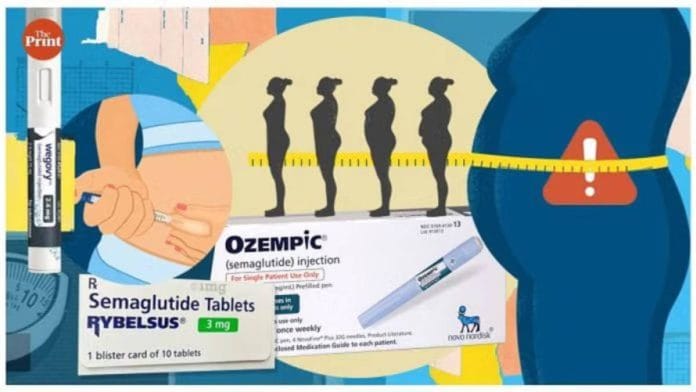

New Delhi: People taking GLP-1 receptor agonist drugs—medications that help control blood sugar and reduce appetite—especially semaglutide, face a “modestly increased” risk of developing a rare and potentially blinding eye disorder compared to those on a different class of diabetes medication, a large study has found.
The study, one of the most comprehensive assessments of its kind, was funded by the US Department of Veterans Affairs and published in JAMA Network Open on 30 April.
The authors were careful to note that the absolute risk remained low, but that the specificity of the finding “may warrant heightened vigilance”.
The eye disorder—non-arteritic anterior ischaemic optic neuropathy or NAION—involves a sudden, painless loss of vision caused when blood supply to the optic nerve is disrupted. It is sometimes called an “eye stroke”. NAION is the leading cause of vision loss in adults and the second most common optic neuropathy after glaucoma. There is no established treatment, and once vision is lost, it rarely returns fully.
The study is the latest entry in one of medicine’s most contested ongoing debates on whether semaglutide, sold as Ozempic and Wegovy by US drugmaker Novo Nordisk, and one of the most prescribed drugs, raises the risk of irreversible vision loss in some patients.
Dr Anoop Misra, chairman of Fortis C-DOC Hospital in New Delhi, told ThePrint he has seen just one case of NAION among approximately 5,000 GLP-1-treated patients at his practice.
“While extremely uncommon, this is a potentially sight-threatening complication and should be discussed with patients, and wherever appropriate, involvement of an ophthalmologist is advisable,” he said.
Dr Vidya Nair Chaudhry, senior consultant, ophthalmology, Aakash Healthcare, said: “There are certain structural variations in the nerve and retina of some individuals that could predispose them to NAION… it is advisable to get an eye fundus screening done by an ophthalmologist before administration of these drugs to rule out any risk factors.”
Also Read: Beyond Ozempic: A look at India’s anti-obesity drug market, what’s available now & what is to come
US study findings & methodology
The study is notable not just for its size but for its design.
Researchers from the VA (Veteran Affairs) St Louis Health Care System, Missouri, led by epidemiologist Yan Xie and physician-scientist Ziyad Al-Aly, used a method called target trial emulation—a rigorous approach that mimics the structure of a randomised controlled trial using real-world data—to study 5,88,168 patients in the veterans’ health administration system.
The researchers compared participants with type 2 diabetes who had newly started a GLP-1 receptor agonist against those who had newly started an SGLT2 inhibitor, another widely used diabetes drug that works by prompting the kidneys to flush excess glucose through urine.
Patients were followed for up to three years. To ensure the two groups were comparable at the outset, the researchers used propensity score weighting to balance them across dozens of variables like age, BMI, blood pressure, pre-existing eye conditions, and more.
The researchers found that GLP-1 receptor agonist users had a 35% higher relative risk of NAION compared to the SGLT2 inhibitor group. In absolute terms, that translated to roughly 10 additional NAION cases per 10,000 persons over three years. This, the authors noted, is a small number, but a consistent and statistically significant one.
“The absolute risk is low. But NAION can be serious. Patients starting GLP-1 drugs should know to seek urgent care for changes in vision. Clinicians should counsel patients on this risk, especially those at high baseline risk of NAION,” co-author Ziyad Al-Aly wrote on X, explaining what the findings mean clinically.
Growing evidence & rebuttal
This was not the first study to arrive at this conclusion.
The largest study so far, published in JAMA Ophthalmology on 1 March this year, followed more than 1,02,000 US veterans with type 2 diabetes for up to 7.5 years and found semaglutide users had a twofold higher risk of NAION compared to those who started an SGLT2 inhibitor, with NAION developing in 0.29 percent of semaglutide users versus 0.13 percent of the comparator group.
A Danish nationwide cohort study tracking all 424,152 persons with type 2 diabetes in Denmark between 2018 and 2024 found that semaglutide exposure was associated with a higher incidence of NAION.
Against this backdrop, a paper published in the British Journal of Ophthalmology last month, authored in part by Novo Nordisk employees and funded by the company, took a different approach.
Rather than drawing on real-world patient data, it pooled safety records from completed randomised placebo-controlled trials of liraglutide(another GLP-1 receptor agonist drug) and semaglutide, covering 96,829 participants. Potential NAION cases were independently reviewed by two ophthalmologists and classified as definite, probable, unlikely or not assessable—with only the first two categories counted.
The researchers found just three confirmed NAION cases among 64,917 patients on GLP-1 drugs, against five confirmed cases among 31,912 on placebo. The paper concluded that the trial data show no relationship between GLP-1 use and NAION.
Another large US study published in the American Journal of Ophthalmology also found no significant NAION risk increase in semaglutide users.
A 2025 systematic review in the Cureus Journal of Medical Science, a Springer Nature journal, examining nine studies found inconsistent evidence overall.
“While a small potential risk of NAION may exist, the absolute risk remains low, and current evidence does not support widespread changes to clinical practice. Given semaglutide’s proven efficacy in managing Type 2 diabetes and obesity, its benefits likely outweigh the potential ocular risks for most patients,” the authors concluded.
Dr V. Mohan, an obesity researcher and chairman of the Madras Diabetes Research Foundation (MDRF), said the overall weight of evidence points to a real but very small risk.
“There is some evidence that semaglutide is associated with NAION—that’s the bad news. But the good news is it’s quite rare. From the studies I’ve assessed, the incidence seems to be about 1 in 7,000 to 10,000 people,” he told ThePrint.
He also flagged that some studies that found no association were industry-funded.
“Overall, the weight of it seems to be that there is a very small risk involved,” he said, adding that the drug’s benefits in glycaemic control, cardiovascular outcomes and weight management continue to far outweigh its risks.
“Such contradictory results are rather typical of the initial stages of the research process and may arise when investigating infrequent conditions such as NAION,” said Dr Siddhi Goel, a Delhi-NCR-based ophthalmologist, who trained at AIIMS Delhi and is senior consultant and Head of Ophthalmology at Asian Institute of Medical Sciences.
“It should be understood that none of the available studies proved a causative relationship between taking GLP-1 agonists and developing NAION. Most participants in such research were predisposed to NAION by pre-existing diabetes, hypertension, or other risk factors,” she added.
Also Read: How semaglutide is emerging as A-Z drug, helping with diabetes, alcohol cravings & more
No warning label yet
In June 2025, the European Medicines Agency’s safety committee (PRAC) concluded, after reviewing all available data, including clinical trials, post-marketing surveillance and medical literature, that NAION is a very rare side effect of semaglutide, potentially affecting up to 1 in 10,000 people, and recommended that the product information for Ozempic, Rybelsus and Wegovy—all brand-name medications containing semaglutide—be updated accordingly.
The WHO followed with a global safety alert in late June last year. India’s drug regulator has not issued a comparable advisory, and the US Food and Drug Administration has not yet added a black box warning.
India’s own regulatory response has been notably silent on the eye risk.
Last month, the government issued a detailed advisory on GLP-1 drugs, covering their mechanism, side effects and the government’s crackdown on unauthorised sales, but made no mention of NAION.
Indian patients using these drugs are currently without equivalent guidance from domestic regulators, making physician-level counselling all the more important.
“GLP-1 receptor agonists are effective in regulating blood glucose levels and preventing cardiovascular complications. The only recommendation is to maintain vigilance. Patients should inform their doctor of any acute visual impairment, while doctors should carefully monitor their condition,” Dr Goel said.
(Edited by Nida Fatima Siddiqui)
Also Read: Mounjaro or Ozempic? What 1st study on Indian cohort found out about efficacy of anti-obesity drugs