



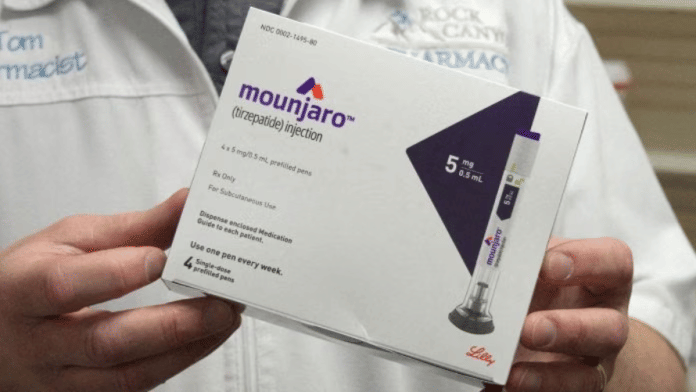

New Delhi: Anti-obesity drugs such as semaglutide and tirzepatide have helped millions shed excess kilos. But weight loss does not come from losing fat alone. About 25 to 40 per cent of the weight lost on these medications may be lean body mass, including muscle.
This means that a person who sheds 10 kg on drugs such as Mounjaro (tirzepatide) could lose up to 3-4 kg of muscle along with body fat.
Now, a phase 2 clinical trial published this week in Nature Medicine has shown that a drug called apitegromab, a muscle-preserving antibody therapy, can significantly reduce muscle loss when used alongside tirzepatide, the active ingredient in weight-loss and diabetes drugs such as Mounjaro.
Researchers found that adding apitegromab can cut muscle loss by more than half without affecting the total weight lost.
GLP-1, or glucagon-like peptide-1, is a hormone the gut releases after eating. It signals fullness to the brain, prompts the pancreas to release insulin, and slows digestion. Drugs like semaglutide, sold as Ozempic for diabetes and Wegovy for weight loss, and tirzepatide, sold as Mounjaro, are engineered to amplify these effects.
Tirzepatide goes further, also targeting a second hormone receptor called Gastric Inhibitory Polypeptide (GIP), making it the more potent of the two.
The trial, called EMBRAZE, enrolled 102 adults with overweight or obesity at seven sites in the United States. At the end of 24 weeks, both the apitegromab group and the placebo group had lost similar amounts of total body weight. But the apitegromab group lost significantly less muscle, preserving approximately 1.9 kg more lean mass, representing a 54.9 per cent retention relative to those on tirzepatide alone.
“These are early days, of course, but if we can have a tool where people who are on faster weight loss can preserve muscle, that will be very helpful,” Dr Ambrish Mithal, the Chairman and Head of Endocrinology and Diabetes at Max Healthcare in New Delhi, told ThePrint.
Also Read: New weight loss drug delivers extraordinary results in late-stage obesity. Clears Phase 3 trial
Significant findings
At the end of the 24-week trial, both the apitegromab group and the placebo group had lost similar amounts of total body weight, around 11 to 12.5 kg. But the composition of that loss was strikingly different. In the placebo group, 30.2 per cent of total weight loss came from lean mass. In the apitegromab group, that figure was just 14.6 per cent. Fat loss was similar in both groups, meaning the drug changed the quality of weight loss rather than its quantity.
Dr Mithal said the finding was significant precisely because it addressed a problem that existing guidance around diet and exercise has not been able to fully solve in patients losing weight rapidly.
“Whenever we lose weight rapidly or substantially, we always lose some muscle, too. That is why we say that people on these modern drugs need to take enough protein and exercise regularly to protect their muscles. The challenge has always been whether any drug helps with that,” he said.
Mumbai-based diabetologist Dr Rajiv Kovil said the most important message from the trial was that all weight loss is not the same.
“In practice, we observe that the faster the weight loss, the more muscle we tend to lose. Muscle is not just for strength or appearance. It is a major metabolic organ. It helps with glucose disposal, mobility, balance, aging, and long-term weight maintenance,” he said.
He added that the finding is especially important for older adults, people with sarcopenic obesity, diabetes risk, frailty risk, or those losing weight rapidly. It suggests a future where obesity therapy is not judged only by kilograms lost, but by body composition.
However, the caveat, he said, is that EMBRAZE was short and Phase 2. “We still need longer phase 3 & outcome studies showing better strength, mobility, safety, and real-world outcomes,” Kovil added.
What’s apitegromab, why similar drugs failed before
Apitegromab is part of a class of experimental medicines known as myostatin inhibitors. These drugs are designed to block myostatin, a protein that acts as the body’s natural brake on muscle growth. If myostatin is blocked, the body can build or retain more muscle.
Developed by US biotechnology company Scholar Rock, apitegromab works by targeting the inactive, or latent, form of myostatin before it becomes active. This helps protect muscles from breaking down during rapid weight loss.
The concept of myostatin inhibitors is not new. Scientists have been trying to develop such drugs for more than two decades, but none has yet reached the market.
Drugs in this class have been studied since the early 2000s, after researchers at Johns Hopkins first reported in 1997 that Belgian Blue cattle with natural myostatin gene mutations had extraordinary muscle mass, and a landmark 2004 paper in the New England Journal of Medicine reported the same mutation in a child with unusual muscular development.
However, most of the drugs in this class failed in clinical trials. While some increased muscle size, they did not consistently make people stronger or improve their ability to walk, exercise, or carry out daily activities. In other words, bigger muscles did not always translate into better health outcomes.
Some candidates also interfered with related biological pathways, raising concerns about side effects. Experts say another challenge was proving that gains in muscle mass resulted in meaningful benefits for patients.
“Muscle mass alone is not enough,” said Dr Kovil. “Doctors and regulators need evidence that patients are stronger, function better, and benefit in the long term.”
What makes apitegromab different
Experts say apitegromab stands out from earlier myostatin inhibitors because it is more precise in how it works. “It targets latent or pro-myostatin, which is the inactive precursor form of myostatin,” said Dr Kovil.
Unlike earlier drugs that affected several related proteins in the body, apitegromab specifically targets inactive myostatin. This more selective approach could help preserve muscle while reducing the risk of unwanted side-effects.
The EMBRAZE trial also tested the drug in a different setting from many previous myostatin inhibitors. Rather than treating severe muscle diseases, it was used to prevent muscle loss caused by weight-loss medication. “Earlier drugs were largely tested in muscle-wasting conditions. Here, the goal was different,” said Dr Kovil. “Tirzepatide drives fat and weight loss, while apitegromab helps protect lean mass.”
The safety results were also encouraging. Side effects were similar in the apitegromab and placebo groups, with gastrointestinal symptoms — the common side effects of tirzepatide — being the most frequently reported. Serious adverse events were rare and balanced at one per group.
Though the study showed that apitegromab helped preserve muscle mass, it did not prove that people became stronger or functioned better in daily life. Whether the extra muscle translates into better strength, mobility, or long-term health benefits will need to be tested in larger studies.
Apitegromab is not the only drug that has been tested as a muscle-sparing companion to weight-loss medication. A rival compound, bimagrumab, was originally developed by Novartis, later licensed to startup Versanis Bio, and subsequently acquired by Eli Lilly, the maker of tirzepatide itself, for up to $1.9 billion in 2023.
Lilly ran its own Phase 2b trial combining bimagrumab with tirzepatide, but terminated that trial in September 2025.
According to Dr Kovil, the termination was for commercial rather than safety reasons, though Lilly has not publicly detailed its full rationale.
None of these inhibitors has been approved for obesity or general muscle preservation. Apitegromab itself has completed a successful Phase 3 trial in spinal muscular atrophy, and Scholar Rock has resubmitted a Biologics License Application to the US FDA as of March 2026, following an earlier rejection.
(Edited by Ajeet Tiwari)
Also Read: Mounjaro or Ozempic? What 1st study on Indian cohort found out about efficacy of anti-obesity drugs