



New Delhi: Generic and biosimilar cancer drugs have become up to 93 percent cheaper under the revised maximum retail prices (MRPs) released by the National Pharmaceutical Pricing Authority (NPPA) Wednesday, following the government’s 30 percent trade margin cap on 137 non-scheduled anti-cancer medicines.
However, the revised list offers no price relief for at least 65 high-cost, single-source cancer drugs, underscoring how the margin cap can sharply reduce prices where intermediaries’ mark-ups are high but leave medicines expensive when manufacturer prices remain steep and competition is limited. The revised prices will take effect from 9 November.
Meanwhile, as per filings by the pharmaceutical companies submitted to the NPPA, generic and biosimilar brands have seen price cuts of over 90 percent.
Revised prices for 27 of 137 drugs were not reflected in the company filings available so far. These include abemaciclib, cabozantinib, dabrafenib, lazertinib, selpercatinib, sotorasib and vemurafenib. The list is based on price information submitted by companies up to 27 October.
The revision comes after a 17 October order issued by the NPPA that limits trade margin added by distributors, stockists and other intermediaries on 137 anti-cancer medicines to 30 percent of the MRP. These medicines are classified as non-scheduled drugs, meaning they are not covered by the usual price ceiling applied to medicines on the National List of Essential Medicines.
Trade margin refers to the difference between the price a manufacturer charges a distributor and the MRP printed on the medicine pack.
The Supreme Court, which is also hearing the matter, questioned Tuesday how a private hospital could charge Rs 1.3 lakh for a cancer injection that a medical distributor could procure for Rs 11,000. A bench of Justices Vikram Nath and Sandeep Mehta was hearing a public interest litigation filed by advocate Kishan Chand Jain and a connected petition by Dr Sanjay Kulshreshtha, which raised concerns over medicine prices and prescribing practices. The bench has reserved its order.
Last month, the court had flagged the wide price disparity, observing that a drug bought for Rs 2,700 but sold with an MRP of Rs 27,000 amounted to “extortion”.
Generic brands see cuts of over 90 percent
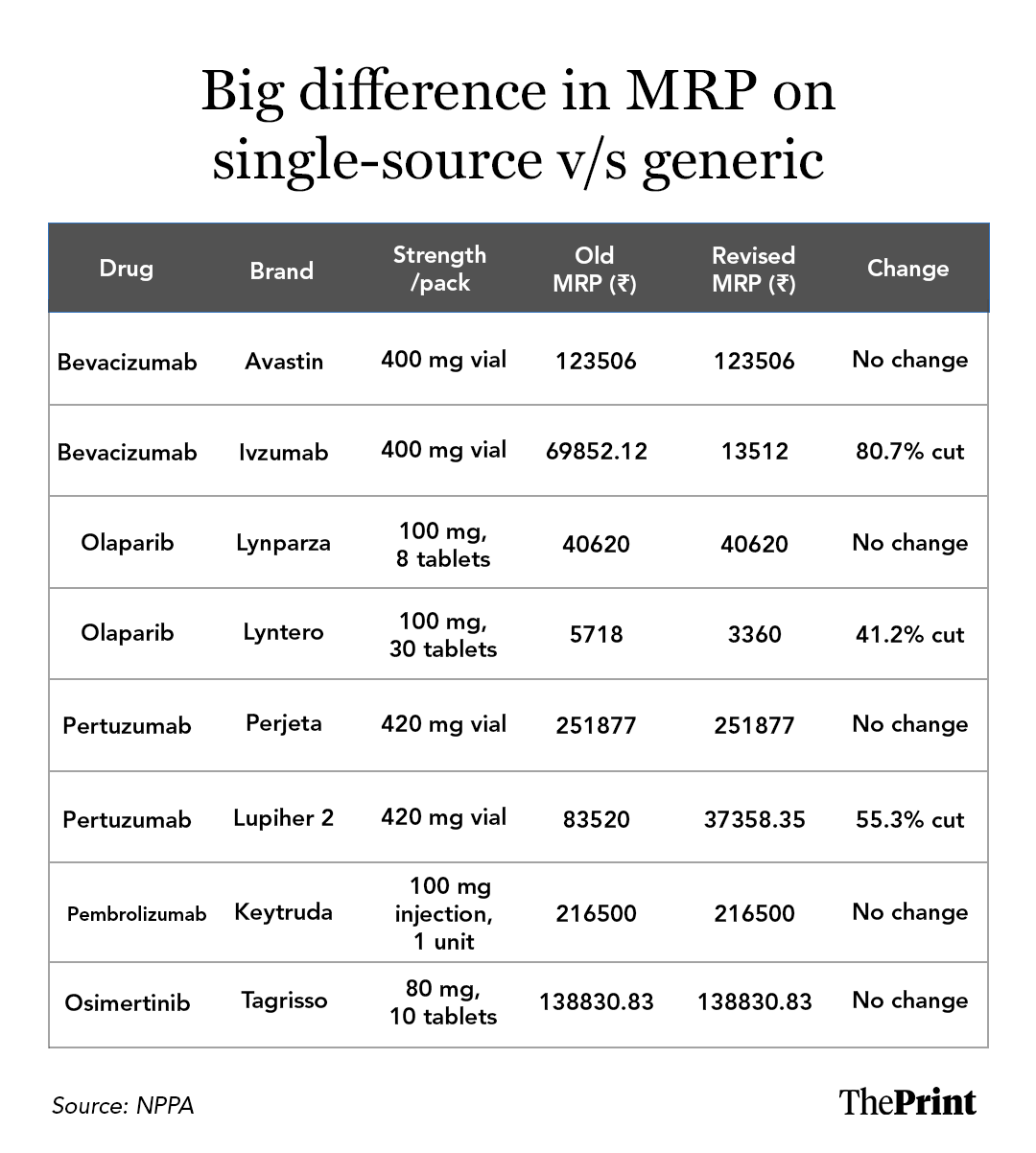
The revised list shows steep price reductions for several generic brands. Palbopro, a brand of palbociclib used to treat certain types of breast cancer, has seen the MRP of its 125 mg pack of 21 capsules fall from Rs 40,421.33 to Rs 2,720, a reduction of about 93 percent.
Abiralive, a brand of abiraterone acetate used in prostate cancer treatment, has become cheaper by about 83 percent. The price of its 250 mg pack of 120 tablets has fallen from Rs 28,000 to Rs 4,840.
Womazol, a brand of anastrozole used in breast cancer treatment, has seen its listed price fall from Rs 458.85 to Rs 39.52 for a 10-tablet pack. The price of a 400 mg vial of bevacizumab (Ivzumab), used to treat several cancers, including colorectal, lung and kidney cancers, has dropped from Rs 69,852.12 to Rs 13,512, a reduction of about 81 percent.
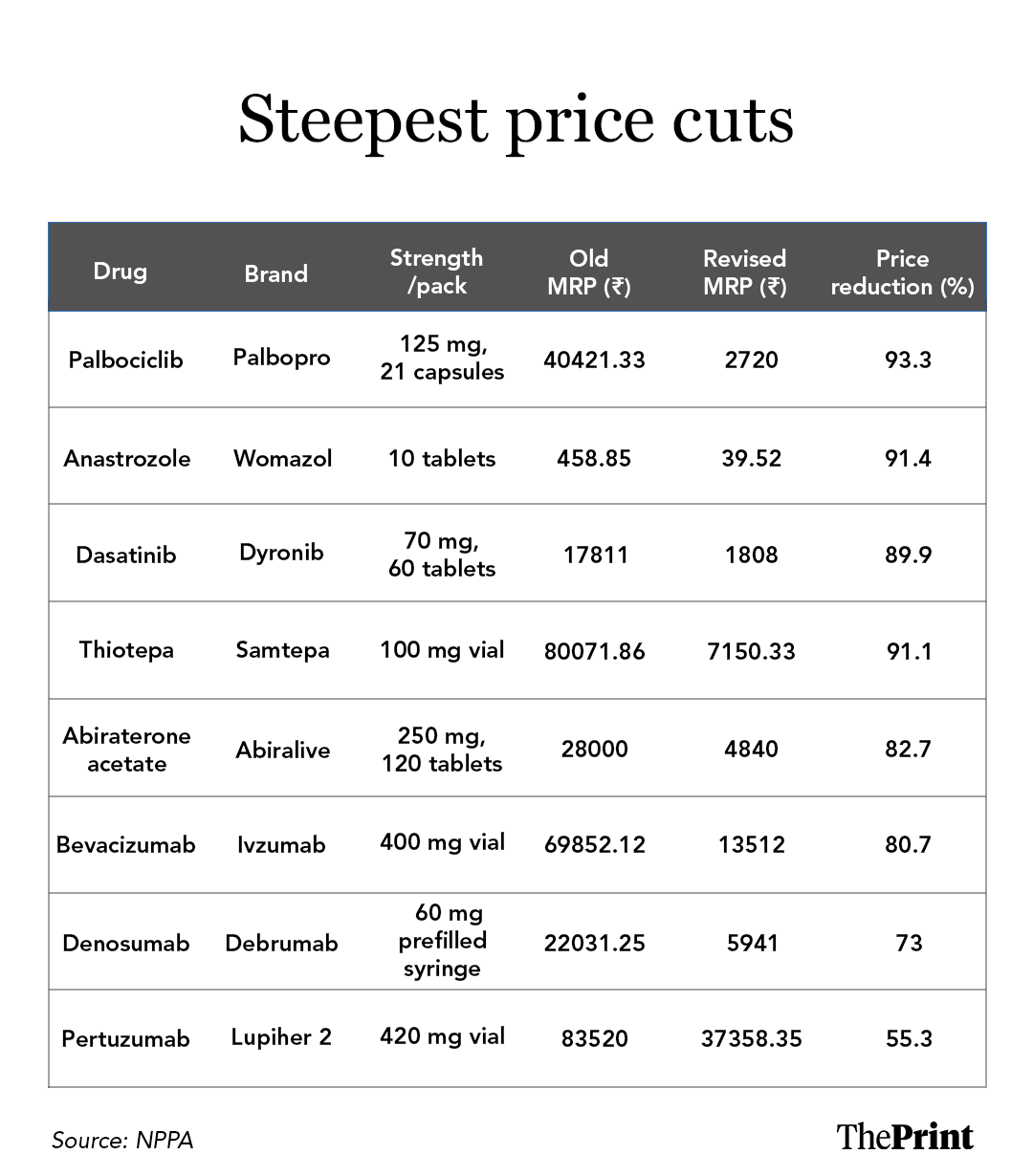
The price of Samtepa, for a 100 mg vial of the chemotherapy drug thiotepa, has also fallen sharply, from Rs 80,071.86 to Rs 7,150.33.
However, the reduction is not the same for every brand of a drug. Ivzumab’s price has fallen substantially, for instance, while Avastin, another brand of bevacizumab, remains priced at about Rs 1.24 lakh for a 400 mg vial.
Prices of 65 expensive drugs remain unchanged
A comparison of the revised NPPA list with pre-capping prices of anti-cancer drugs shows that prices of 65 expensive single-source anti-cancer drugs have remained unchanged. Single-source medicines have only one supplier or lack competing brands that could put pressure on prices.
These include Keytruda, which contains pembrolizumab and is used in cancer immunotherapy. Its listed price remains the same as it was before capping, at Rs 2,16,500 for a 100 mg vial. Tagrisso, used to treat certain types of lung cancer, is another high-cost medicine, the listed price of which is unchanged.
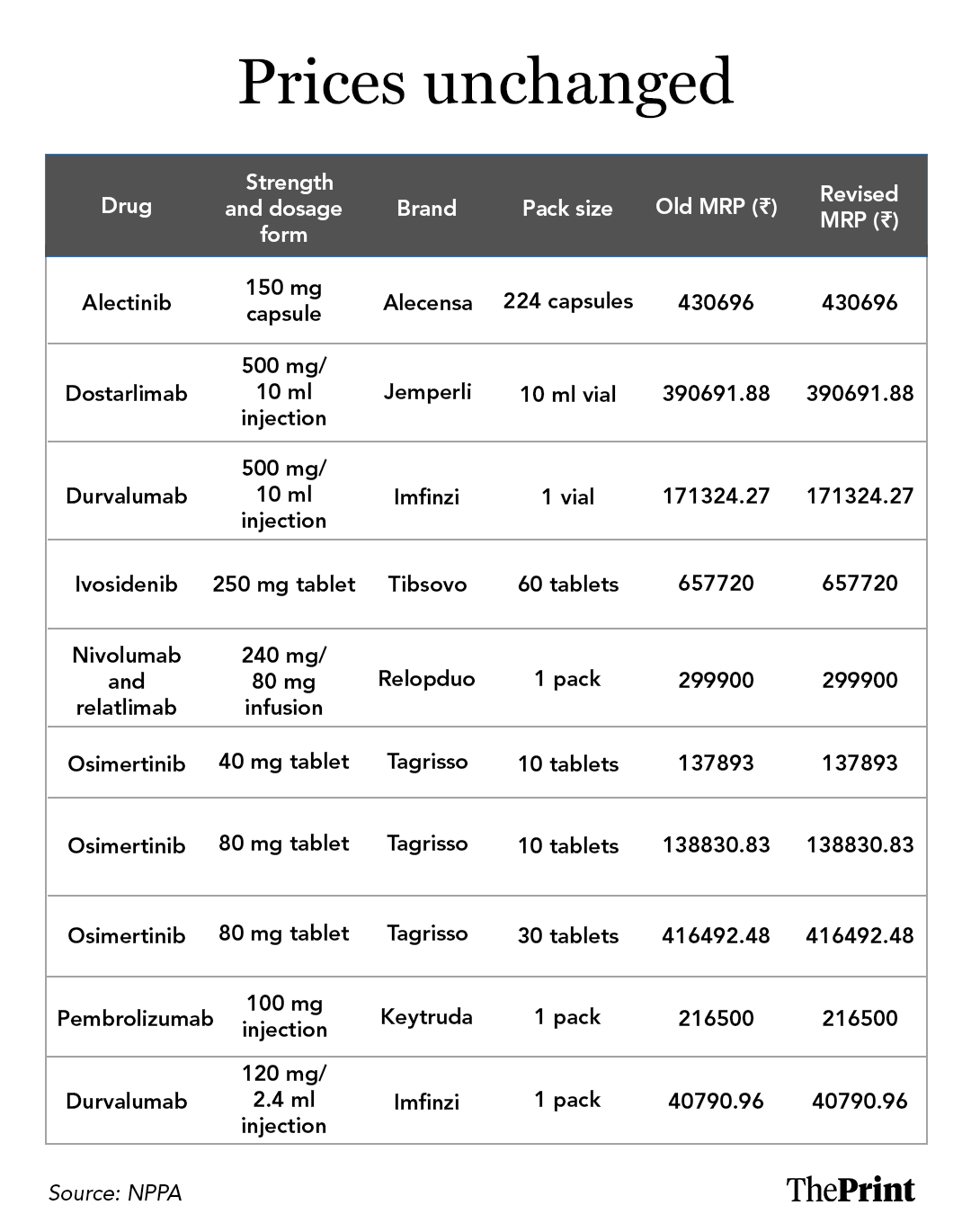
Some original branded cancer drugs may already have MRPs close to the maximum allowed under the new NPPA rules, so their prices may not change.
The biggest cuts have been seen in generic and biosimilar brands, where the gap between the distributor price and the printed MRP was large.
ThePrint has reported earlier on how the trade margin capping only limits how much intermediaries can add to a medicine’s price after buying it from the manufacturer. It does not directly limit the price that the drug company charges when it first sells the medicine to a distributor or hospital.
This means that where the manufacturer’s starting price is already high and there are few competing brands, the medicine may remain expensive even after the margin cap. By contrast, generic brands competing with other manufacturers may see sharper price reductions.
Companies need to submit revised price details to the NPPA even when a medicine’s MRP does not change. They must also circulate updated price lists, publish the revised prices and maintain existing production levels. Manufacturers intending to reduce production must seek prior permission from the authority, the NPPA price capping order had stated.
The NPPA order also addresses medicines supplied directly to hospitals. Hospitals buying these drugs from manufacturers are treated as distributors for the margin cap and must follow the revised pricing rules.
Some pharmaceutical companies also provide free or discounted medicines to eligible patients through patient assistance programmes. The order allows qualifying free supplies to be excluded from the distributor-price calculation, subject to specified conditions and records. The effect of this provision will depend on how the programmes and their supplies are accounted for.
The government expects the measure to save patients up to Rs 2,500 crore annually. But the revised list shows that the benefit will depend on the medicine and brand prescribed. While some patients may see large reductions in their drug bills, those relying on expensive medicines prices of which remain unchanged may receive little or no relief from the margin cap alone.
(Edited by Viny Mishra)
Also read: Drug price caps can’t stop at cancer medicines. India needs to regulate pharma margins