



New Delhi: Pune’s Arohi Deshpande had a telling reaction when she became the highest-ranked woman with an AIR of 77 in JEE Advanced this year: “I would have been happier if there were more girls before me.”
A record 10,107 women cleared JEE Advanced for entry to the IITs this year, making up around 18 per cent of successful candidates. Yet the merit list is still largely a sea of men’s names, and only a handful of women have broken through into the top ranks or come close over the years.
So, where do those who make the cut reach professionally?
ThePrint tracked the career trajectories of the highest-ranked women in JEE Advanced (IIT-JEE until 2013) between 2012 and 2021. All ten went into computer science, much like many male toppers in the past several years. Nearly all women are still in the STEM fields, with eight out of 10 now based in Western countries, pursuing careers in artificial intelligence, machine learning, computational biology, and cryptography. None joined the civil services, while only one has chosen to be an entrepreneur in India.
One of the women toppers whose career has taken more turns than most is Riya Singh, who secured an AIR of 133 in JEE Advanced 2016. After a stint in the UK as a computer scientist and then in finance, she returned to India a year ago and is now building a startup.
“I got an off-campus job opportunity with Adobe, but I always wanted to see how people work in a global setting. So when I got an opportunity in the UK to work in ML and computer science, I moved to Edinburgh,” said Singh, who studied computer science at IIT-Delhi. “Unfortunately, I was part of the mass tech layoffs, so I had to pivot from software engineering and ML research to core finance and quant research—something I never imagined I would do.”
Now based in Bengaluru, she says the IIT network helps her navigate career challenges.
“I decided to take risks on my own terms, and build something which I am passionate about. It is pretty new but it’s a new challenge to take. I still have many batchmates and seniors who have chosen to go for entrepreneurship. It gives me a lot of confidence to rely on the shoulders of giants,” she added.
Until 2017, women accounted for only about 8 per cent of IIT undergraduate admissions. The following year, the institutes added seats exclusively for women, raising their share to 14 per cent in 2018 and about one in five in the years since.
As far as women’s ranks in JEE Advanced go, there has been no consistent pattern. Women made it to the top 10 in 2013, 2014, 2018 and 2019, but in other years the highest-ranked woman finished well outside it.
Also Read: Life after JEE All India Rank 1 and IIT. Where are the 2000-2019 toppers?
Top-ranked women in JEE, 2012-2021
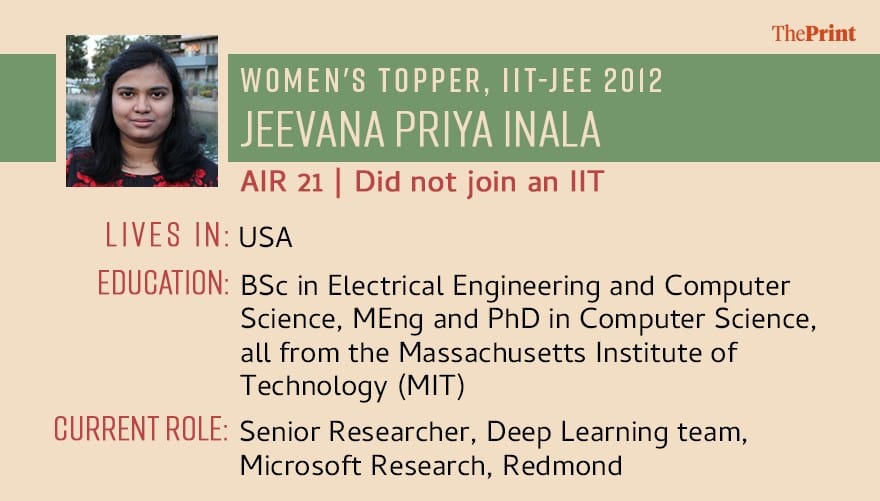
Jeevana Priya Inala skipped the IITs and went to MIT, where she stayed for the next nine years, through a bachelor’s, a master’s and a PhD in computer science. She reached MIT with an impressive Olympiad record, including gold at the Asian Physics Olympiad, silver at the International Physics Olympiad, and gold at the International Olympiad on Astronomy and Astrophysics.
She received Microsoft’s Research Women’s Fellowship in 2016 and joined its Redmond research lab after completing her doctorate. Her work is in program synthesis, or getting machines to write and reason about their own code. “I develop neurosymbolic approaches for learning models that are interpretable and generalizable,” she writes on her personal website.
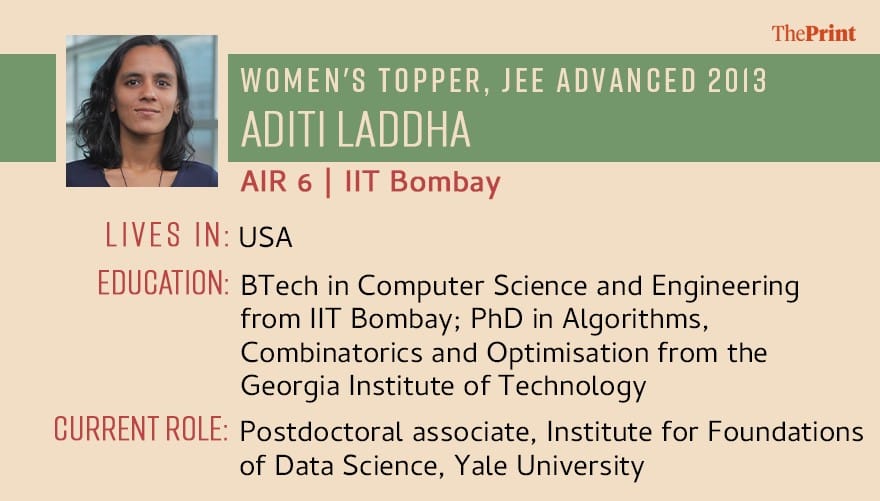
The year 2013 was a good one for women in JEE Advanced, with two breaking into the top 10 for the first time: Aditi Laddha at AIR 6 and Sibbala Leena Madhuri at eighth. After graduating from IIT Bombay, Laddha, who is from Ratlam in MP, got a widely publicised job offer from Uber in the US. However, she stayed at the job for only six months and pivoted to academia instead.
At Georgia Tech she did a PhD in high-dimensional sampling and convex optimisation, and won Microsoft’s Ada Lovelace Fellowship in her second year. The three-year fellowship is for PhD students at US universities who are underrepresented in the field of computing. She is now a postdoc at Yale, working, broadly, on the mathematics behind machine learning.
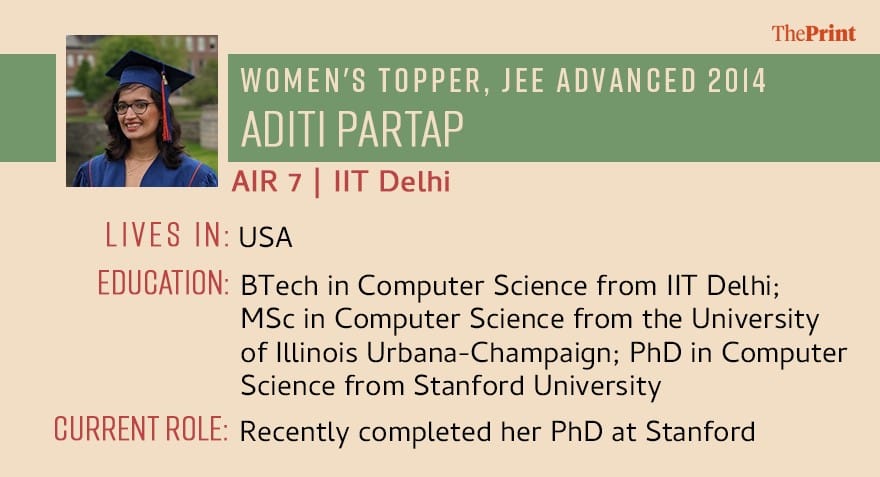
Aditi Partap graduated from IIT Delhi in 2018 at the top of the computer science department and received the Institute Silver Medal. She took a software engineering job at Microsoft in Vancouver for about nine months and then left industry for higher studies.
Her doctorate at Stanford, finished this May, is in cryptography, the science of keeping information secure. “My current focus is on accountability in threshold cryptography and leader election protocols,” she writes on her Stanford page. In her online CV, she adds that her research has included “tracing leaked secret information back to the responsible parties”.
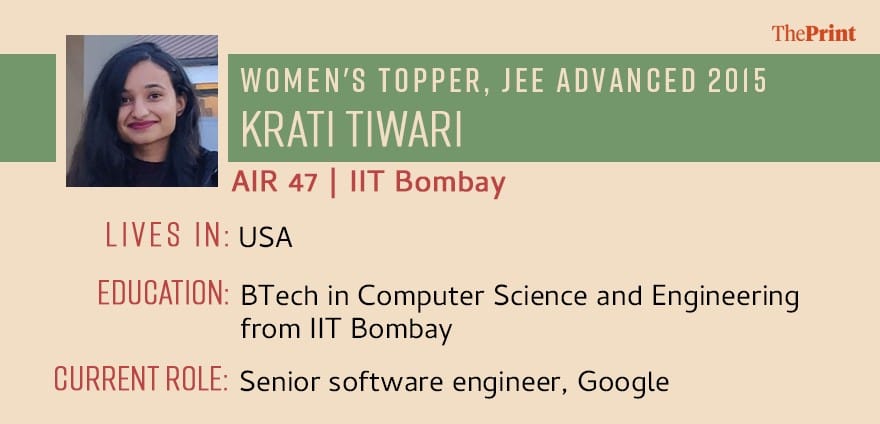
Krati Tiwari, who grew up in MP’s Mhow, has said in interviews that she nearly quit preparing for the JEE because of the daily travel to Indore for coaching. After she became the highest-ranked woman, the government made her a Digital India brand ambassador for a year. She interned at Google twice while at IIT Bombay and joined the company after graduating.
In 2021 she moved to the US and is now a senior engineer working on applied AI at Google’s Silicon Valley headquarters. She is one of the few on this list who did not pursue further studies.
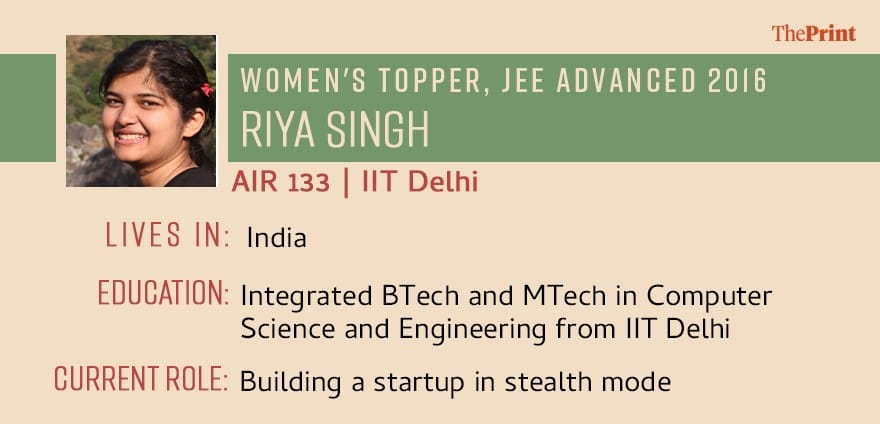
After IIT Delhi, where she also minored in economics, Riya Singh has traversed multiple geographies and careers, from software engineering at Adobe in Bengaluru and Amazon in Edinburgh, to quantitative finance at Barclays in London as an associate vice-president.
She has recorded each of these turns on her LinkedIn with some candour. The break she took in 2025, before returning to India to become an entrepreneur is logged as: “Transitioning from being a corporate slave to being a curious builder at the crux of AI research in finance.”
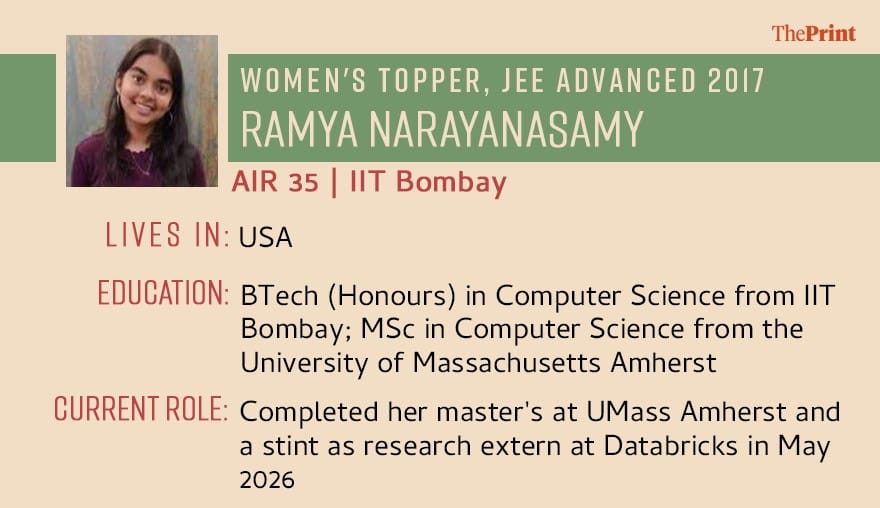
After graduating from IIT Bombay, Ramya Narayanasamy spent three years as a software engineer at Wells Fargo in Hyderabad, where she helped develop the engine that computes and delivers foreign exchange rates to the bank’s clients. In 2024, she moved to the US for a master’s in computer science at UMass Amherst, specialising in data science. There, she worked on medical AI at the university’s BioNLP Lab, spent a year as an intern at Nokia in California, and completed a research stint at Databricks. Her LinkedIn says she is open to work.
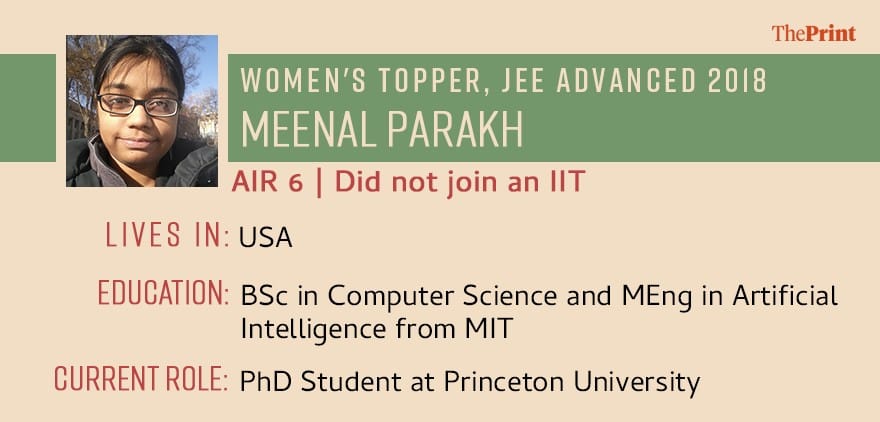
Meenal Parakh, who prepared in Kota (there’s speculation online that she inspired the character of Meenal Parekh in Kota Factory) and cracked the top 10, ended up not going to an IIT at all. Instead, she went to MIT, for a bachelor’s and then a master’s in artificial intelligence.
Parakh is now a doctoral student in Princeton’s Vision and Learning Lab under Jia Deng, one of the creators of ImageNet, the dataset that transformed how machines recognise images. Her work is in robotics and computer vision.
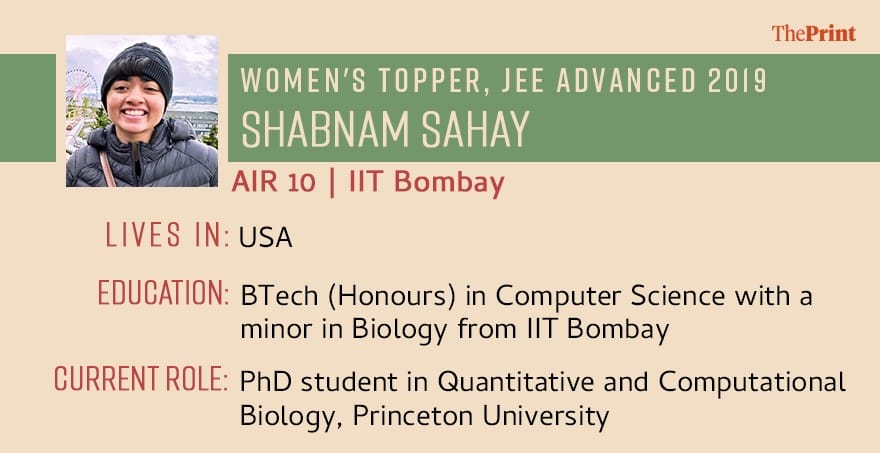
Originally from Ahmedabad, Shabnam Sahay studied computer science at IIT Bombay but minored in biology, and has worked at the intersection of both ever since. During her undergraduate years she spent 18 months at the National Centre for Biological Sciences in Bengaluru and a summer at the Mechanobiology Institute at the National University of Singapore. Her final-year thesis modelled cancer signalling networks.
After graduating she did a short research stint at the Vienna Biocenter, then a year at Microsoft in Hyderabad, before leaving for Princeton for a graduate programme leading to a PhD. At the Lewis-Sigler Institute for Integrative Genomics, she says her academic interests are “developmental biology and collective cellular behaviours through a combination of computation and experiments.”
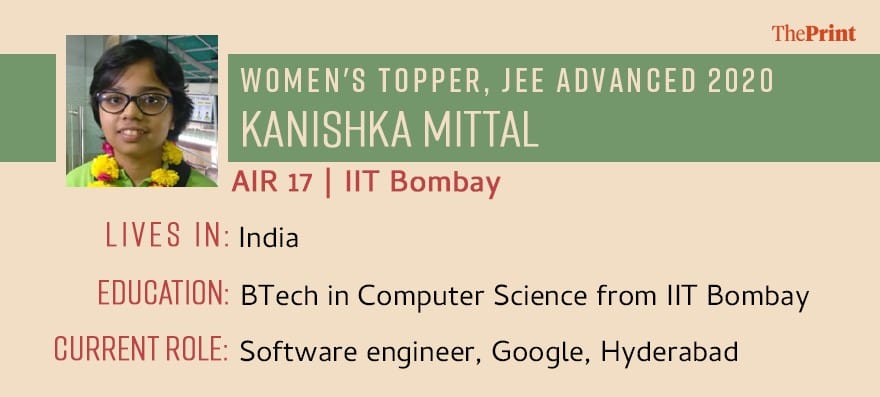
Moradabad’s Kanishka Mittal went to IIT Bombay to study computer science, during the course of which she spent a summer as a research intern at Uppsala University in Sweden and another at Google in Hyderabad. Her tongue-in-cheek verdict on the latter, written for her department’s internship blog, was: “You will go for the food and stay for the food.”
After working on GPay’s fraud systems during that internship, she accepted an offer to work at Google in Hyderabad and has been there since July 2024.
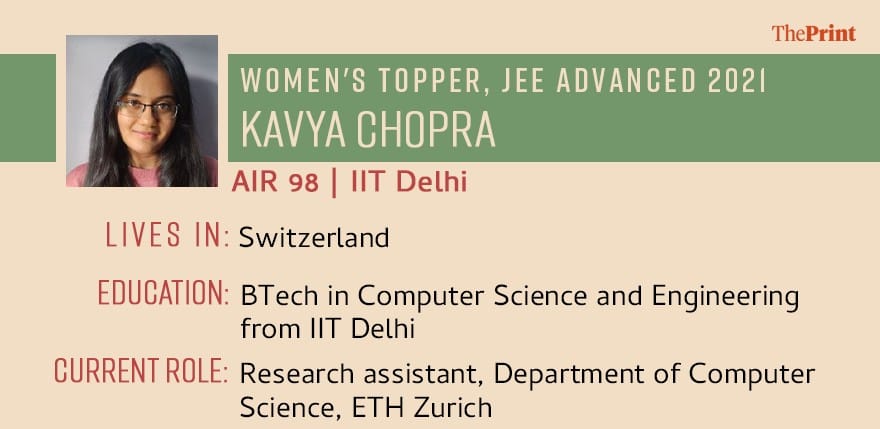
Kavya Chopra had already made history before she got to JEE Advanced. She wasn’t happy with her 99.97 percentile the first time she gave the JEE Main, so she gave it again, and became the first woman to score 300 on 300. In her final year at IIT Delhi, Chopra went to ETH Zurich, a premier public STEM university in Switzerland, where she worked on finding bugs in C compilers. After a short stint at Jump Trading in Singapore, she returned to ETH Zurich, where she has remained as a research assistant.
Her team’s tool, Reify, has turned up dozens of bugs in compilers used across the industry. In June, she presented a paper on it at PLDI, a leading computer science conference, in Colorado. She wrote on LinkedIn: “What started as a hacky prototype thrown together in two weeks during my internship eventually grew into Reify.”
(Edited by Asavari Singh)