



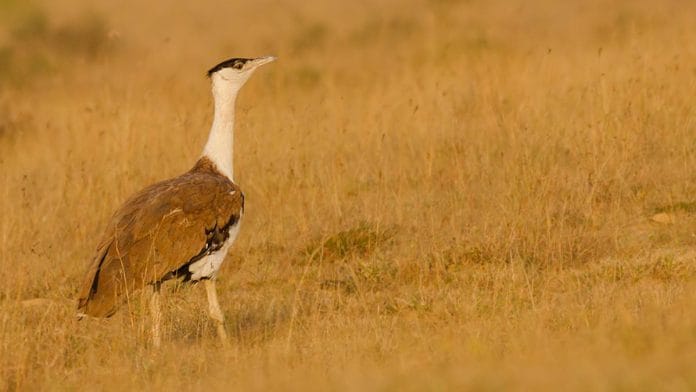
Jaisalmer: As R1 and R2 saunter along the sandy landscape of the Desert National Park in Sam, Rajasthan, taking brief, laborious flights, they are unaware of the expert eyes watching them ever since they were released into the wild on Sunday. Five days have passed since the two captive-bred Great Indian Bustards tasted freedom, and initial field observations offer a flicker of hope — both the birds are foraging, finding water, and slowly discovering the instincts that will allow them to survive this harsh landscape. But for the wildlife scientists involved in the project, every day has been steeped in anxiety.
Tracking R1 and R2 is a relentless relay from dawn to dusk. The field team of biologists and conservationists stay perched for hours on top of the forest department’s watchtowers and other vantage points across the DNP’s desolate landscape. Their eyes shift between binoculars aimed into the endless sea of yellow and the telemetry readings from the 30-gram trackers the birds carry on their backs.
Fine dust particles have settled on Sutirtha Dutta’s olive-green cap. Dutta, the Wildlife Institute of India (WII) scientist heading the Great Indian Bustard breeding and conservation programme, has wiped thin coats of dust from his glasses countless times over the past few weeks.
“These days are extremely stretched. It’s not just the physical exhaustion. These birds consume you. You are always thinking about them. There are moments of happiness when the birds are released because years of effort have led to that. But before you can cherish those moments of happiness, the anxiety returns. When you sleep, you think about the next day and about the birds and about their survival. Many of us find it difficult to sleep properly through the night thinking about what is going to happen with the birds the next day, particularly in this initial phase,” Dutta told ThePrint.
The stakes are high. R1 and R2’s release into the wild is only the prologue to a much larger conservation project. The survival of the critically endangered Great Indian Bustard is linked to the survival of the desert landscape, which has slowly deteriorated over the past two decades. The bird faces threats from every side: feral dogs hunt it, windmills and solar parks turn its territory into an obstacle race, and high-voltage power lines weave a maze of death traps in the skies.
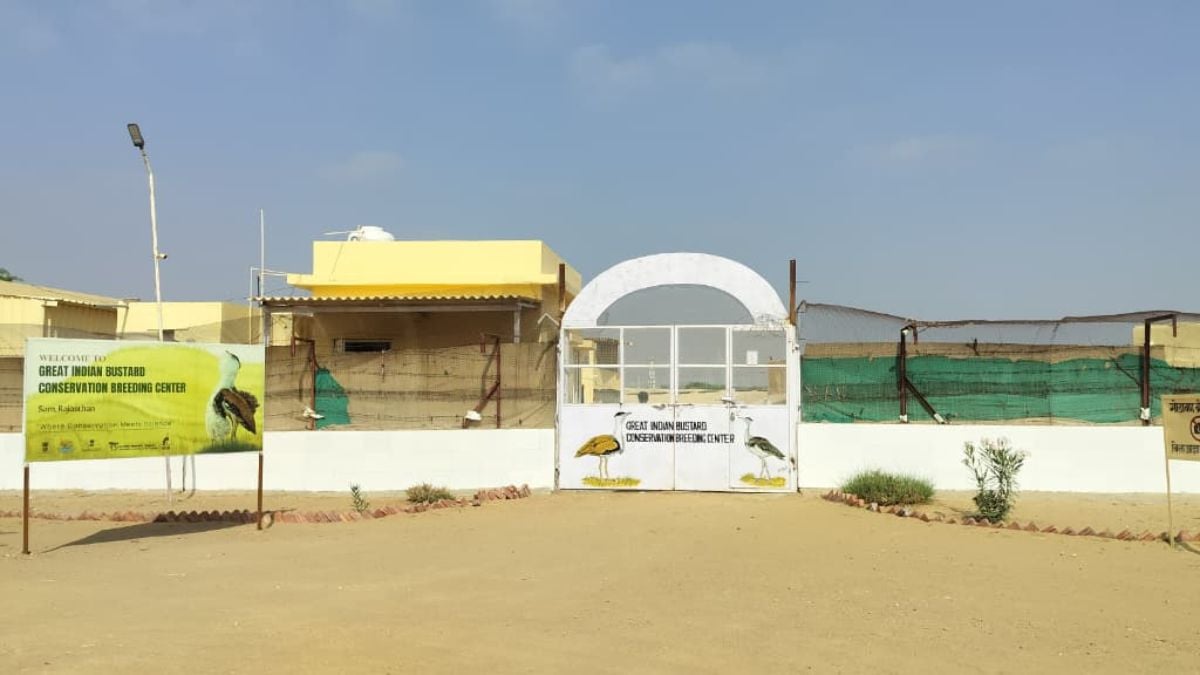
To prevent the bird from going extinct, the Ministry of Environment, Forest and Climate Change (MoEFCC), the Rajasthan Forest Department, and the WII set up two Great Indian Bustard Conservation Breeding Centres, one at Sam and another at Ramdevra, not far from Jaisalmer. But breeding the bird is only one step in restoring the desert itself.
The centre at Sam was established in 2019 as a “pilot” project, while the one at Ramdevra was established in 2022.
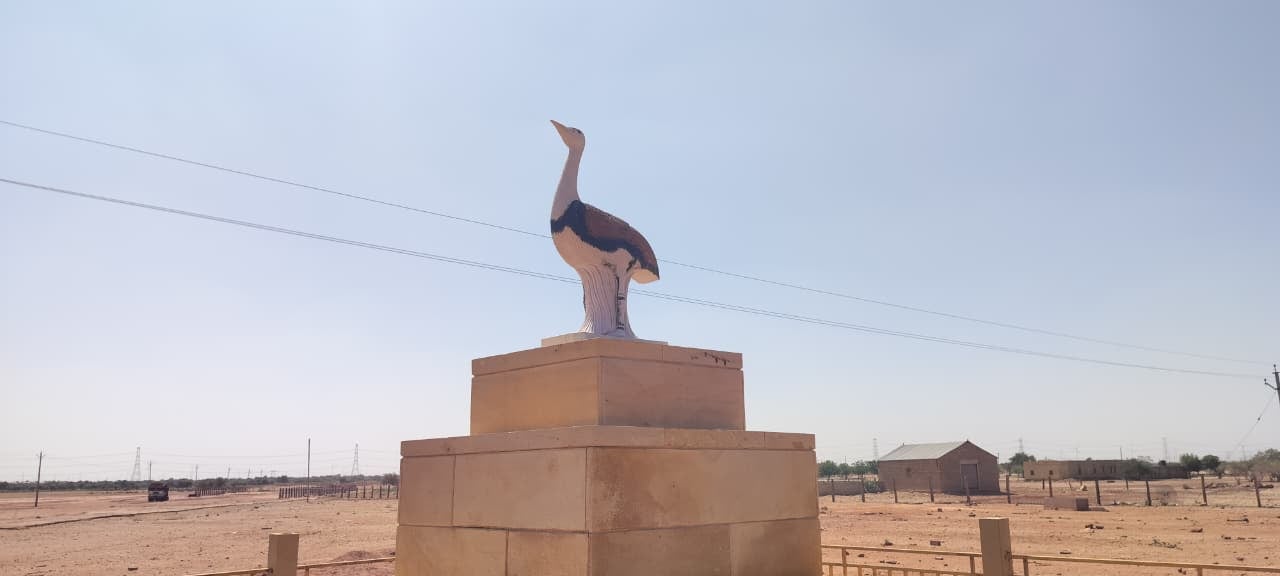
Saving the bustard, saving the desert
The release came after seven years of conservation efforts, and the two six-month-old males made headlines across India. Dutta and his team, however, were wary. They know the post-release survival rate of captive-bred birds, especially bustards, is only about 10 to 30 per cent. For them, the celebration was only the beginning of a long period of observation.
“There is a lot to learn from how they’re adjusting, how they’re adapting to the wild, based on which we can later tweak and refine the process of rewilding and increase the survival of the birds in the wild. For now we’re observing their behavior, seeing how their wild instincts are developing over time,” said Dutta.
The bustards are all the researchers at Sam talk about. In the evenings, when the field team returns to its rented accommodation in Sam, the dinner table conversation is about how the duo has been stooping to pluck grasshoppers from shrubs, and how one of the males, who seemed quite unassuming during the initial six months of rearing, has suddenly taken the lead, while the other follows behind.
Yet, Dutta says that the Great Indian Bustard is just an “umbrella”.
“It is an iconic species that leverages a kind of support among people which benefits all other taxa around. The same grasslands that have been restored for the Great Indian Bustard have a much higher diversity of insect populations like grasshoppers and spiders, and even chinkara, a revered antelope here. Threats that affect the Great Indian Bustard affect other species too. If you conserve the Great Indian Bustard, you also get to conserve wildlife that does not garner that support individually,” said Dutta.
Also Read: The Great Indian Bustard lost India’s national bird race. It is now close to extinction
Names for the captive, numbers for the free
Not far from R1 and R2, their parents remain captive within the bio-secure enclosures of the Sam Conservation Breeding Centre. Hand-reared and accustomed to their human caretakers, Leo, Phoenix, Aman, and Sam will never be released into the wild. Their role is to mate and produce more Great Indian Bustards who may taste the freedom they never got to experience themselves.
The scars on Hrishika Sharma’s forearms have faded, but every year between February and June, the mating season, when hormones run high, the captive Great Indian Bustards leave loving scratches on whatever part of the senior wildlife scientist they can get their beaks on. Sharma doesn’t mind. The 33-year-old joined the breeding project straight out of her master’s in wildlife science nearly eight years ago.
In 2019, when the centre first started, Sharma and her colleagues collected bustard eggs from the wild and hand-reared the chicks. By 2023, when the birds had reached maturity, natural and captive breeding began.
“Sometimes there are problems with natural breeding. The female might be ready, but the male is not, or the other way around. To solve that, we use a decoy female and collect semen from the male, and when the female is ready, we inseminate her. The chances of fertility increase using AI,” Sharma said, quickly adding with a laugh, “For us, AI means Artificial Insemination.”
Sharma is one of the team’s longest-serving members. Working alongside her is Dr Prerna Kardile, a 28-year-old veterinarian who traded Mumbai’s crowded chaos for Sam about six months ago. Kardile spent the previous four years caring for Humboldt penguins at the Mumbai zoo and knew little about bustards when she arrived.
“One lives below zero degrees, the other lives in 50-degree heat! One swims, the other flies! But they both have one thing in common – they bite!” said Kardile, recalling this year’s mating season.
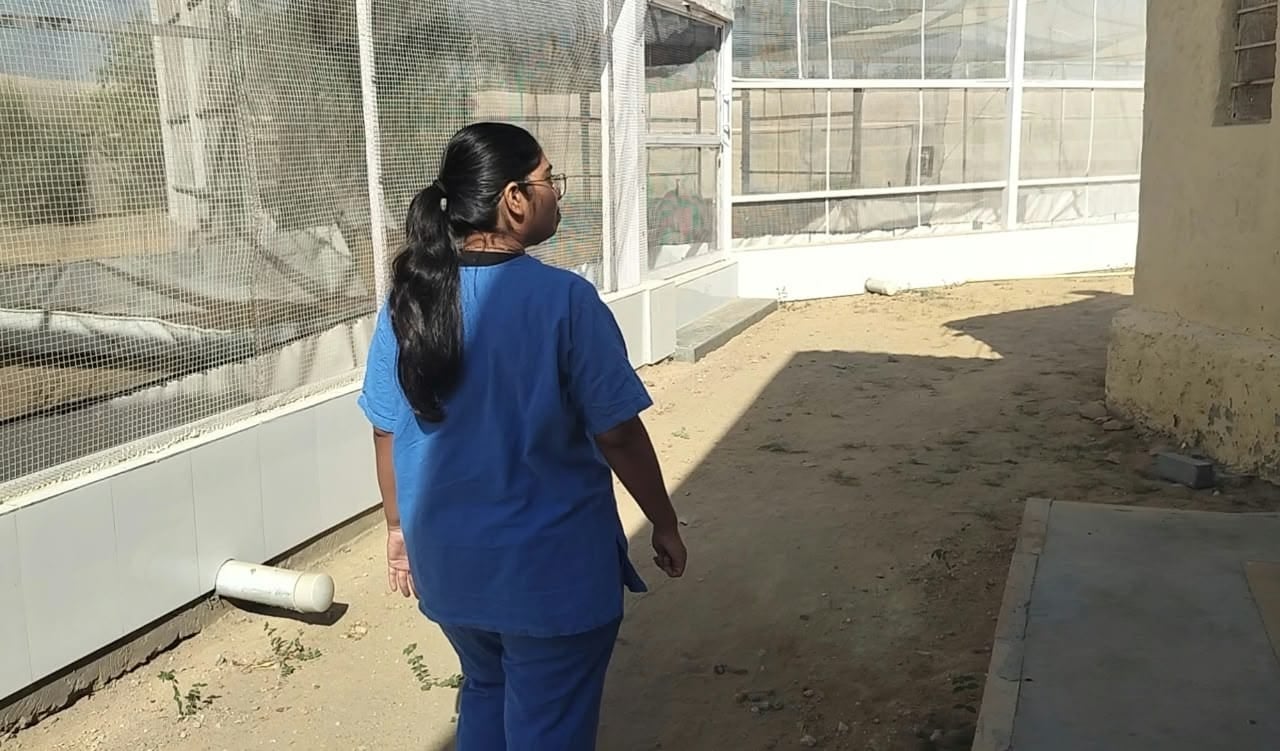
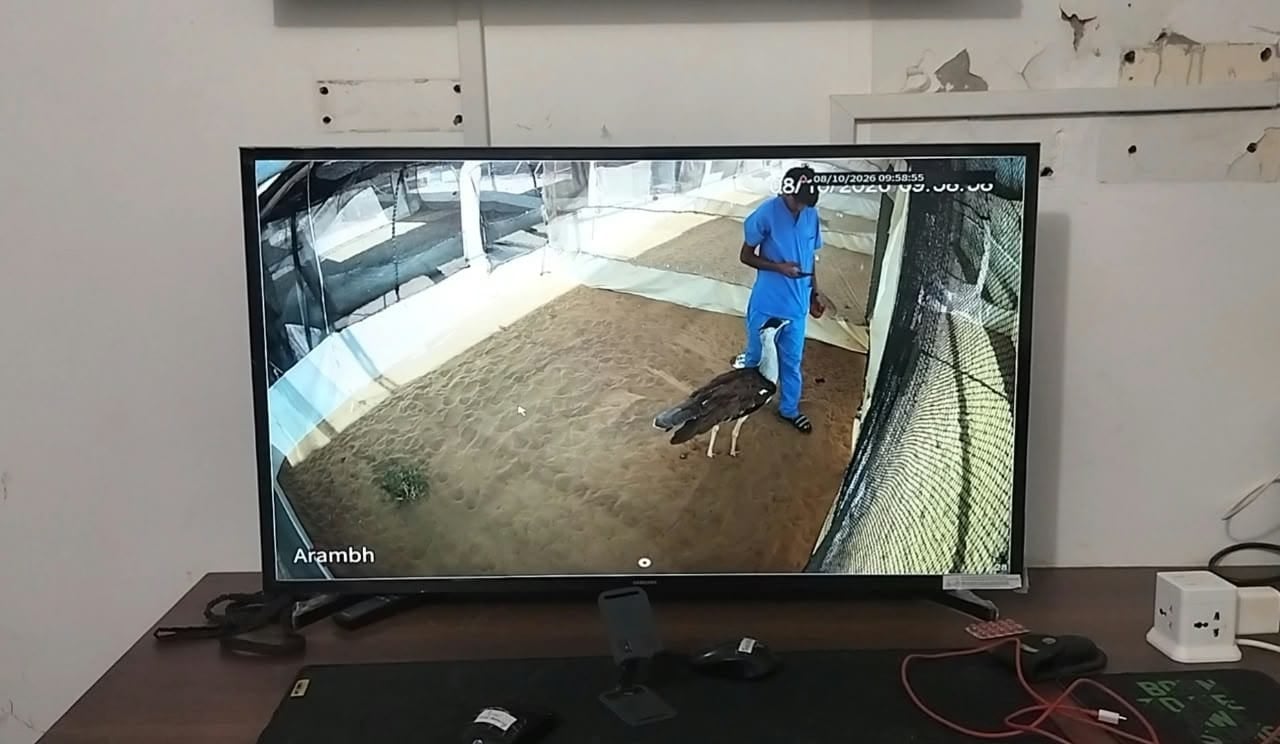
Every morning, when Sharma and Kardile arrive at the breeding centre, they begin by leaving their shoes outside, washing their hands and feet with soap, and wearing clean blue scrubs over their clothes. Inside the office, two screens let them monitor all 18 bustards currently housed in the facility’s long, shaded tunnels.
Feeding them is a five-stage ritual beginning at 6:30 am to mimic their natural rhythms. First come the high-protein pellets, sometimes watermelons, fresh desert squash or kachri, and live meals like crickets and worms. Sharma and Kardile burst into giggles as they spot Aarambh on the CCTV, the first bustard born through artificial insemination, turning mealtime into a game, pecking at the keeper’s hands and feet.
“I think the younger ones like me better. They are more open and curious with humans. The older the bird, the more skittish it gets. They tend to get anxious if more than two humans enter their cage. The older ones just want you to give them food and get out,” said Kardile.
The Great Indian Bustard’s quirks and identities are also a part of the project’s history. Sharma’s nephew, who visits the facility every few months, knows the entire flock by name.
There is Leo, the male who has fathered most of the naturally born Great Indian Bustards at the centre, including one of the recently released ones; there is Sharky, an eight-year-old female who, even as a chick, would hunt insects with “the speed of a shark”; there is Toni, who was born the day Nobel Prize-winning writer Toni Morrison died; there is Corona, who broke out of her shell during the lockdown; and there are Vyomika, Atom, Mishri and several others who hatched during Operation Sindoor in May 2025, when drone interceptions and artillery fire around Pokhran forced scientists to evacuate the birds to a nearby facility.
The names are a mark of affection, but being named means the Great Indian Bustards will never know the freedom of a cageless life. The decision to release a bird is made long before it is born.
“Based on the genetic data in the AI process, we choose the best combination of genes for the chicks we want released. It has to be decided early because when the chick hatches, we make sure it never sees a human face. It is shifted into the release aviary in Ramdevra and is kept completely isolated from humans and even vehicle noises,” said Kardile.
The researchers even wear faceless masks and “dehumanised gowns” so that the chicks never form an attachment with humans. The aviary is far bigger than any of the tunnels at Sam, allowing the birds to learn how to fly, forage for food, and prepare themselves for the wild.
“Every captive bird has a name. But for the ones we plan to release, we call them R1, R2 and so on right from the start,” she added.
Beyond the walls, a shrinking desert
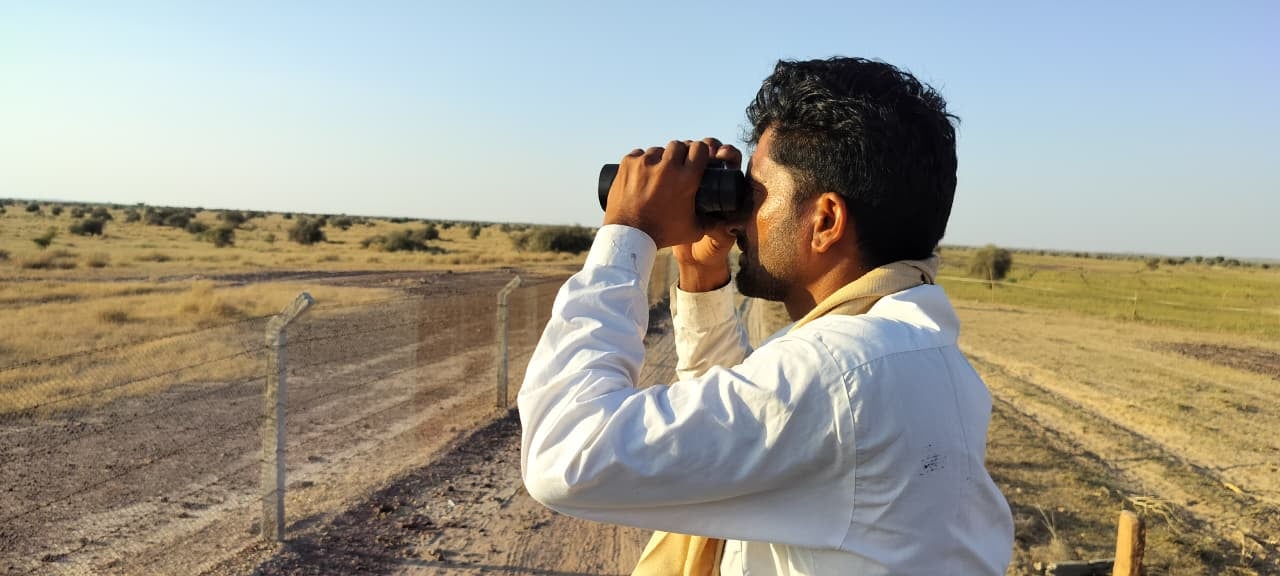
Within the breeding centre’s walls, the scientists are in control. Beyond them lies a harsher reality. Uras Khan’s open-top Gypsy sputters along the uneven tracks of the Desert National Park. One hand on the steering wheel, another clutching a battered pair of binoculars, Khan squints into the setting sun, scouring the landscape for a familiar flurry of white, the Great Indian Bustard.
Over the past two decades, Khan, a resident of Sam, has taught himself to recognise the DNP’S birds. Unlike photographers who come to the park with long lenses, Khan simply whips out his phone camera, aligns it with the binoculars, and clicks pictures to later look up their names. As the Gypsy rattles along the winding path, along the fenced mesh of the DNP, Khan spots a fleeing monitor lizard, a variable wheatear on a lone branch, greater short-toed larks hopping on the golden grass, and several tawny pipits. But no Great Indian Bustard.
“They go where there is food. When there were lots of locusts, wild berries, and insects, the Great Indian Bustard had enough to feed on. If it doesn’t rain, the natural food becomes scarce, and the population of Great Indian Bustards also drops because they starve,” he said, pointing to habitat destruction as the real culprit of the Bustard’s decline.
The DNP might be a protected area, but in the distance electrical poles stand out of the landscape like scarecrows, and hundreds of windmills spin silently. Parth Jagrani, a 43-year-old farmer, says those lands were once ancient Orans, sacred groves, that were never classified as such.
Many of these lands are still called “wastelands,” making it easy for them to be allocated to solar parks and windmills. Eventually, the Orans that once contained grasslands and shrub-strewn areas home to wildlife were razed.
“The Supreme Court has already laid down orders that power lines need to be shifted underground, but years have passed without compliance. Where lines couldn’t go underground, bird diverters were mandated. But companies only put them near main roads where people can see them, not in the interiors where lines stretch for kilometres. And they mostly installed reflective ones that only glow when light hits them at night. Do they think birds wear headlights or carry torches?” questioned a frustrated Jagrani.
The Great Indian Bustard’s anatomy makes the wires even more dangerous. The bird’s eyes sit on the sides of its skull, leaving its frontal vision extremely poor. When the heavy-bodied creature flies at low altitude, it fails to swerve or brake even if it sees a thin wire ahead.
“Previous studies have shown that power lines are a key current threat for Great Indian Bustards and associated birds. Surveys conducted in 2017-2018 in the Thar landscape have estimated that about 88,000 birds die every year due to power line-related mortalities. Power lines span a distance of about 2,000 km in the landscape and have increased manifold in the last few years,” states a WII study.
On the ground, another predator lurks: feral dogs. These aggressive packs roam the desert, and for a bird that needs a long runway to take off, they can be deadly. They hunt the birds and trample their eggs, mostly found in open sand. But according to Khan, the number of these dogs has gone down over the years thanks to sterilisation drives in the region.
While the DNP region itself might not have too many feral dogs, in villages a few kilometres away, some residents, requesting anonymity, admit they still sometimes roam the area with guns to shoot at or scare off the dogs.
“The DNP covers 3,162 square kilometers, and our primary focus is habitat protection, specifically protecting the grasslands so that fauna like the Great Indian Bustard, desert fox, desert cat, chinkara, and reptiles remain safe and intact,” said District Forest Officer (DFO) Chandrapal Singh Chavan.
Chavan and Dutta both blame the destruction of grasslands for the Great Indian Bustard’s disappearance. While much of the land has been diverted for other projects, the remaining grasslands have also been heavily grazed. The forest department has tried to limit grazing by creating fenced areas where livestock cannot enter.
Khan is sceptical of the fences. The birds, after all, fly far beyond them.
And yet, according to Dutta, the fence has allowed vegetation in the area to recover and insect populations to rise. Even though only about 5 per cent of the DNP has been fenced, it is home to nearly 80 per cent of the Great Indian Bustard nests.
“This (breeding) program has received a very high success rate, 80 per cent survival from egg to adult. And we could do so because we could work in peace and follow the scientific process. That same scientific process needs to be followed in the rewilding too. There will be obstacles, but we will find a way out, as we did with the conservation breeding,” said Dutta.
Edited by Maryam Hassan