







The grassy desert landscape of the Jaisalmer region is otherworldly. Big skies encase lazily outstretched sands. From these rise pale, creamy-yellow grasses, whose thick blades taunt urban lawns. In between these are gnarled Khejri trees.
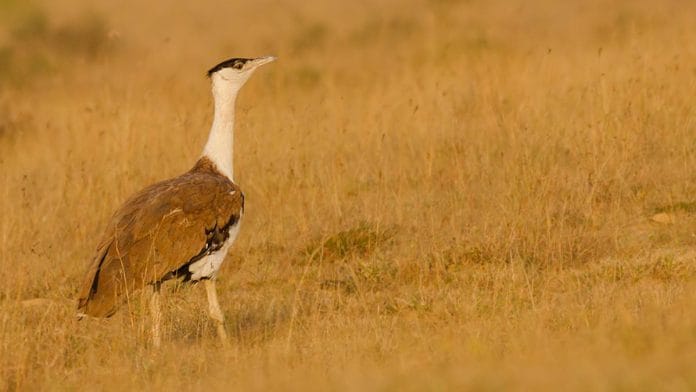
You can sit for hours with binoculars, as your eyes adapt to the camouflaged movements in this deceptively gaunt landscape. With some luck, an excellent guide, and friends who know the landscape like the back of their hand, you might see the Great Indian Bustard (GIB), Ardeotis nigriceps. The bird sports a thick line of black on its head, giving it the ‘nigriceps’ moniker. With a pale white head and neck, and an indescribable tawny brown body, it could blend with the background but for its size. The male can weigh 15 kg, almost as much as a golden jackal. Despite its weight, the bird can still fly.
I recall the hours spent watching this bird over the years as melancholically tender. I was not just observing one of the most critically endangered birds in India; I was also witnessing the fate of a step-bird.
On 1 February 1963, India adopted the Indian Peafowl, popularly called the peacock, as its national bird. The GIB, a contender for the same title, has lived in decline ever since, a step-bird, as it were.
A widely held belief is that the GIB faced this condemnatory rejection not only because the peafowl is more colourful and dramatic-looking, and more widely found, but also because of the name bustard—similar to a pejorative term for a child born outside wedlock. The bird was also known to fly across the border to Pakistan.
“They should have just used Godawan and made it the national bird,” signed an eminent scientist to me. He was referring to its local name. His deep exhalation was rooted in horrifying numbers. In the 1960s, naturalist Raol Shree Dharmakumarsinhji estimated about 1,260 GIBs across 11 states. By the beginning of this century, that number was halved. Today, under 150 GIBs exist, suggesting the bird is very close to extinction.
Conservationists vs environmentalists
The exercise of identifying India’s national bird was high on glamour but low on conservation. The idea of a national bird, anachronistic as it seems today, was a proposal from the 1960 International Council for Bird Preservation conference in Tokyo. India’s iconic birdman, Salim Ali, prophetically campaigned for the GIB as the top pick—a grand title like that could have improved its numbers and ecosystem. The Ministry of Agriculture, under which the India Board of Wildlife was housed, didn’t agree. Under the leadership of the former Maharaja of Mysore, it rejected both the GIB and the Sarus Crane.
The peafowl was already flourishing when it won the crown. What if it hadn’t been anointed? Would it be threatened by the trade in its feathers? Would its numbers be in decline? I can’t be sure; it’s too theoretical. Yet, it is an adaptable bird that is found almost everywhere across the plains today. The GIB needs a highly specific ecosystem, one that is in steady decline. Besides, the Western Indian grasslands are perfect habitat for an important route to India’s decarbonised growth: renewable energy. Ironically, this has become one of the most high-voltage clashes between conservationists and environmentalists, if such a dichotomy must be made.
I’ve travelled to the Jaisalmer region four times in the last seven years to watch the birds of the desert. I have been lucky enough to see more than one GIB every time. The largest group I have ever seen is one of seven. When they leave, it is a low, heavy flight that doesn’t take them much higher than about a hundred meters. Scientists say they can fly slightly higher too.
The solar-energised wires are at the same height as the bird when it flies. This clash electrocutes this rare creature. In 2022, seven GIBs were killed in this manner. This took place against a much-debated 2019 Supreme Court case, M.K. Ranjitsinh & Others v. Union of India. It resulted in an initial order to shift the wires underground at the cost of the companies, in approximately 99,000 sq km of the GIB habitat. This expense would have increased solar power costs by about 10 per cent or more. In 2024, the court reduced its order to apply to about 13,663 sq km.
A memorial to the Great Indian Bustard
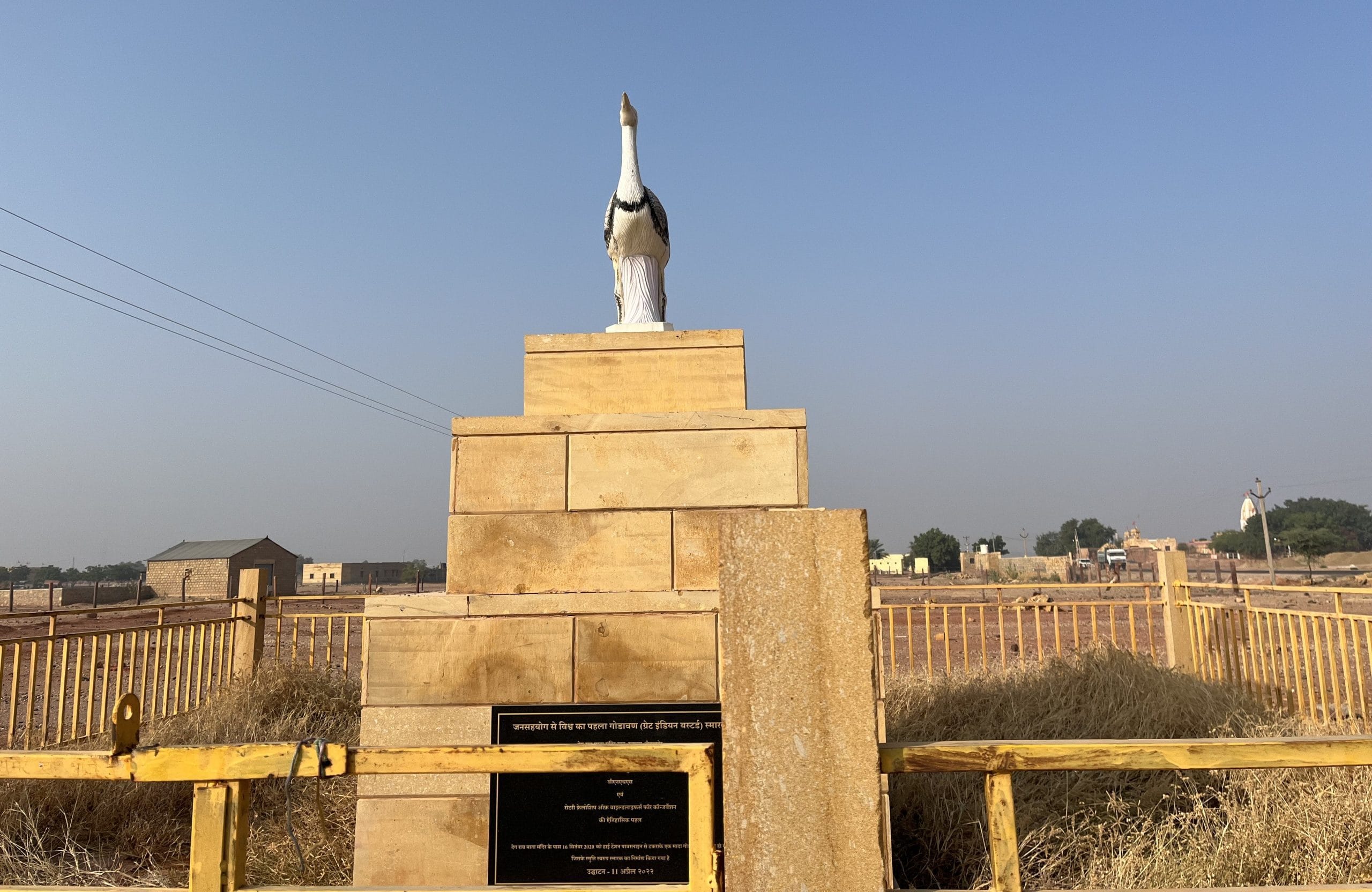
On a warm afternoon a few Septembers ago, my friends and I saw a strangely poignant memorial with the statue of a GIB on top. We stopped and tracked down Sumer Singh Bhati, who had raised funds from the villagers to build this monument of protest. In an outfit that was a blend of military structure and Rajasthani colour, he pointed out how local residents themselves experienced a form of erasure with the loss of the species. The memorial was for the first bird that died from the power lines.
Solar energy isn’t the only aspect of GIB annihilation. A walk around its habitat shows the presence of feral dogs, some of whom snatch its lone egg and attack the birds. In 2018, in a village close to the GIB range, I heard bullets. Minutes later, a rust-jeep full of villagers with a gun went by. I called out after them to ask what they had shot. “A dog,” one of them said. The jeep stopped, and I learned about the intense menace feral dogs had become. This is compounded by the GIB reproduction pace itself—the bird lays a single egg every couple of years.
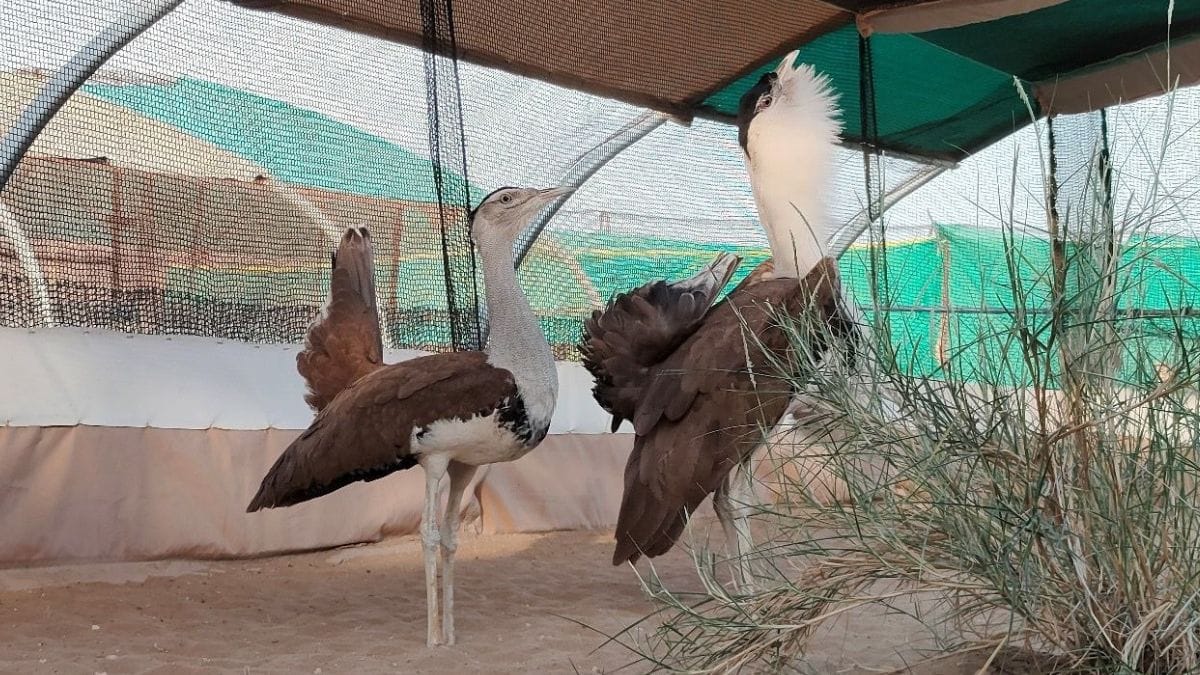
Government investment in saving the species is ongoing. Young scientists, living in sparse rooms in the GIB habitat, artificially incubate eggs, breed insects to feed the sub-adults, and spend hours in rash-causing white hazmat outfits, so the birds get accustomed to an anonymised presence that documents their progress. A young woman at the site said, quite simply, “We just want to fight its extinction. Let’s see.”
Nearly 64 years after the GIB became India’s step-bird, we should ask not how we value one, but all our 1,458 species. Should losing out on a title marginalise any species’ chances of flourishing?
Bharati Chaturvedi is an avid birder. She is the founder of the environmental non-profit organisation, Chintan India. She tweets at @Bharati09. Views are personal.
(Edited by Prasanna Bachchhav)