



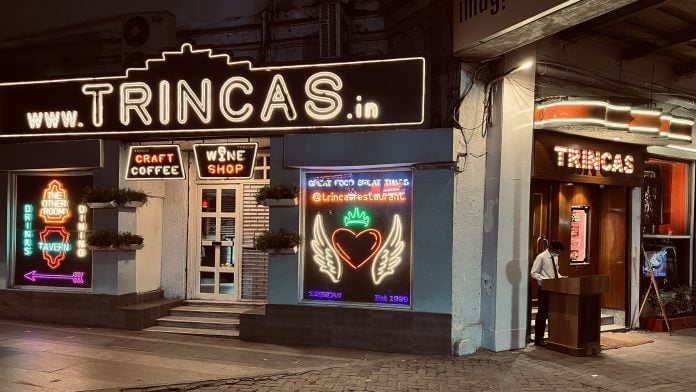
Kolkata: Trincas, at 99, still looks like the party scene from an 80s film. The red velvet curtains, the live music, the clink of glasses, and the chatter. For almost every Kolkatan, Trincas is where adulthood kicked off with their first big night out or perhaps their first sip of the “grown-up” stuff.
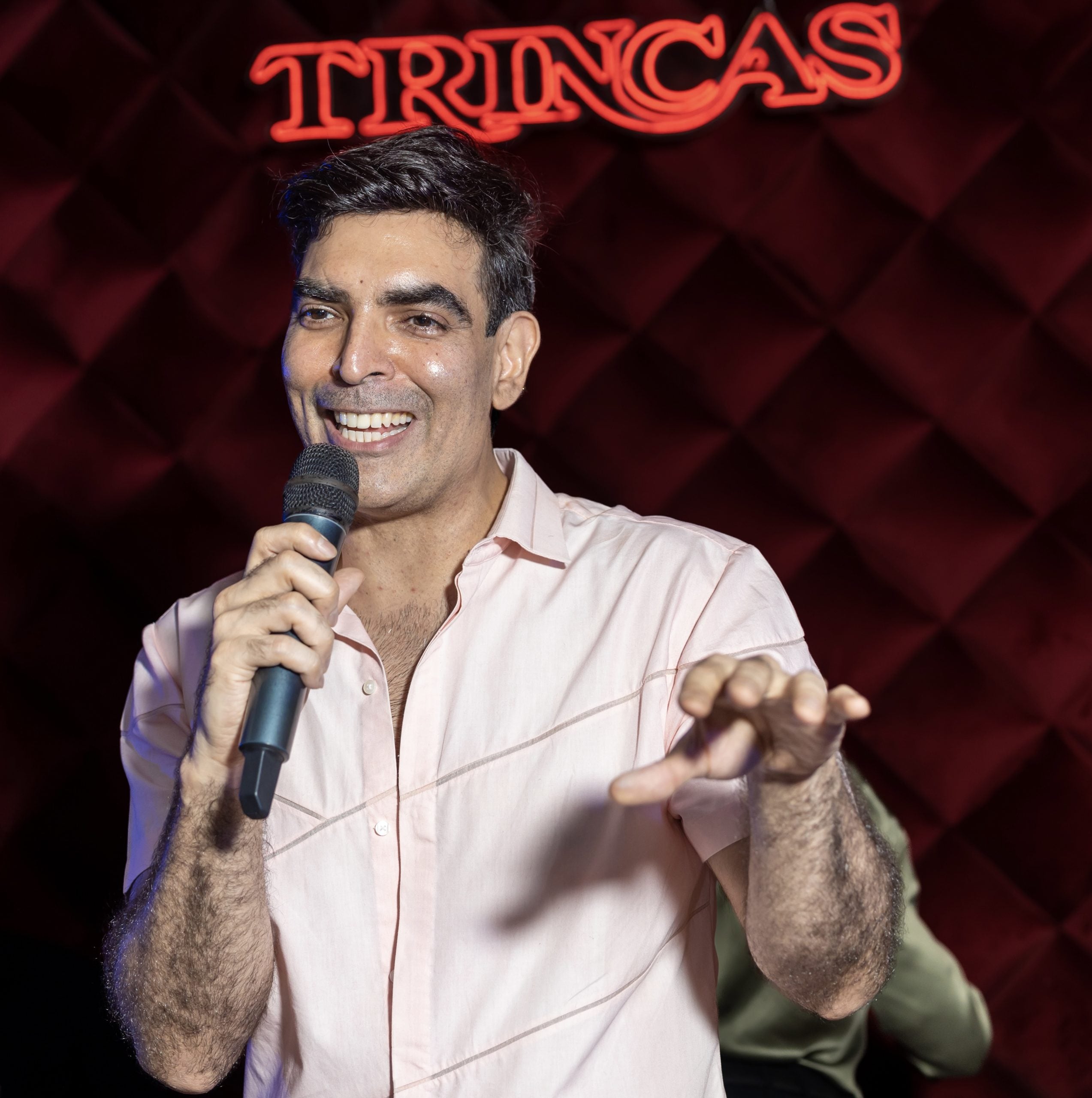
“Trincas is timeless. It’s a classic and is embedded in the psyche of the city. Completing 100 years is a milestone moment, but I want to take this nostalgia and do something with it. The idea is to use that legacy as fuel to establish a retro cool identity for future generations,” said Anand Puri, the third-generation owner.
The 45-year-old is lately in hibernation. He is scanning through all historic records, stories of his family, and drowning in the history of Trincas as well as Kolkata.
“We have planned multiple things for the 100-year celebration, including a book and a bunch of events which Kolkata will remember,” Anand said.
On Park Street, the restaurant that began as a Swiss tea room has been a nightclub, a jazz stage, a Chinese-food innovator, a queer karaoke club, and eventually, a living archive of Kolkata itself.
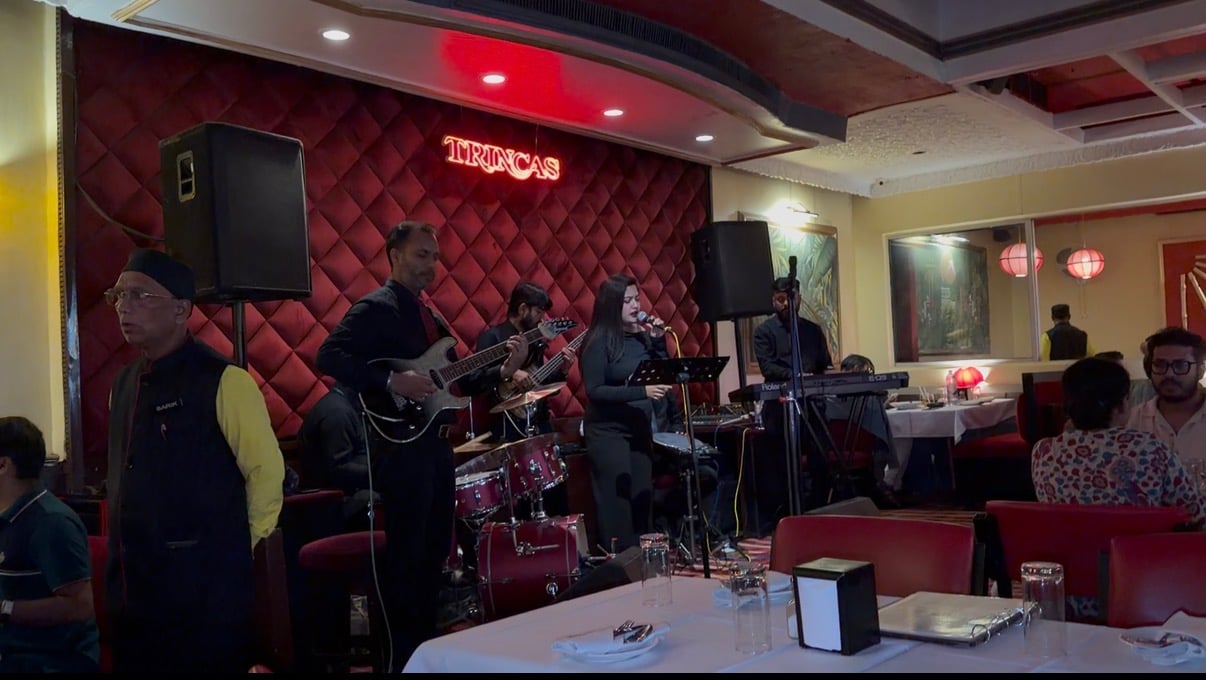
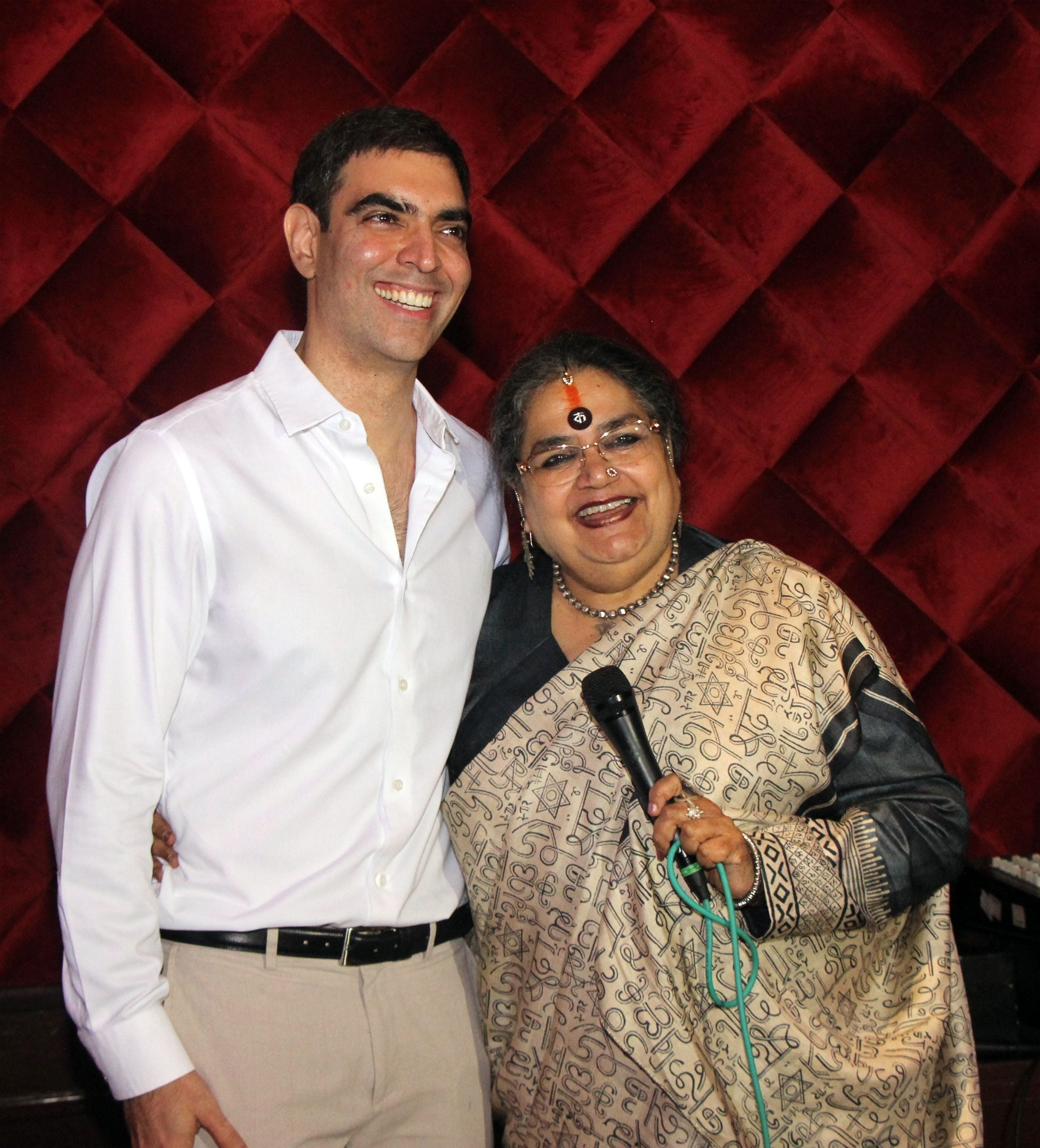
Music made Trincas famous. Bollywood singer Usha Uthup began her career on its stage. The room went on to host jazz players, cabaret dancers, and touring bands.
Hard years followed. The Naxalite unrest of the 1970s kept people home, and 1980s power cuts made air conditioning impossible, but the Puris persisted.
“Trincas has shaped generations. It has been, and will always remain, the soul of Park Street,” said Ayandrali Dutta, food writer and culinary commentator.
“There was a phase when I felt Trincas had lost some of its old-world charm. I remember wondering if the place would ever recapture the magic I had known growing up. But with Anand coming on board, the revival has been heartening. The energy is back, and so is much of what made Trincas special in the first place,” Dutta added.
Kolkata Continental, still on the menu
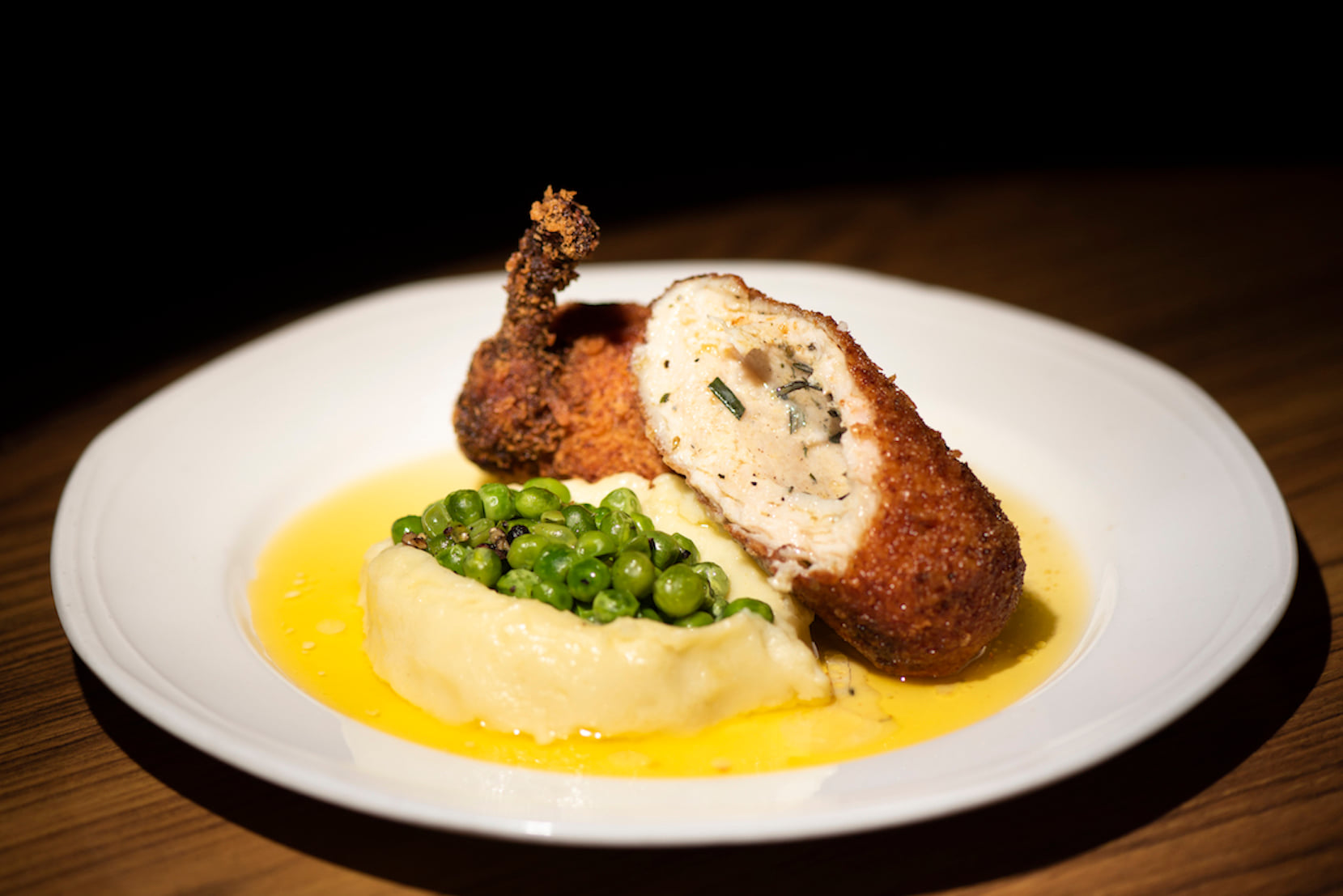
There are two ways to eat Trincas’ Chicken a la Kiev: either with sophistication or with a respect for the laws of physics.
Slice into the flattened chicken breast, and the garlic butter inside comes rushing out; sometimes it even reaches the next table. The side of mashed potatoes and sautéed vegetables helps mop up the delicious evidence.
For Trincas regulars, this is one of the restaurant’s ‘old charms.’
“The Kiev and the lobster dish, the lobster Thermidor, have tasted the same for the last 10 years,” said Chaitanya Pal, a regular at the restaurant.
Trincas also serves what its loyalists call Kolkata Continental, a local interpretation of Continental cooking, with Chinese and Indian influences. It is the cuisine of a city that has borrowed generously from different cultures, adapted them to its own tastes and, over time, made them unmistakably its own.
Prawn cocktail, fish meunière, and bekti Florentine bring a touch of old-world glamour, while lobster Thermidor, devilled crab, chicken stroganoff and sizzlers continue to draw diners. There is room for Indian favourites, too, from mutton rezala to chicken tikka. However, one customer swears by the chicken Lahori kebab.
The Sichuan secret behind the glass
The Continental menu is only half of what Trincas is known for. The restaurant’s story has another, spicier chapter.
In 1983, Anand’s father, Sani Puri, introduced Ming’s Room, a Chinese restaurant tucked behind a glass partition from Trincas’ main dining area. The idea was to give Kolkata’s increasingly curious palate something with a little more fire.
At the time, Sichuan-inspired cooking was not common. Ming’s Room helped popularise a bolder, chilli-forward style of Chinese food that would become part of Kolkata’s culinary vocabulary. At the heart of this transformation was a special chilli paste, now known as Ming ‘83.
Made with garlic and chillies, the secret sauce became a defining ingredient in dishes such as chilli garlic noodles, lamb in hot garlic sauce and Sichuan prawns.
The restaurant’s influence is visible in the small rituals that play out at its tables today. A family may settle into a meal on their fifth consecutive visit in five weeks. The server barely needs to ask what they would like to begin with. Drums of Heaven, chilli garlic noodles and golden-fried prawns are simply mandatory.
For Pal, the evolution of Chinese food in Kolkata was about introducing diners to an entirely new world of flavours.
“Cantonese and Hakka influences dominated commercial Chinese cuisine in Kolkata. It was a cuisine that spelt exotic, something for the brave and adventurous. To give context, most Kolkatans had never seen a noodle before they were introduced to Chinese food,” he said, as the live music drowned out his voice.
Kolkata’s relationship with Chinese food is unlike that of any other Indian city. It’s woven into the city’s multicultural fabric, leaving a culinary legacy that includes not one but two Chinatowns, Tiretta Bazaar and Tangra, each with its own much-loved eateries.
The food that emerged from these communities evolved over generations, shaped by migration, local ingredients and Indian appetites. Yet, Anand said he only recently discovered the extent of his own family’s role in that story.
“In the early 1980s, Sichuan cuisine was almost unheard of in India and was only served in two places: Taj Bombay and Taj Delhi. At the time, five-star dining was extremely expensive, required advance reservations, and was out of reach for most ordinary diners,” Anand claimed.
While working at the Taj hotels in Bombay and Delhi, Sani learnt Sichuan dishes from Frankie Lock, a chef who had arrived from Hong Kong. Lock had adapted the cuisine to suit Indian tastes, and Sani learnt the recipes and techniques directly from him.
Bringing those flavours to Ming’s Room meant taking a once-exclusive style of cooking to ordinary Kolkata diners. At Trincas, two culinary worlds came to coexist behind a glass partition.
“I told my father, ‘ Do you realise that it was a full-blown ‘food revolution’ in the city?’ but my father simply brushed it off as just something he had done. He is very humble and never bragged about it,” Anand said.
Also Read: Delhi’s Project Otenga pairs Northeast fine dining with mental health. ‘Not a restaurant’
Launchpad for musicians
Surinder Debakar, a retired accountant and a frequent Trincas visitor, remembers walking into the restaurant during the 70s. He spotted a woman singing in heavy vocals. She wore a sari, sported a large bindi, and sang with a voice that could stop a conversation mid-sentence.
The voice, Debakar recounted, was “damdar” (powerful) enough to command the room and hold an audience captive.
That woman was Usha Uthup, and Trincas was where her story with the city truly took flight in 1969. At a time when nightclub stages were largely associated with Anglo-Indian performers in gowns and wigs, Uthup came in her Kanjeevaram saris and bold bindis. Her performances soon became a Park Street talking point.
Looking back on five decades of association with the restaurant in 2019, Uthup, in an interview, said, “Trincas is the best thing that has happened to Park Street. It always has a wonderful crowd.” She also spoke about learning the finer points of performing from the musicians around her, discovering that a song was about more than just the person singing it.
In another interview, she summed up her relationship with the restaurant in a line that could well serve as its unofficial motto: “I belong to Trincas and Trincas belongs to me.”
Uthup’s voice soon found its way into Hindi cinema with her debut in Bombay Talkies in 1970, followed by Hare Rama Hare Krishna (1971). The English portion of the song, I love you, from the latter film, became an early milestone in a career that would span pop, jazz, advertising jingles and film music.
Where the stars came to unwind
Uthup wasn’t the only draw. Amitabh Bachchan, before becoming a superstar, was a regular visitor during his years in Kolkata. During a recent episode of Kaun Banega Crorepati, he recalled the concentration of restaurants along Park Street, naming Trincas alongside Mocambo and Blue Fox.
“Hum log bahut bekaar log hote the. Yeh humara raat ka entertainment hota hai. Park Street mein ek line se lage hue the yeh sab, Trincas, Mocambo, Blue Fox. Maine aaj tak duniya bhar main aise kahi nahi dekha hai ki ek street par itne saare ho,” Bachchan said. (“We were a pretty idle lot, and this was our night entertainment. They were all lined up on Park Street… I have never seen so many on one street anywhere in the world.”)
International performers passed through, too. Engelbert Humperdinck performed at Trincas early in his career, and musicians such as Chris Perry, who later pursued opportunities in Bombay’s film industry, also performed, according to Anand.
Apart from them, the Kapoor family was also there. “The Kapoor family has a long association with the restaurant. Karisma Kapoor visited Trincas while shooting a film…her father, Randhir Kapoor, frequented Trincas across generations, from the 1960s to the period when my father was here in the 1990s and 2000s,” Anand said.
“Half of Bollywood in the 1960s has visited Trincas,” he added.
Live music has long been part of Kolkata’s restaurant and bar culture, and its spirit survives in newer venues such as AMPM and Little Bit Sober, where live bands remain central to the experience.
However, Debakar says there aren’t any popular names in today’s live music circuit.
“Maybe 20 years from now, some of these boys and girls will also be singing in Bollywood. But there is no talent like Uthup nowadays,” he said.
Burmese refugee, Lahori teenager
Anand’s eyes light up whenever he talks about Trincas. The restaurant’s history seems almost woven into his memory, passed down through generations along with the stories of the people who built it.
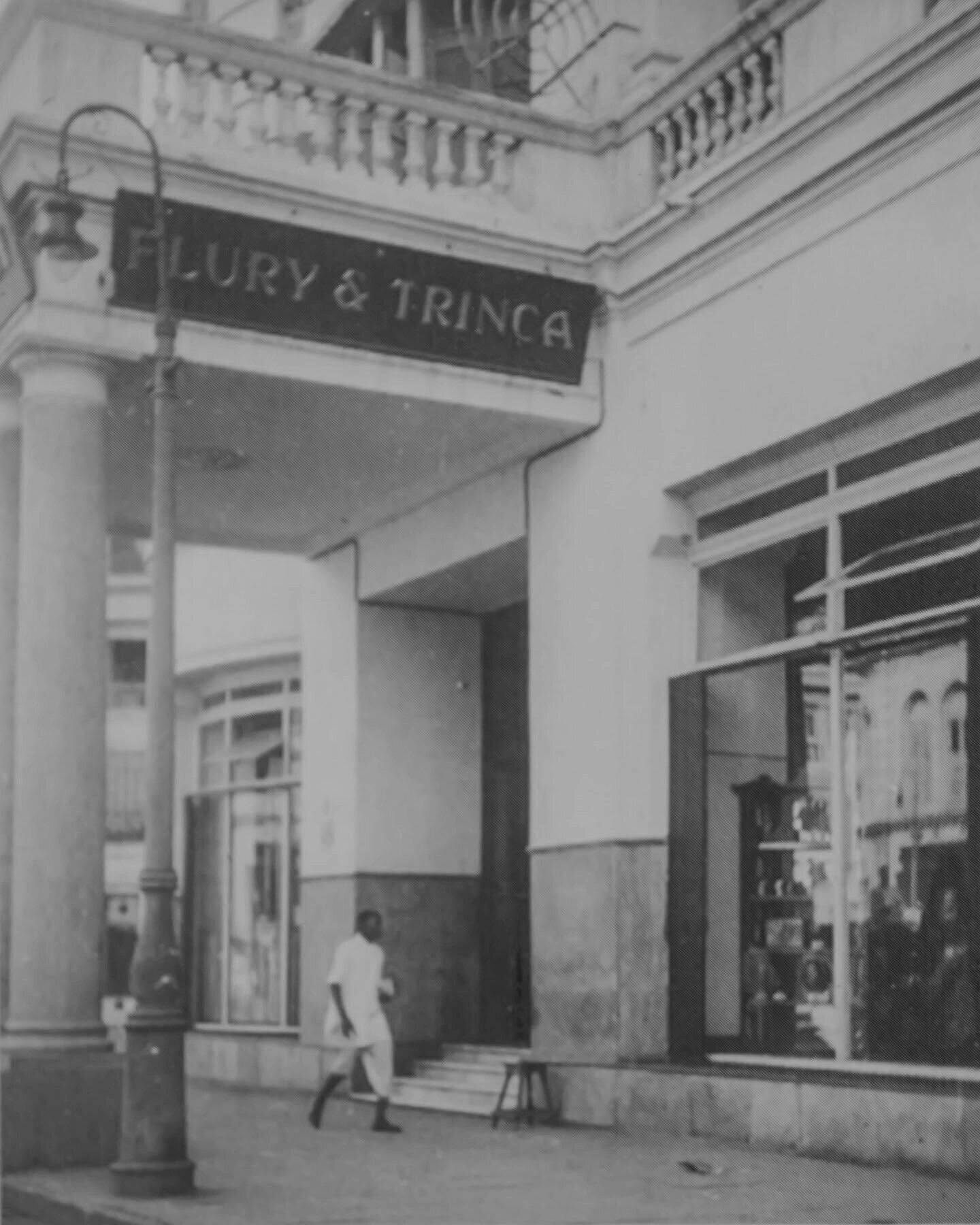
Trincas began as Flury & Trinca, a tea room run by Swiss partners on Park Street in 1927. When Quinto Cinzio Trinca and Joseph Flury parted ways in 1939, Flury retained the original premises, while Trinca moved across the road to 17 Park Street, where the restaurant stands today.
In 1959, as Trinca prepared to return to Switzerland for retirement, two friends stepped in to take over. Ellis Joshua, a refugee from Burma, and Om Prakash Puri, who had arrived from Lahore at the age of 18, bought the restaurant and carried its legacy forward.
“Nobody thought to change the name,” Anand said.
For a while, business flourished. But Kolkata’s changing political and economic climate soon began to take its toll. The Naxalite unrest of the late 1960s and 1970s kept people at home, and by the 1980s, frequent power cuts became another challenge.
The loss of air conditioning made long afternoons and evenings uncomfortable, forcing the restaurant to weather a difficult period.
Yet Trincas held on. Its familiar name, established clientele, and association with Park Street’s live-music culture helped it survive as the city changed around it.
The memory project
By the time the third generation of the Puri family took charge, Trincas had become more than a restaurant. It was a repository of memories, with stories of first dates, favourite songs, family dinners and nights spent listening to live bands woven into its history.
In 2019, Anand returned home after spending nearly a decade away for his studies and work.
However, when he did step into the business, he didn’t attempt to change the face of the restaurant or the food that was served. Anand understood that every diner at Trincas has nostalgia in their heart. So, his strategy was to capitalise on that nostalgia.
And that is why he set out to build a community-based memory project, called the Trincas Timeline Project.
“I launched the Trincas Timeline Project to collect memories, the collective memory of the patrons, and document the people and moments that had shaped the institution because no single individual could possibly remember a full century of history,” Anand said.
He turned into a self-described “hermit,” spending months immersed in books and archival research. He reached out to Kolkata’s vast global diaspora, now spread across Canada, the US, Australia, Europe, and the Middle East, by reaching members of Facebook history groups like “Kolkata photographs and memories” which have between 15,000 and 30,000-plus members each.
Through the project’s page, he discovered old, rare photographs of Trincas, Park Street, and Kolkata spanning back several decades. People recalled how groups of five teenagers would order just one Coke and one coffee between them so they could hold a table, dance, gossip, and enjoy local adda.
There was also the ‘Borrowed Dinner Jacket (DJ)’ tradition. People in their 70s and 80s shared memories of showing up for formal evening dining and borrowing a jacket from Trincas’s rack of spare dinner jackets at the entrance whenever they forgot to bring their own.
“Some even shared personal milestone memories, from having their very first drink at Trincas to holding 22nd and 90th birthday celebrations at the exact same tables,” Anand added.
As Trincas approaches its centenary, these recollections are more than anecdotes from a restaurant’s past. They are a record of how one address has seen generations of Kolkata growing up, going out and returning to the same tables.
(Edited by Maryam Hassan)