





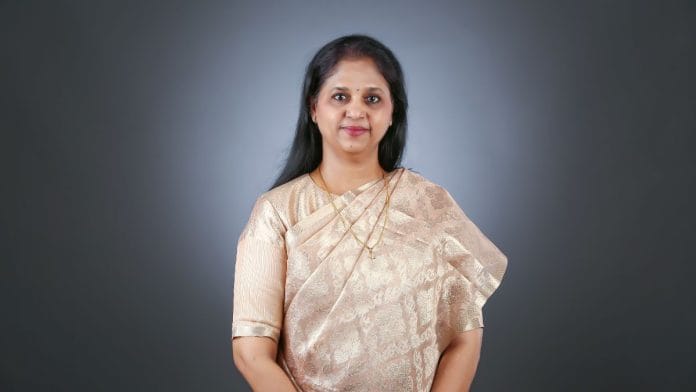


New Delhi: For generations, St. Stephen’s College represented a certain idea of elite education in India — one rooted in liberal arts classrooms, debating societies, academic excellence, and a long tradition of producing public intellectuals, civil servants, and political leaders. Its next principal comes from a very different world.
Professor Susan Elias, who will become St. Stephen’s first woman principal on 1 June, is a computer scientist whose work has focused on artificial intelligence and interdisciplinary engineering research. Her appointment arrives at a moment when Indian universities are increasingly grappling with questions around technology, employability, and the future of liberal education itself.
“In the pre-independence era when St. Stephen’s was launched, India needed leaders. So till date it produces the best leadership for India. But today India needs entrepreneurs. India needs youths to create more jobs and India also needs research scientists. We need to keep our country ahead of its time,” Susan Elias told ThePrint.
In an announcement dated 12 May, Rt Revd Dr Paul Swarup, Bishop of Delhi and chairman of the college, announced Elias’ appointment.
“The Supreme Council of the College is pleased to announce that Prof Susan Elias will take charge as the XIV Principal of the College and as its first lady Principal with effect from the 1st of June 2026,” the statement said.
If you look at my profile, I wouldn’t be a fit to St. Stephen’s as it is today. But if you look at where you want to see St Stephen’s moving forward, then I’m a fit.
– Susan Elias
A minority institution with a 50-per cent reservation for Christian students, St. Stephen’s is among India’s oldest and most prestigious liberal arts and sciences colleges. Ranked third among colleges in the country in the 2024 NIRF rankings, the institution has historically been associated with academic excellence and leadership in public life.
Elias’s appointment, however, signals a possible shift in emphasis — toward research, entrepreneurship, and emerging technologies.
A computer scientist and academic administrator whose career has largely unfolded within engineering institutions and research leadership roles, Elias brings to St. Stephen’s a profile markedly different from the humanities-heavy leadership traditions often associated with the college.
From engineering classrooms to St. Stephen’s
Until a few months ago, Elias was charting out the future of another university. St. Stephen’s was not part of the plan.
Most recently, she was serving as Pro Vice-Chancellor (Research) at Chandigarh University’s Lucknow campus, where she had joined in January and was preparing a five-year roadmap for the university when St. Stephen’s unexpectedly entered the picture.
Her engagement with the college began in March this year after she was invited to Delhi University as a subject expert for the recruitment of computer science faculty.
During the interviews, she realised many applicants came from engineering backgrounds and that her own qualifications technically made her eligible for positions at St. Stephen’s as well.
“I never associated myself with St. Stephen’s because I’m from an engineering background. But when I came here, I realised I could probably have worked here years ago.”
Around the same time, she learned that applications for the principal’s post were still open in the second round of recruitment. She applied, attended interviews in Delhi, and was eventually selected. The appointment, she said, was “totally unexpected”.
“I was on a different track at the university as a Pro Vice-Chancellor, all set to become the Vice-Chancellor probably in a year. And suddenly this was a whole different kind of opportunity,” she said.
Elias acknowledged that her profile may initially appear unconventional for St. Stephen’s.
“If you look at my profile, I wouldn’t be a fit to St. Stephen’s as it is today. But if you look at where you want to see St Stephen’s moving forward, then I’m a fit.”
A principal unlike its predecessors
Elias’s appointment is also significant because it departs from the traditional leadership profile associated with St Stephen’s. Founded in 1881, the college has historically been shaped by principals rooted in theology, liberal arts, and the humanities. Many of its earlier leaders came from backgrounds in history, philosophy, literature, and church administration.
Even in later decades, the principals largely emerged from humanities subjects. Elias’s predecessor, John Varghese, holds a doctorate in English literature. Before Varghese, Valson Thampu (2008-2016) held a doctorate in theology, and before him, Anil Wilson (1991-2007) also came from an English literature background.
Elias in contrast has built her career almost entirely within engineering institutions and research administration.
According to her LinkedIn profile, she completed her Bachelor of Engineering in Computer Science and Engineering from Bharath Institute of Science and Technology in Chennai in 1991, followed by a Master’s of Engineering in Multimedia Technology and a PhD in Multimedia Communications from Anna University. She later pursued postdoctoral research at IIT Madras in Membrane Computing.
In my experience, it doesn’t matter what discipline you come from when you want to run an institution. It’s important that you have good views, a liberal outlook, and a balanced approach to academics.
– Dinesh Singh, former DU Vice-Chancellor
Over the past three decades, she held senior academic and administrative positions across multiple engineering and research institutions. She served as Dean of the School of Electronics Engineering (SENSE) at Vellore Institute of Technology (VIT), Chennai, where she also worked as Deputy Director of the Centre of Advanced Data Sciences. She later became Director of Research and Head of the Digital Health & Bio-Innovations Centre at Hindustan Institute of Technology and Science.
Her research has focused on artificial intelligence, machine learning, medical imaging, robotics, and digital health, while also intersecting with entrepreneurship and startup mentorship. She has served as principal investigator on five DRDO-funded projects and says she deliberately chose roles centred around research and innovation throughout her career.
That background, Elias says, is precisely why she was selected.
“They were looking for a profile which had strong research skills and something that could bring into the campus what is not there”.
Elias said that over time, she was increasingly pushed into leadership positions with “research in brackets”, allowing her to build funding pipelines, mentor researchers, and shape institutional innovation ecosystems. “I brought in a lot of funding when I was Dean at VIT,” she said.
Elias argued that while St. Stephen’s already possesses a strong legacy in leadership and liberal education, research and entrepreneurship remain comparatively underdeveloped spaces within the campus ecosystem.
“These two are missing on campus and these two are my strengths,” she said. “Without disturbing their legacy, I will be able to bring this as a value addition.”
She is also confident that emerging technologies such as artificial intelligence will increasingly shape even traditionally liberal arts disciplines. “I don’t think humanities and social sciences are yet AI-empowered. In any profession, people using AI will replace people not using AI. Now I want to make the college AI ready and aware of the next big wave, which is the quantum computing era.”
Continuity and change
Among St. Stephen’s alumni, Elias’s appointment has prompted both celebration and deeper reflection about the future direction of one of India’s most recognisable colleges.
Congress MP and alumnus Shashi Tharoor welcomed the appointment on X, writing: “Since women were admitted as students in 1975, it’s about time a woman was allowed to lead the College too.”
Rajya Sabha MP Sagarika Ghose described the development as a “proud and historic moment”, writing on X that Stephanians, “past and present”, were delighted to welcome the college’s first woman principal.
For Saket Misra, Member of Uttar Pradesh Legislative Council and St. Stephen’s alumnus, the appointment marks an overdue institutional milestone — though he argued that the more important question ultimately remains one of academic leadership rather than gender alone. He called the move “a breath of fresh air.”
“If she can ensure that the college maintains its educational standards, I am overjoyed,” he said, adding that greater representation and visibility for women within campus life would be a welcome outcome of the appointment.
At the same time, Misra expressed some caution about how technology and artificial intelligence are being framed within higher education conversations today. In his view, AI should function as a tool to strengthen teaching and research rather than become the defining identity of a liberal arts institution.
“There is no point trying to make St Stephen’s College into an engineering college,” he said, arguing that the institution’s long-standing strengths continue to lie in both the humanities and pure sciences, particularly disciplines such as economics, physics, and chemistry.
Still, he acknowledged that institutions like St. Stephen’s cannot remain insulated from wider changes in education and employment.
“The world moves on and if we don’t move with technology, we’re not going to be talking a lot,” he said, describing technological literacy as increasingly necessary for employability and research.
St. Stephen’s once became known for students who excelled not only academically but also in debating, sports, and public life. “The strength was in churning out people who were still connected with the masses and tried to do service,” Misra said.
He also argued that the social composition of campuses has changed substantially over the decades. While St. Stephen’s once drew heavily from privileged educational backgrounds, today’s student body, he said, is far more aspirational and socially diverse, shaped by economic pressures and a stronger focus on career-building.
“Today students are much more focused on creating opportunities for themselves,” he said.
What makes a good principal
Former Delhi University Vice-Chancellor Dinesh Singh also welcomed Elias’s appointment. He pushed back against the idea that St. Stephen’s has historically been defined only by the humanities and public life. While acknowledging the institution’s liberal arts legacy, he noted that the college has long maintained strong science departments as well.
“St. Stephen’s has had disciplines of mathematics, physics, chemistry for at least 60 years,” he said.
For Singh, the more important question was not the academic discipline a principal comes from, but whether they possess the intellectual temperament required to lead a university institution.
“In my experience, it doesn’t matter what discipline you come from when you want to run an institution,” he said. “It’s important that you have good views, a liberal outlook, and a balanced approach to academics.”
Singh also situated Elias’s appointment within a longer history of women in higher education leadership, recalling Hansa Mehta — who was a freedom fighter, a Constituent Assembly member, and the first vice-chancellor of Maharaja Sayajirao University of Baroda — as an example of transformative institutional leadership that transcended disciplinary credentials.
“She was one of the best vice-chancellors India has had,” Singh said. “So let’s not worry about that.”
Singh linked the appointment more broadly to the changing direction of Indian higher education under the National Education Policy (NEP), which places greater emphasis on interdisciplinarity, undergraduate research, and innovation-driven learning.
“The NEP calls for a healthy mix through a trans-disciplinary approach, a hands-on pedagogy connected to the real world. For the first time collectively, from a central level, we are being asked to bring in innovation and research at the undergraduate level in India,” he said.
In that sense, Singh suggested, Elias’s research-oriented and technology-focused background may align with wider shifts already underway across Indian universities rather than represent a sharp break from them.
Also read: Inside the secret makeover of Nalanda Museum. India’s tryst with pride & pain
Studying the past for the future
Even as Elias speaks about entrepreneurship, artificial intelligence, and research, she insists that her vision for St. Stephen’s is not about radically remaking the institution overnight. Instead, she says her first priority is understanding how the 145-year-old college built and sustained its reputation in the first place.
“I want to study their model because whatever they produced were the best in India then and now,” Elias said.
For her, the challenge is not simply introducing technology-oriented pathways into the college ecosystem, but ensuring that any new direction retains what she calls the “St. Stephen’s brand”.
“Whether we are producing entrepreneurs or whether we are producing scientists, it has to have that brand sense,” she said. “Even though the rest of the country produces entrepreneurs, we need to have that something special when we produce them.”
Her approach, she suggested, will likely be gradual rather than disruptive. While conversations around her appointment have centred heavily on AI, interdisciplinary education, and employability, Elias said she does not see curricular transformation as something that can happen immediately. Instead, she envisions introducing value-added courses, certification programmes, and technology-oriented interventions alongside the existing liberal arts structure before any larger curricular integration takes place.
Elias also addressed the attention surrounding her becoming the first woman principal in the college’s history. While she described breaking the “glass ceiling” as meaningful, she said she did not believe the selection committee was searching specifically for a woman candidate.
“I don’t think they were particularly looking for a woman. They were looking for a profile which had strong research skills and something they could bring into the campus that is not there.”
She argued that what ultimately distinguished her candidature was the combination of teaching, research, entrepreneurship and administrative experience accumulated over three decades in academia.
“The combination is what is difficult to achieve. That is something which helped me stand out.”
At the centre of Elias’s vision, however, remains students. Despite spending most of her career within engineering institutions, she said she is particularly curious about engaging with students from liberal arts and humanities backgrounds.
“With 35 years, the best part of my career is the students. I’m a very student-centric person. I want to sit with them and observe and learn how they learn,” she said.
(Edited by Aamaan Alam Khan)