





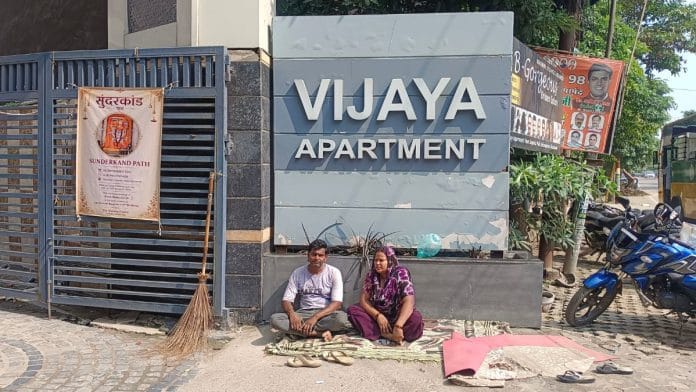

Ghaziabad: For more than 20 years, 65-year-old Gopal Singh has worked inside Vijaya Apartment in Indirapuram, Ghaziabad, cleaning lanes inside and outside the society and handling its waste. Now, he is lying on the pavement outside the society’s main gate with his family to protest against working conditions and his termination.
The two-day-old face-off with the Indirapuram Residents’ Welfare Association (RWA) has a longer history. At its heart is the RWA’s demand that Singh and his family segregate the building’s waste with his bare hands.
It is part of a larger pattern of growing tensions between RWAs and building workers across Delhi-NCR – a spectre that has a far-reaching impact on how RWAs rule their societies and formulate rules.
On Monday, Singh began a protest and hunger strike outside the society, hoping to save not only his own job but also the livelihoods of four members of his family who also work there as sanitation workers. The family refused to segregate garbage and demanded that they be given safety gear first.
On Tuesday morning, members of the Valmiki Samaj, a charitable trust, also joined the protest outside the society gate, raising slogans against the RWA members.
Protesters, holding brooms in their hands, raised slogans such as “Santosh Singh murdabad” and “Vikas Vajpayee murdabad”, against the RWA members.
The protest began after the RWA handed the workers a handwritten termination letter on Sunday, asking them to stop working from Monday onward. The letter accused them of misbehaving with staff members and residents.
For Singh, who has spent more than two decades working inside the same society, the letter came as a sudden blow. By the next day, the gate that he had entered for years was shut to him.
“Your service has been terminated, and you can come and collect your money any day after 7.9.2026,” the handwritten letter reads.
Turning the society’s main gate into the site of a growing protest, the five sanitation workers now demanded that the RWA withdraw the termination and questioned why they had been removed without, they said, any prior notice or explanation.
“We have been working here since before the RWA was formed, but now they are terminating us without giving us any prior reason,” said Anuj Singh (34), Gopal’s son. “The RWA is doing this because of their ego. We refused to segregate garbage with our bare hands and asked for proper safety and hygiene measures,” he said.
Safety, dignity and demand for change
But the confrontation at the gate is only the latest chapter in a dispute that has been brewing for more than a year.
Tensions began to escalate after the current RWA took charge. Since then, disagreements over work, wages, and conditions have repeatedly pitted the workers against the residents’ association.
“It has been more than a year since the new RWA was formed, and they have been trying to remove us and bring in new people who will work for less money and under their conditions,” said Anuj.
At the core of the dispute lies a question that has long confronted sanitation workers across the country: whether hazardous cleaning and waste-handling work can be carried out safely and with dignity.
Demands for protective equipment, safer methods of sewer and manhole cleaning, proper hygiene measures, and timely wages have long been part of sanitation workers’ struggles. Workers continue to enter sewers, handle waste and perform hazardous cleaning work despite the risks, often with little choice but to accept unsafe conditions.
But that equation is changing. Increasingly, workers are questioning tasks they consider dangerous and demanding protective equipment. At Vijaya Apartment too, the newer generation of sanitation workers refused to segregate waste with their bare hands and, on some occasions, declined to enter sewers without adequate safety equipment.
Soon, these refusals and disagreements became a flashpoint in the workers’ relationship with the RWA.
However, members of the residents’ association rejected the workers’ allegations as baseless. They said the decision to terminate their services was not arbitrary, but came after residents and the RWA jointly found negligence in the workers’ duties.
“There have been several complaints from residents and other workers regarding the sanitation workers, including delays in completing their duties and inappropriate or abusive behavior toward others. After discussing the matter with the residents, the RWA has decided to terminate their services”, said a RWA member on the condition of anonymity.
Beyond job loss, allegations of harassment
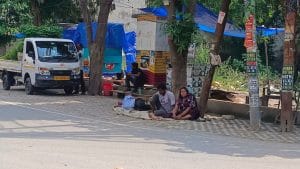
Anuj, along with his father, wife Lata, aged 35, and two brothers, aged 30 and 32, sits in a corner near the society’s main entrance.
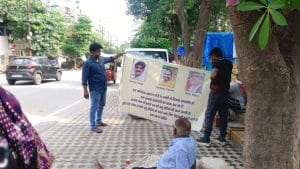
A broom placed beside them symbolised their work as sanitation workers, and a poster accusing three RWA members of abusive behaviour towards the workers was also put up at the protest site on Monday afternoon.
The protest was not only against the termination of their employment but also alleged harassment towards women workers like Lata.
Recalling an incident from 28 June, Lata said that the family lodged a complaint at the Kanawani Police Post in Indirapuram alleging molestation and the use of caste-based abusive language.
“They asked us to clean the sewer by entering it. When I said my husband would do it the next day, they started making casteist remarks, calling us ‘bhangi’, and threatened to dismiss us from work,” she said. “They touched me inappropriately multiple times and passed comments about me,” Lata alleged.
In July, Anuj and his family submitted a complaint to the National Commission for Scheduled Castes (NCSC) against the RWA manager and members, alleging the casteist remarks.
Several residents expressed concern and support for the sanitation workers, although they did not come forward publicly.
“This is just an ego issue for the RWA members who are in a position of power. They think, how can someone who has less power and money than them say no to them?” said a resident of Vijaya Apartments, speaking on condition of anonymity.
“This is completely unjust. We have seen the RWA doing this to the family for the last one year, seemingly just to remove them and satisfy their ego.”
Domestic helpers, residents and passers-by stopped to photograph the protest and ask those gathered why it was happening. Some called it an example of cruelty by the RWA toward poor and marginalised communities.
Police at the Gate
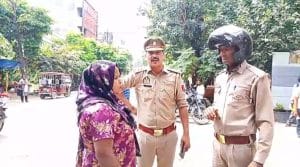
Later on Monday afternoon, police reached the protest site following the commotion and asked the protesters to leave the area. The officers instructed them not to enter the society premises without permission.
“Don’t create any litter or noise here, or we will take you to the lock-up,” one police officer shouted at the protesters.
“We received a complaint that they were littering the society premises as part of their protest. However, no formal complaint has been filed against them yet,” another police officer at the site said.
On Monday, Anuj and his wife Lata also submitted a complaint to the District Magistrate, Ghaziabad, alleging harassment, pressure to withdraw a police complaint, and termination of their employment.
“The police are not registering an FIR. The residents for whom we worked are not coming forward to help us, and the RWA is threatening us like goons, asking us to withdraw our complaints, end the protest, and leave the society,” said Lata.
Lata added that her family had been harassed and mentally tortured for the past year and a half.
Blame Game and Justice
As the family continued its sit-in protest, they appealed to other sanitation workers to join them in the fight against their termination. But they found no support from other workers or their unions.
“If we join them, the residents and the RWA will target us as well, and our work will also be affected. What will we do then?” said another sanitation worker employed in a different block of the society.
“The police, authorities and everyone are always on the side of people with money. They are wasting their time sitting in the sun and asking for justice,” he added.
The RWA’s Version
Denying the allegations, the RWA said it had received multiple complaints about irregularities in the family’s work.
The RWA member alleged that multiple complaints had been raised against the family by the society’s maintenance manager and other workers, including allegations that they had abused people and argued with them when asked to do their duties properly.
“Residents had complained about their work, and we took a mutual decision and issued them a termination letter,” said an RWA member, speaking on condition of anonymity.
He further claimed that after an argument between the workers and the RWA in July, communication between them broke down.
He said even some residents had stopped speaking to the sanitation workers, fearing the family might file complaints against them, including under the Scheduled Castes and Scheduled Tribes (Prevention of Atrocities) Act.
“Now, residents and even other workers are afraid that they may file a complaint against them or invoke the SC/ST Act. Their whole family works there, and they just want to dominate the area by themselves,” the RWA member said.
Amid the competing allegations, the family continues to sit outside the society, demanding justice.
“We don’t want money or the advance they are offering us to leave the work. We want our jobs back,” said Lata.
Edited by Maryam Hassan