


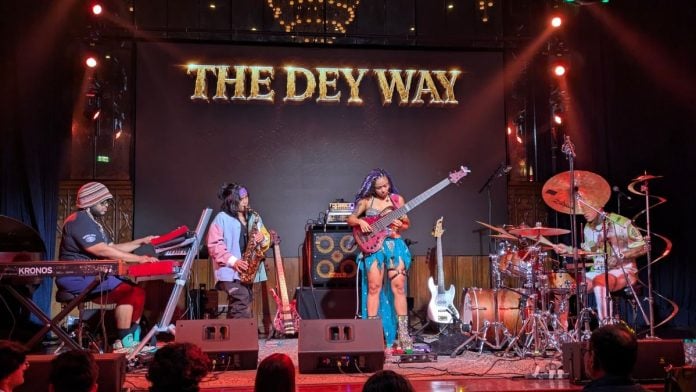
New Delhi: The bass guitar is often the instrument you feel before you see. The low notes hold a song together, giving the drums something to lean against and the melody a foundation to rise from. But at The Piano Man in Delhi, Mohini Dey was doing something rather different. She took the familiar rhythmic syllables of Carnatic music, sang them out to the audience and then reproduced them on her bass, moving between Indian percussion and jazz with a speed that left little room to catch one’s breath.
The room watched as the woman with the bass guitar became the centre of the performance. Dressed in a blue two-piece outfit with Indian embroidery she designed herself, gold waist chains, and embellished boots, her long curls falling around her shoulders, Dey moved between the instrument and interacting with the audience with the ease of someone who had spent most of her life on stage. The rest of her band stepped back for her solo, giving the instrument — and its player — the room.
“For those who don’t know, I learned to play the bass from my father. He was also a bass player,” she told the crowd before playing ‘Joy,’ the song that she wrote for her father, who had introduced her to bass and taught her to play it. After his death in late 2023, she wrote the song for him. “He gave me music as a gift.”
The spotlight was now on the musician who has spent much of her career playing alongside some of the biggest names in music. Dey was headlining the Delhi show with her own band, performing material from her latest album, The Dey Way. Released on 20 July 2026, Dey’s 30th birthday, the eight-track album marks another step in her journey as a composer and bandleader. She has been touring internationally, with nearly a million followers on Instagram and over 2 lakh people cheering her on on YouTube.
Forbes India described her as the “Most Successful Musician Under 30.” She is among a small but growing group of Indian women who have made professional careers out of an instrument traditionally dominated by men. Other Indian women bassists such as Shalini Mohan and Nilanjana Ghosh Dastidar have also helped change the picture. Dey, however, has built a career that stretches well beyond the Indian music circuit.
Mentored by jazz keyboardist Louis Banks and drummer Ranjit Barot, she began performing professionally as a child. She went on to spend eight years playing with AR Rahman’s band, collaborating with musicians such as Steve Vai, who called her a phenomenon, Jordan Rudess, Guthrie Govan and Stanley Clarke.
In 2024, Dey joined Willow Smith’s band, performing on NPR – American National Public Radio – Tiny Desk Concert series and The Tonight Show Starring Jimmy Fallon.

Dey’s story is not one of a young musician accumulating impressive credits. It is also about a daughter negotiating her father’s ambitions, a musician finding an identity beyond being a sought-after sideman, and a performer who treats the stage as an extension of her music, fashion and personality.
Her online presence is equally expansive. She has a YouTube account with over 200,000 subscribers, where she regularly posts updates about her life, as well as videos of her performances. Her Instagram account has nearly a million followers
“Playing bass is one part of who I am,” she told ThePrint, “and I’m proud of the full picture.” She lists herself as “an influential voice, an innovator, a creator, a fashion designer, the founder of a social media marketing company, a composer, a producer, a vocalist, and a bass guitarist.”

The beginning, the training
Dey’s life was surrounded by music long before she could understand what a career in it might look like. Her mother is a Hindustani classical singer, while her father, Sujoy Dey, was a session bassist who worked with Bollywood composers, including Laxmikant-Pyarelal, and played in jazz fusion groups around Mumbai. Her younger sister, Esani, plays the guitar.
“Music was always floating in the house,” she said in a 2024 interview with Rick Beato. “I’m Bengali, and all Bengali families always have some type of art-related things growing up – either it’s painting or dancing or singing or something.”
Music became the chosen art form that Dey’s father raised her with. He always dreamed of having two children: one a bassist, and the other a drummer. He raised his two daughters in pursuit of his dream.
When she was three, her father was practising at home and put his headphones over her ears. She began tapping out the rhythm on her lap, keeping time with the music.
“That’s when he realised, I’ve already got rhythm in me,” she said, smiling at the memory.
Her father made her a small wooden bass guitar, one she could handle before she was big enough to play a proper instrument. He became her first teacher, introducing her to the discipline of regular practice.
She woke up every day at 5.30 am and was in school by six. She reached home by 12.30, and right after lunch, a private tutor taught her for nearly three hours. Then came the tutor’s homework, then school homework, then a snack, and finally her father’s lessons and homework, which went on late, usually around 9 pm. He taught her scales and tunes, and made sure she was practicing along. After lessons, she would have dinner and sleep, and in the morning it began again.
“He was a very hands-on dad, controlling, but, again, his intentions were really good,” she said. “He wanted me to be independent because he didn’t want me to struggle like him and my mom.”
He never sent her to music classes to eliminate any possible distraction.
The home-classroom had a soundtrack. Her father played her Mark King, Victor Wooten, Jaco Pastorius and Weather Report, and drummers such as Dennis Chambers. When she tried to watch fashion shows on the family television, he would change the channel to a musician he wanted her to learn from.
“In those early years, I practised for five to six hours a day, but what mattered most was what I was learning during those hours,” she said in an email response. “They weren’t just music lessons; they were life lessons.”
Dey said the start shaped everything that followed.
“Starting so young, on an instrument my father built for me, made the bass feel like a natural part of my life,” she wrote. “It taught me dedication, hard work, and resourcefulness—that even when you don’t have the financial means, you can find a way.”
The family did not have much money growing up in Mumbai. Her father worked long hours as a session musician, and the household often ran on a tight budget.
“I know what it feels like to have very little. We lived paycheck to paycheck, but my parents worked hard and saved to give my sister and me the best education they could and invest in our futures,” she said.
The training, however, did not always come without resistance. Dey was interested in fashion and wanted to become a designer. She began rebelling against her father’s strict routine in her early teens, and arguments became frequent. She has recalled being locked in a room when she could not get a musical passage right.
She eventually applied to a fashion college without telling her parents. After her Class 12 examinations, three opportunities arrived within weeks of each other: admission to fashion college, a full scholarship to Berklee College of Music, and a place in AR Rahman’s band.
She chose Rahman’s band; that way, she could continue pursuing fashion alongside music. She now designs most of the clothes she wears on stage.
A child prodigy always in demand
By the time most children her age were still learning long division, Dey was drawing a salary. Having started performing professionally at the age of nine, she grew up in studios and on stages.
At 11 years, she met Ranjit Barot, a friend of her father’s, who brought her on tour with his band. She auditioned for him with a Victor Wooten tune in five, and he took her under his wing. After school, she would head to his Nirvana Studio and sit in while visiting bassists such as Jonas Hellborg and Dominique Di Piazza played. She watched, and she asked questions. The drummer Gino Banks, with whom she would later form MaMoGi, has known her since the same age.
“It was great, kind of like a master class for me just sitting there and watching them play,” she had said, reflecting on the early lessons.
The invitations for her to perform kept following. At 14, she accompanied the American jazz guitarist Mike Stern on his India tour. In her teens, Rolling Stone India noted, she had played for everyone from Zakir Hussain to Barot and AR Rahman. Visiting musicians would hear that a little girl in India played bass, and they wanted to try her out. Many of them kept her close.
Then, the call from Rahman came.
Dey met Rahman through Coke Studio, where she was already in the house band. She was reported to have been in his backing band for eight years, playing on his film scores and on tour. He was impressed enough by her drumming and tapping on the bass to build a project around vocalists with Dey as the only instrument.
Her early professional years taught her a new language of music.
She played with Carnatic instrumentalists, playing kanjira, mridangam, morsing, and she heard tabla players do things she had not thought possible. She wanted to recreate the sounds on the bass, so she mapped the tabla onto her instrument.
The low register became the bayan, her thumb the strike, and the plucked notes the sharper chatti. She started using her third finger to play faster. The rhythmic training in konnakol, the spoken syllables of South Indian percussion, changed how she heard time.
Her training in Carnatic music and her expertise in bass together gave birth to her very unique fusion style.
For years, Dey remained the sought-after sideman.
She recalls hearing Rahman tell another musician how incredible she was on the bass, and she remembers being told that he had been trying to get the Australian bassist Tal Wilkenfeld for his band, until he heard her play.
“That was a big compliment,” she said.
Others who have played with her talk about her in the same terms.
Gino Banks, a close friend and frequent collaborator, said what she does is “commendable and one of a kind,” pointing out how few women play bass anywhere in the world, let alone in India.
The guitarist Rhythm Shaw, who has often performed with her, called her one of the few hardcore bassists around. Bass Magazine has praised her mix of passion, virtuosity, versatility and stage presence.
Dey’s self-titled debut album arrived in 2023. It brought together rock, jazz, R&B and funk with Carnatic rhythms and konnakol vocals. One of its tracks, “Introverted Soul”, had been written when she was 13.
The album also featured an impressive roster of collaborators, reflecting the musical relationships she had built over the years. Her second album, The Dey Way, released in July 2026, continues that approach.
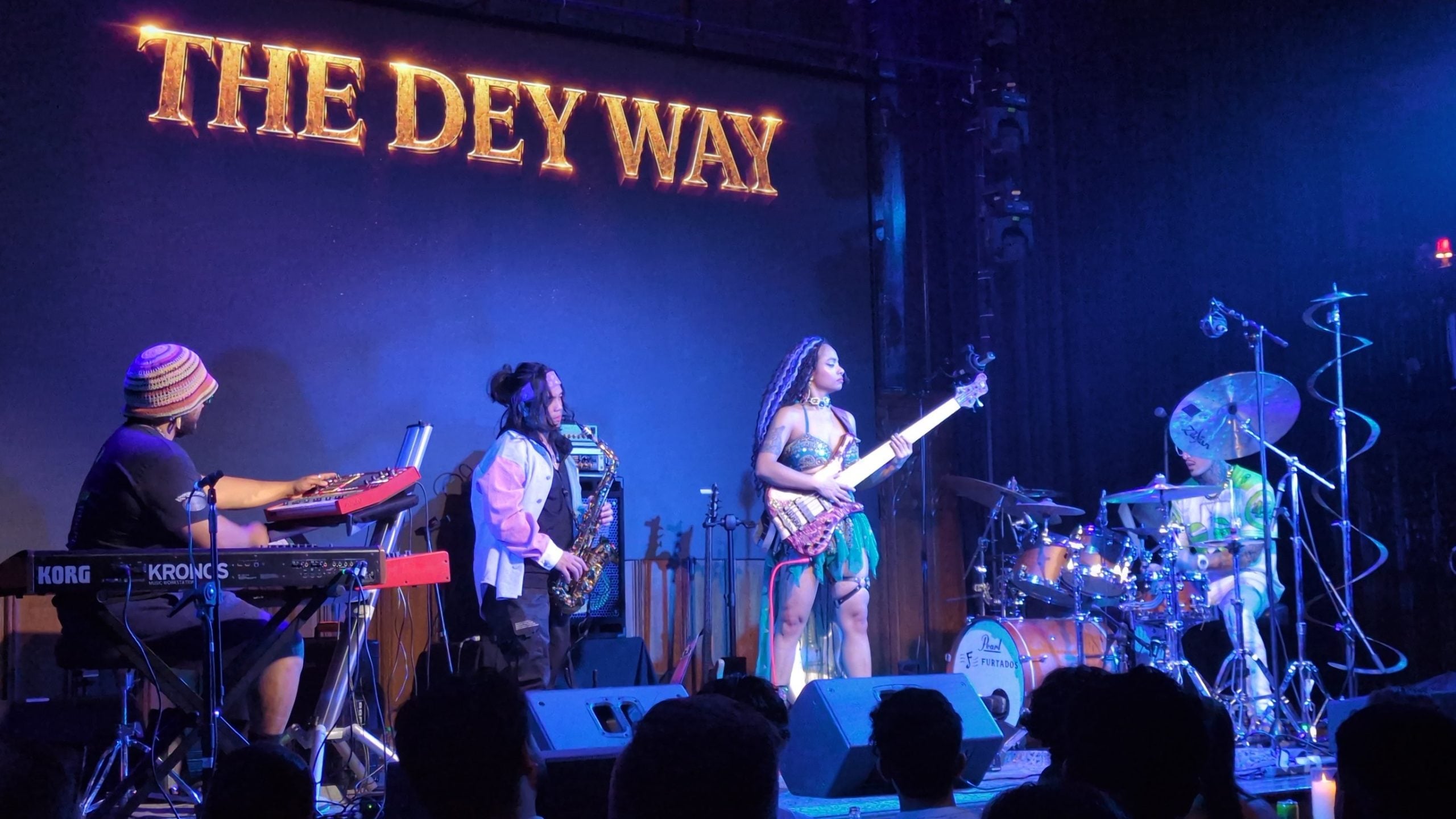
Dey has spoken about the importance of the people she works with, particularly Willow Smith, whom she calls a favourite.
“Just the soul she is,” she said. “I felt like I had already met her. It didn’t feel like I met her for the first time. The first day I met her and we made music, we both just connected like soul sisters.”
She has a long list of musicians she would like to work with in the future, including Bruno Mars, Doja Cat, Lady Gaga, Janet Jackson and Herbie Hancock.
“But I have never approached life by chasing a particular name or outcome,” she said.
Also read: Assam ‘Snake Doctor’ built a Venom Army to save lives. Now India is studying his model
Inherited strings
Sujoy Dey, her father and first tutor, died in late 2023.
By then, the quarrels of her teens had given way to a warmer relationship with him. She moved out of her parents’ home at 17, and for nearly three years she did not speak to him. She wanted to prove that she could do it on her own.
“I believe things happen for a reason,” she said, “and I’m grateful for everything that has happened and everything still to come.”
The father and daughter eventually reconciled, and she describes the last three years of his life as beautiful. She has said that she still catches herself reaching for her old strings to give him, as he liked to use them, before remembering that he is no longer there. After his death, she also learnt that he had taught for free and quietly helped neighbours.
“He was always looking out for people,” she said, “but never looking out for himself.”
Dey has spent her adult years deciding what to keep and what to let go. She kept the bass, and she kept the clothes. She kept the Carnatic phrases from the South and the jazz she grew up on, and she found a way to share a stage between them.
“My dad put me on this train and I didn’t know where the destination was,” she said in an earlier interview. “And I still feel like that.”
(Edited by Ratan Priya)