





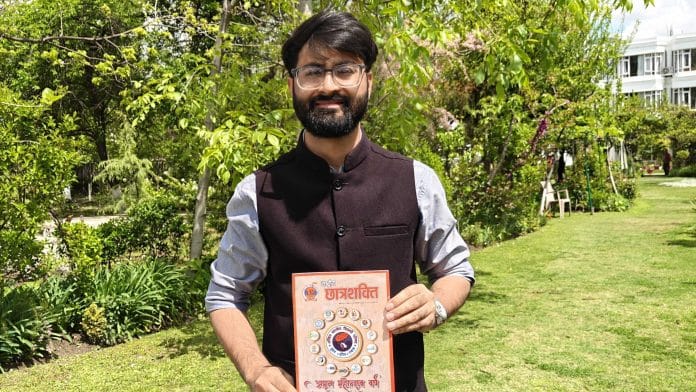



Srinagar: In his modest room in the LoC district of Kupwara, a Class 8 boy pinned a tiny tricolour to his wall. That was in 2012. It was an act of love for his country but he couldn’t afford to be loud about it. In Kashmir back then, such displays were rare and risky. That boy, Akeel Tantray, a 25-year old Kashmiri Muslim now leads the Akhil Bharatiya Vidyarthi Parishad, the student wing of the Rashtriya Swayamsevak Sangh, in the Valley.
“Times have changed. Back then, holding a tricolour in public invited trouble. Now, it does not,” said Tantray, ABVP national executive council member. “Before 2019, even admitting you were with ABVP was difficult. Today, I say it openly.”
ABVP is on a silent rise in a Muslim-majority Kashmir. Its leaders are now coming from an unexpected quarter: Kashmiri Muslims. The organisation is growing roots into campuses one student grievance at a time.
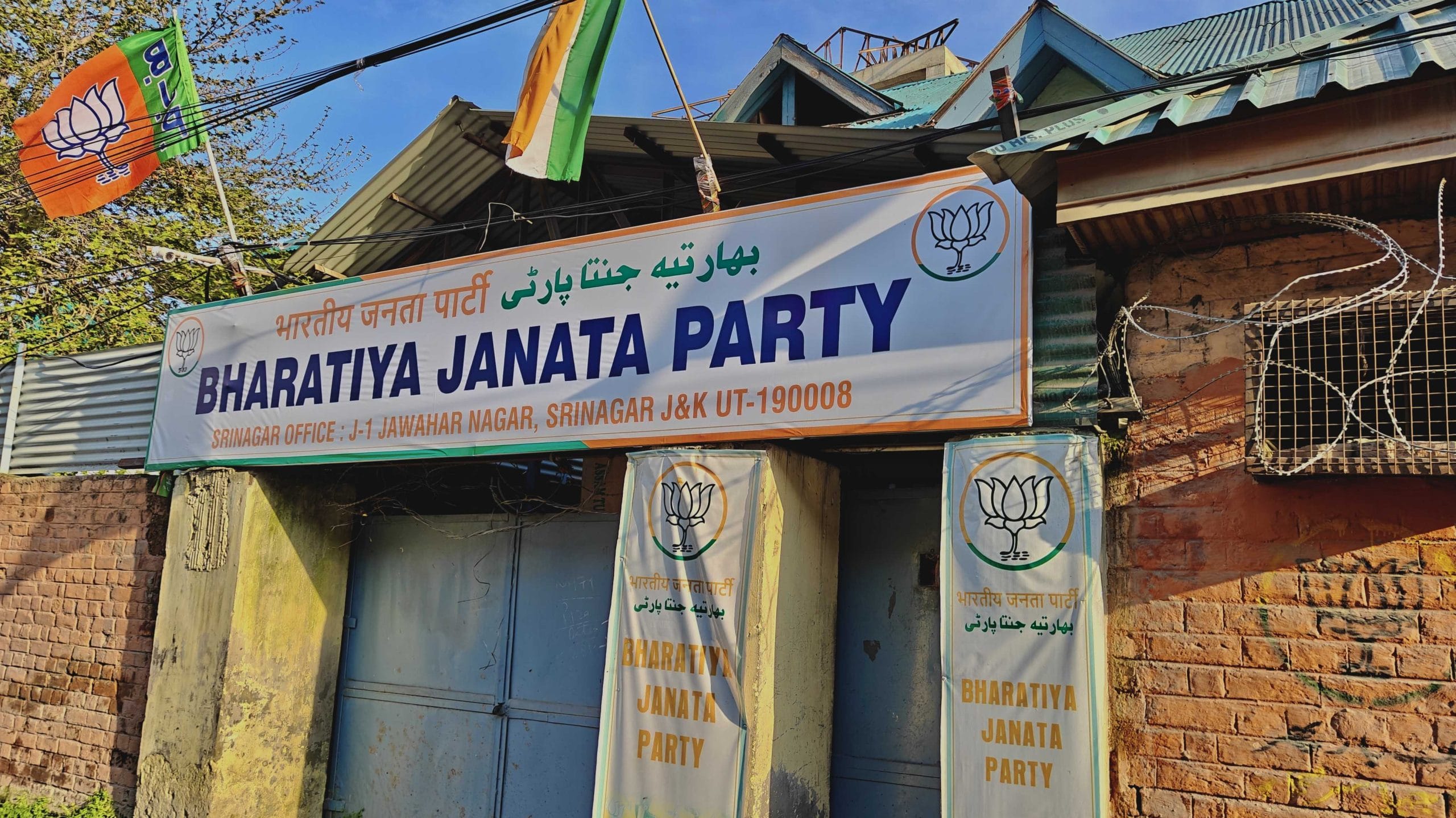
The Kashmiri wing of the ABVP is unrecognisable from its counterparts in Delhi or Prayagraj. There are no signs marking the presence of ABVP in the valley. Even outside their office located in Srinagar
It has customised itself for Kashmir, a region where student activism has historically been either suppressed or instantly politicised as part of the larger conflict. The ABVP isn’t promoting RSS ideology here. There is no talk of a Hindu nation. There are no shakhas. The emphasis instead is on increasing presence on campuses and building a cadre. Its politics is interested in sticking to student issues, from exam delays to financial distress.
ABVP members, for instance, distribute second-hand books to students who cannot afford it, building goodwill at the ground level. Last year, ABVP Kashmir launched a student helpline to assist Kashmiri students studying outside the valley. It has, at times, extended support to student protests as well, including those against delays in examinations. And it is engaging with students on broader topics like global warming.
Even with RSS as its parent body, the student wing maintains a deliberate distance from the BJP in Kashmir. Be it organising camps or carrying out membership drives, it never reaches out to the BJP.
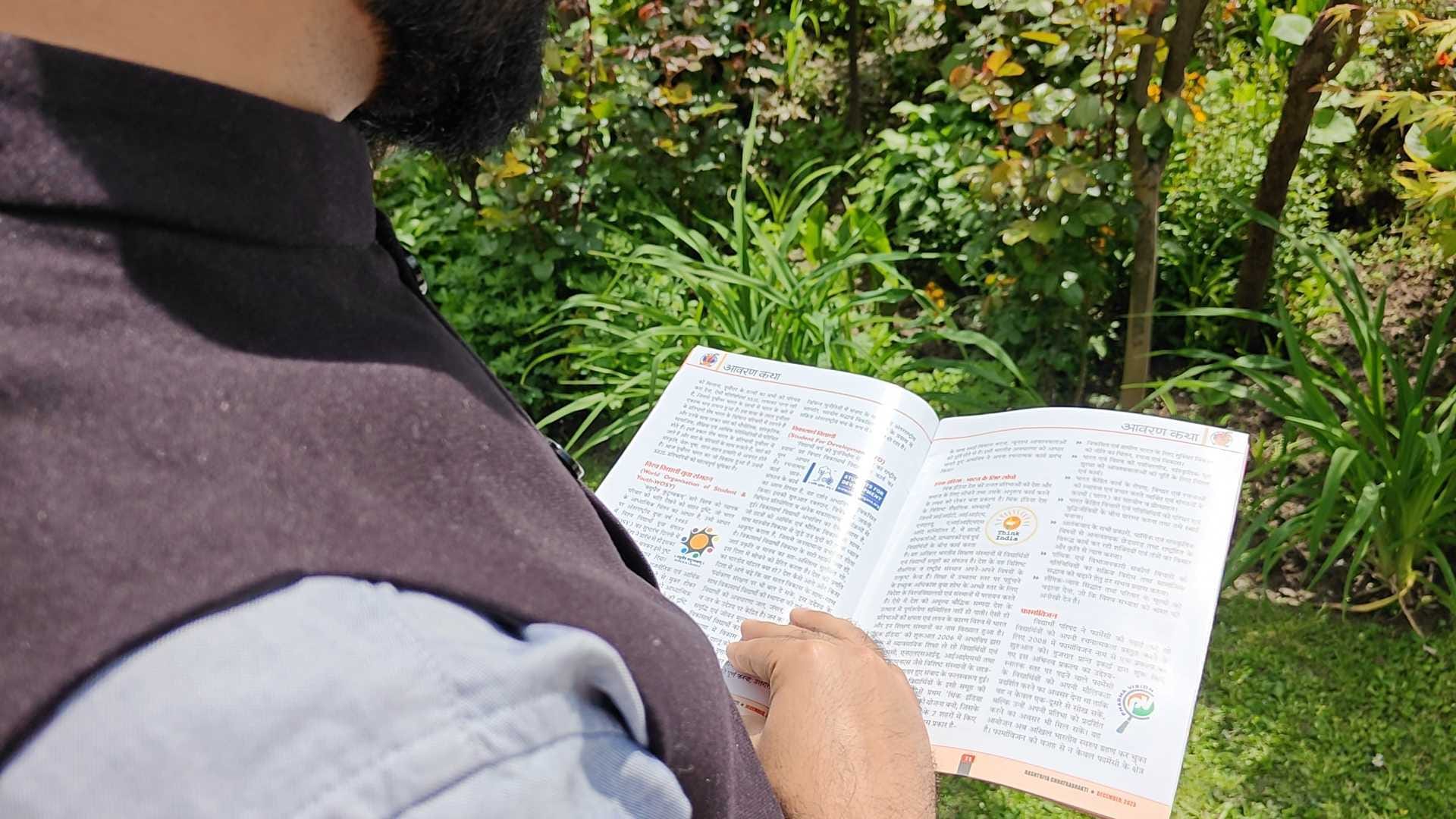
Some of the members fear their organisation’s name will repel students. So, they keep their identity concealed at first and reach out through ABVP-backed platforms such as Students for Seva, Students for Development and Voice of Students. Once they build credibility with students, they gradually reveal who they are.
Also read: DU protest ban has united rival student groups. ‘ABVP, NSUI, Left are all together’
The rise of ABVP in Kashmir
Following the abrogation of Article 370, when Kashmir simmered under curfew and internet blackout. A different churn was underway on the ground. Students began registering with ABVP. In 2019, the organisation had around 300 registered student members. In 2026, that number has risen to 2,643.
The ABVP already has units in Kashmir University, Cluster University and SKUAST. Tantray said they are also operating in seven colleges including Amar Singh College, SP College Bemina and Womens College.
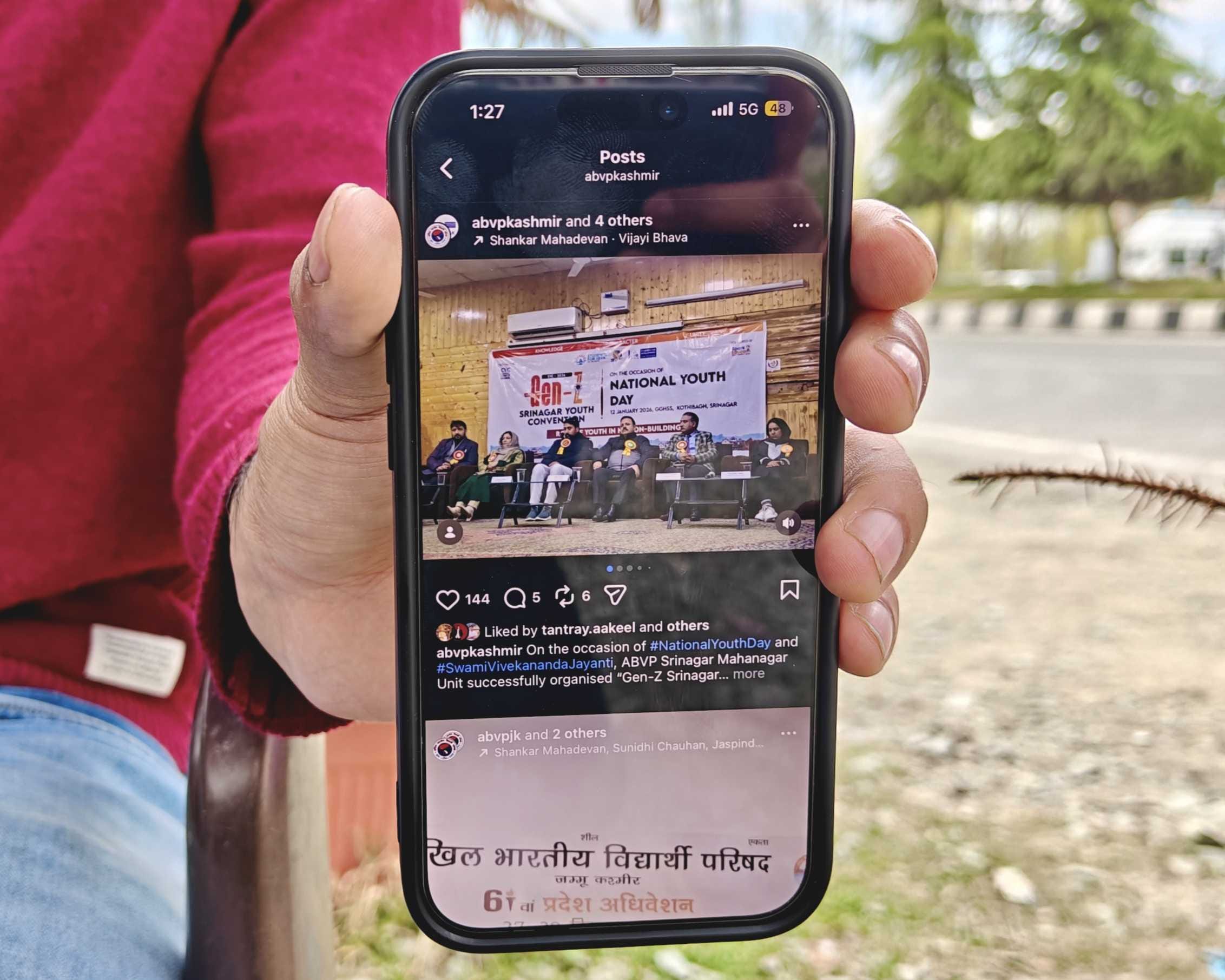
The student wing has built a WhatsApp network across all ten districts of Kashmir where students are updated on the upcoming programmes. It is organising events on Gen Z nation building and felicitating not just the meritorious students, but also those who scored above 75 per cent in exams.
“When students lead, the nation progresses,” reads ABVP Kashmir’s social media pages.
And it is not limiting itself to Kashmir. It’s taking up issues of Kashmiri students outside the Valley.
But many of its members hide behind the tag of social activist. They fear backlash in a society where the idea of nationalism is still grappling to take a firm root.
Nasir Khuehami, who heads Jammu and Kashmir Students Association, the biggest student body in the Union Territory, and has been active in student politics for over a decade, traces the rise of ABVP to the political vacuum.
“After the abrogation, we saw a kind of political orphanage,” Khuehami said. “There was no elected government. Everyday student issues were not being addressed. For five to six years, there was no democratic setup.”
In that vacuum, he said, students began looking for access. “They felt that if their issues had to be heard, they needed to be closer to the power corridors. That is where ABVP came in.”
Across party lines, student wings struggled to keep pace. Khuehami said that he has barely seen the student wing of mainstream political parties take up student issues actively.
“Be it National Conference, PDP or Congress, their student bodies have not expanded in any serious way. NSUI is almost defunct. Even NC, despite being in power, has not put in the resources to build its student wing. I have not seen them consistently taking up student issues, whether it is harassment or intimidation,” he said.
National Conference had an active student wing till 2017, after which it was dissolved. And most of its senior members moved to the youth wing. The Peoples’ Democratic Party is following a similar pattern with its students wing mostly inactive.
“We are working on rebuilding our student wing. After 2017, priorities shifted and student issues took a backseat. However, our youth wing is active in Kashmir, while our students wing continues to work in Jammu,” said a National Conference member.
RSS national publicity in-charge Sunil Ambekar said that behind ABVP’s growing visibility in Kashmir lies years of sustained ground work and trust-building.
“In 2003, I visited Kashmir as national secretary and met people there. We have also remained in touch with Kashmiri students across India, so this has been a long process of building the ground,” Ambekar said. “Back then, there was no scope to come out publicly, but as terrorism weakened, our presence grew.”
For Tantray, days are not far when Kashmir, too, will be home to shakhas.
Who leads?
In a narrow bylane in Srinagar, Tantray’s rented residence doubles up as an ABVP office, functioning quietly under the constant watch of BSF personnel. There are no sign boards or markers of the student association. To a passerby, it’s another house.
Even the internet throws up an arbitrary location for the ABVP office in Srinagar.
Tantray is an ABVP full-timer, the first in Kashmir. He said he has given himself completely to the organisation. Under Tantray’s mentorship, 22-year-old Shakir Rashid from Anantnag joined as a full-timer. A 20-year-old part-timer in Baramulla wants to emulate Tantray.
Tantray has left his family and may not even marry if the work demands it. Tantray has visited his parents only twice in the last two years, and that too, secretly.
“I don’t even let my parents know that I am coming. I enter the house at dusk and leave at dawn. I don’t want my affiliation to pose a threat to my old parents,” said Tantray.
Every time he organises a Tiranga rally, he receives threats on WhatsApp. He recalls one message reading, “Karo tum Sangh ka kaam… hum tumhe dekh lenge.” (Keep doing the Sangh’s work, we’ll see how long you can keep at it) But he doesn’t budge. He simply blocks these numbers.
He has become accustomed to such threats now.
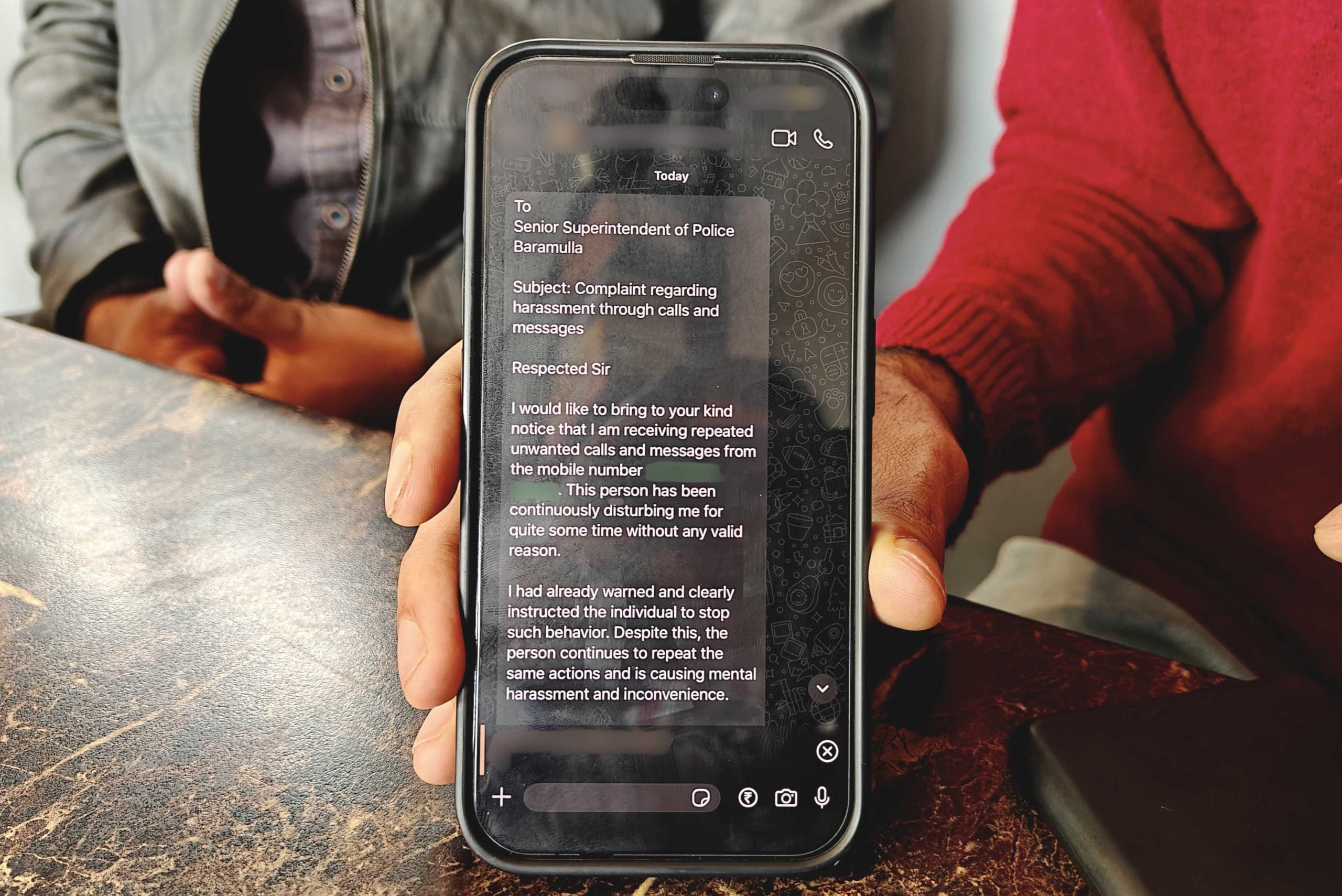
“Those threat messages are from Pakistan. You can easily tell by looking at the contact. But I do inform the police for my own safety,” said Tantray.
Once, three students wearing pherans came to his house-cum-office looking for him. They said they wanted to organise a quiz competition. “Nobody allowed them inside. There was something suspicious about them,” said Tantray.
Even when he became a full-timer in 2021, he was not all in.
“I thought I would do this only for a year,” he said. But the hesitation did not last. He said he was treated as an equal among his Hindu colleagues and never felt discriminated against in a Hindu organisation.
Now, he is a regular at ABVP training camps and sessions. He recently travelled to Mount Abu in Rajasthan for one such camp.
At these camps, he said, the training goes beyond routine mobilisation. Workers are taught to map student concerns, respond to campus issues, and strengthen the organisation at the ground level. It is this template that Tantray is bringing back to Kashmir.
The groundwork is already in motion. His team is preparing for a 10,000-tree plantation drive, which he plans to launch soon.
The ABVP is taking up issues that resonate with young students, from everyday grievances to broader concerns like climate change. They have pitched the drive as a response to global warming.
In 2019, when he joined ABVP, Tantray wasn’t this vocal, unapologetic volunteer that he has become today.
“Before that, I used to be very scared of the consequences. But now, I feel lucky that I am getting a chance to work with young people.”
His entry into ABVP coincided with his student years at Lovely Professional University in Punjab. He describes it as the confluence of his nationalism and a platform to express it. He moved swiftly through its ranks—from district organising secretary to state joint secretary, then national executive council member, and now division organising secretary.
Over time, his vocabulary changed. In everyday conversations, he started using words like Bhojan instead of food or and kshama instead of sorry.
His rise reflects the organisation’s push to build a local Muslim face in Kashmir. His social media shows him with Lieutenant Governor Manoj Sinha, handing over a memorandum on student issues. To students who join him, he signals proximity to power.
“If they get our work done, we will go to ABVP. That doesn’t mean we align with their ideology,” said a Kashmir University student, requesting anonymity.
Tantray, like other members, draws a distinction. ABVP, he said, is not the BJP. “We have nothing to do with the political party. We are different,” he insists.
The rising Baramulla
Shahid Nazir (25) joined ABVP in 2025. Even before that, he was an activist in Baramulla, raising youth issues and helping those in need. Everyone in the town knew him as someone who could be relied upon. Joining ABVP gave him a platform. Now, he could organise seminars and meet students with a stamp of authority.
“Now, when I organise seminars, students look at me with more respect. I was always a nationalist. ABVP has only added to my personality,” said Nazir.
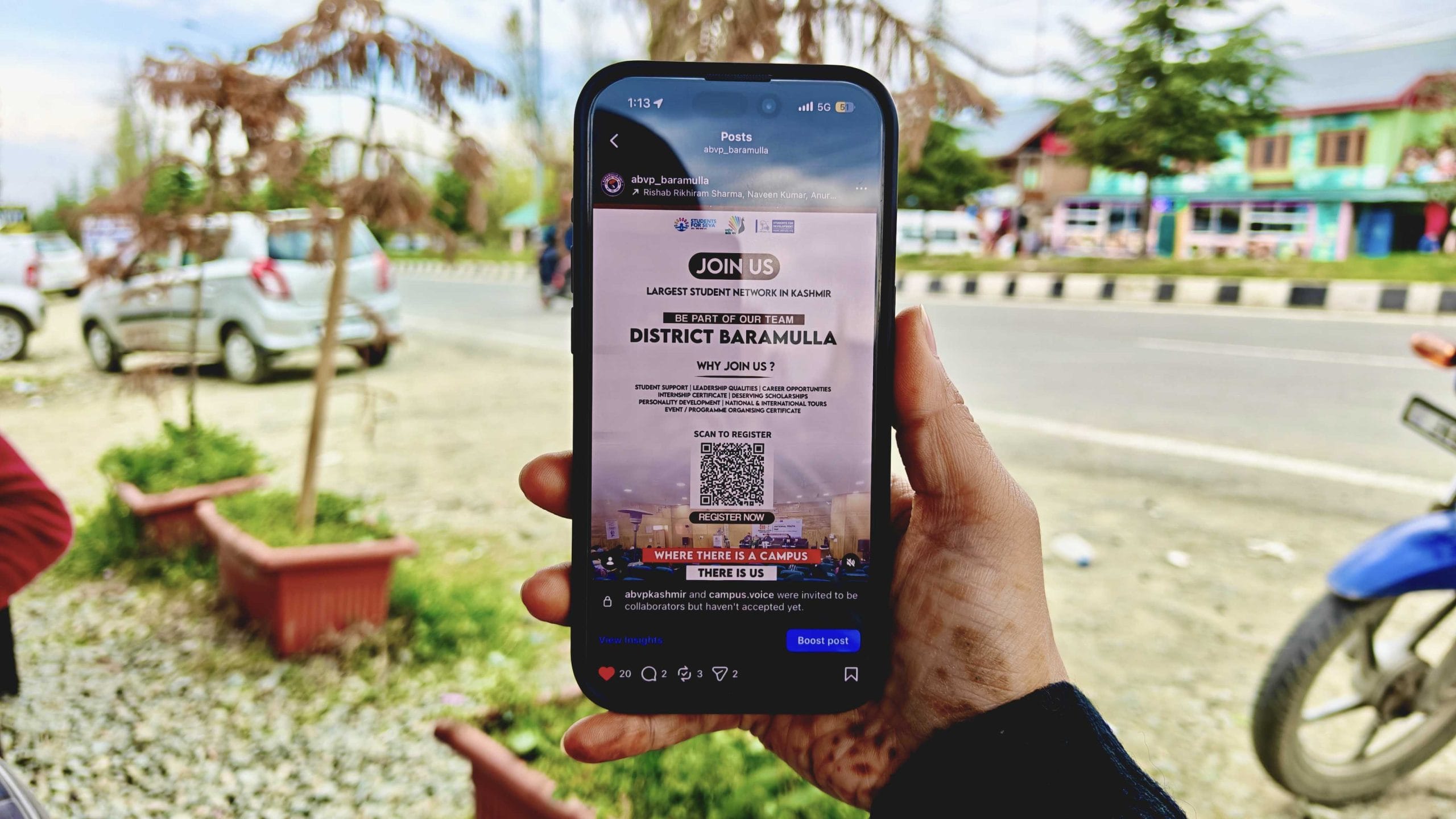
Their seminars often feature panels of IPS and KPS officers, along with social activists. In one blood donation felicitation ceremony, the poster carried an image of BR Ambedkar alongside a mashal, ABVP’s flaming torch logo. The guest list included KPS officer Raja Zuhaib, IPS GV Chakravarty, and social activist Abida War.
But Nazir did his homework before joining ABVP. He said he joined fully aware of what the organisation stood for and its Hindu roots.
The rise of ABVP is linked with the disenchantment with the mainstream student and youth wings. In campuses, where traditional-affiliated bodies are seen as nepotistic and unresponsive. ABVP presents itself as an organisation filling those gaps.
“We don’t see any future in PDP and NC. They only promote their own people. But that’s not the case with ABVP,” said a 20-year-old Muslim ABVP member from Baramulla.
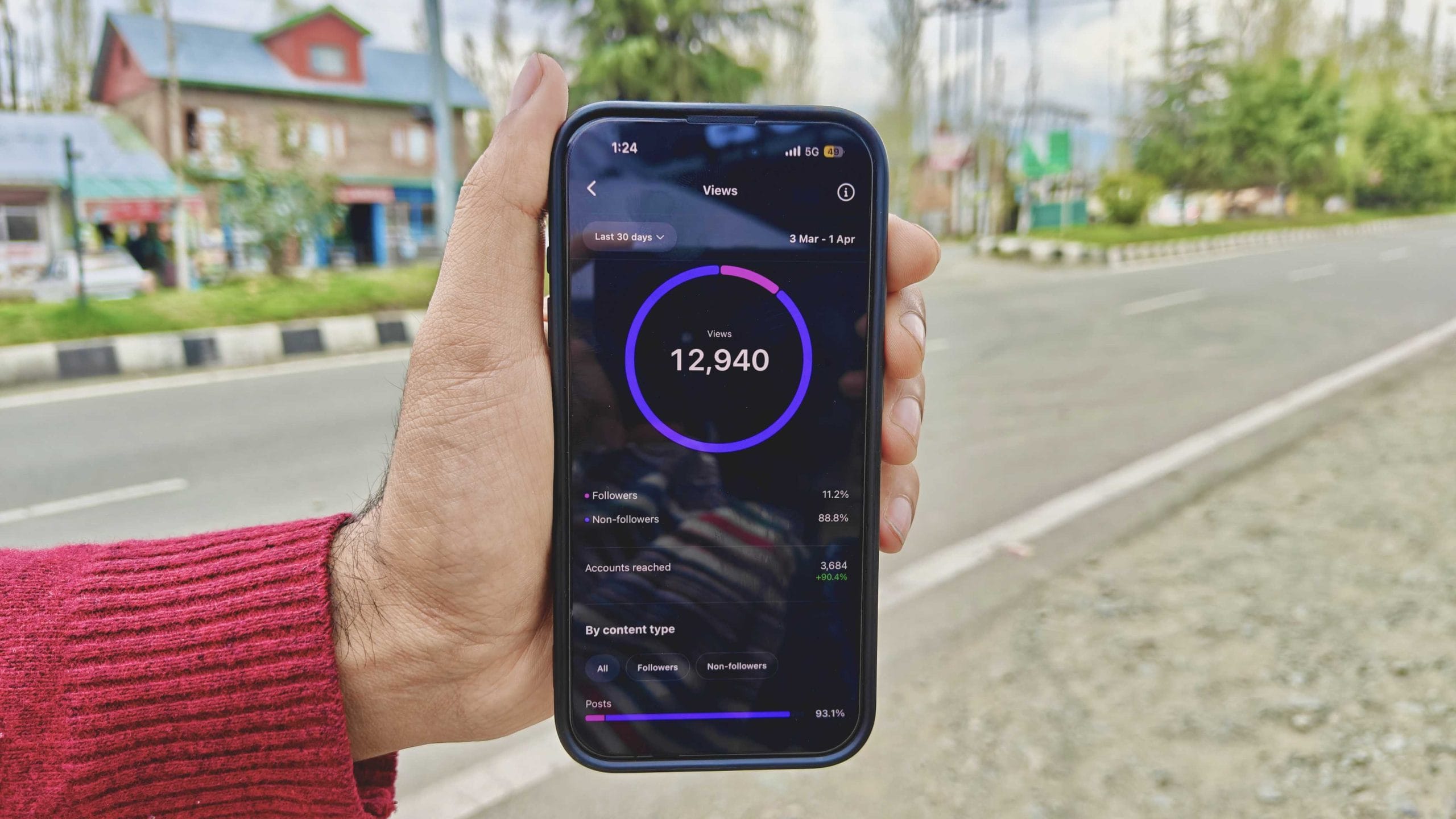
In 2025, only half a dozen students were associated with the ABVP in Baramulla. Today, that number has grown to 70. WhatsApp groups are abuzz with messages like, “The student movement in Baramulla is rising higher than ever.” And soon, came the Instagram page of ABVP Baramulla. The page has over 20k monthly views although the following is barely over a dozen.
The ABVP runs an intensive outreach programme, largely through social media. District seminar posters carry QR codes that direct students to Google forms, where they submit their details to register. These leads are followed up offline, with meetings designed to convince students to join the organisation. The seminars serve dual purposes. They felicitate students and also become recruitment tools.
For some students, the ABVP is a platform for change. That is what drew Raju Showkat into their fold. Nineteen-year-old Showkat was reserved and hesitant. He shied away from speaking in classrooms, struggled in debates and was often mocked.
But after meeting Nazir and coming across ABVP, things began to change.
A keen follower of the news, Showkat was deeply affected by reports of injustices against students across the country. He says, the RG Kar rape case in Kolkata left a strong impression on him. He wanted a platform where he could stand up for students and prevent such incidents.
“ABVP for me is a revolutionary organisation where I can raise issues of fellow students. My voice is no longer suppressed,” he said.
Also read: BJP leaders’ launchpad for decades, ABVP is the rising star of student politics. It’s getting bigger
Man on a mission
When Tantray started attending ABVP seminars as a full-timer, he saw that members carried prejudice toward Muslims. He said because he is from Kashmir, he was able to show them a different side of Muslims. He doesn’t mind visiting temples. He sits with pracharaks, learning from their experience.
His idol is APJ Abdul Kalam. He was introduced to the former president’s achievements through an ABVP seminar. It spoke about Kalam’s life as an extraordinary Muslim. Tantray was impressed. In the following days, he read extensively about Kalam, about how he was a secular Muslim, visited temples, and loved the nation. “I am trying to follow the same path,” he said.
His meetings with LG Manoj Sinha, who also rose from ABVP inspired him. “LG sahab always encourages me to take the movement forward and work for the students.”
Back at his home in Kupwara, Tantray’s parents are constantly pressured to ask their son to leave the organisation. In 2019, he posted a teary-eyed video of him holding the national flag for the first time after the abrogation of Article 370. The video went viral on social media. But back home, his parents started receiving calls questioning whether their son was in the right state of mind, warning that he was inviting trouble.
Tantray’s brush with nationalism began in school. The son of an apple farmer, he studied at an Army Goodwill School, where he learned lessons on unity and the values of a secular nation.
The last time he visited home was at dusk on Eid. The next morning, Tantray kissed his parents while they were still asleep and left for Srinagar, and from there, on to his training programme in Rajasthan.
His younger brother is studying under the Army’s Sadhbhavana scheme and had taken a student loan for his education.
Tantray is the force behind ABVP in Kashmir. Members wait for his approval.
His phone constantly buzzes with student issues. Another alert: “A girl student is being harassed by persistent calls from an unknown number. She also wrote to the SSP but received no response.”
He quickly packs his bag, drops messages in a dozen ABVP groups across the valley, and alerts the seniors. “We need to help her,” he said, moving with the urgency of someone on a mission. In Kashmir, for ABVP, this is not activism, it is the operation.
(Edited by Theres Sudeep)