





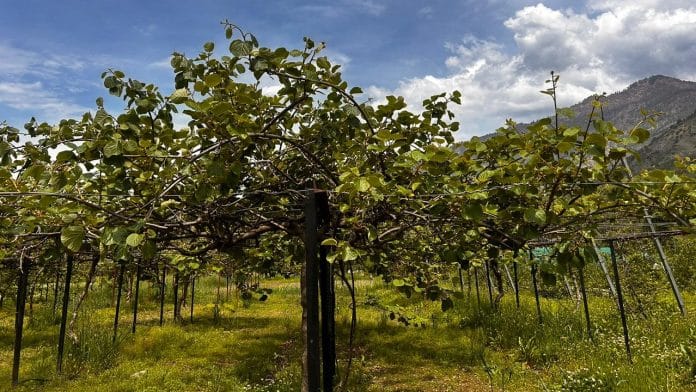


Solan, Himachal Pradesh: Days after the rains, a cold wind lingers as the sun disappears behind the Himalayas. Mandeep Verma, 45, sets out on his evening walk through “Swastik Farms” in Solan. It is a routine he has kept for a decade. He checks the iron trellis structures, runs his hand along the vines, and begins inspecting the fruit. A decade ago, Verma was a manager at Wipro in Gurugram. Today, he is one of the most successful kiwi farmers in Himachal Pradesh.
“My vitamin D levels were at the lowest,” he said. “I knew I had to go back home.”
Verma was 35 when he left his corporate job. On a downhill stretch a few metres from his home, he began clearing 25 bighas of land for kiwi. He started with 150 plants in 2015 and an initial investment of around Rs 15 lakh. He recovered that investment in five years. He now has more than a thousand plants, having replaced mature apple trees on an additional 5 bighas with the new crop. Last year, he earned around Rs 30 lakh.
Verma is not alone. Across Himachal Pradesh’s mid-hills, a new class of farmer is replacing apple orchards with kiwi vines. Software engineers and bank managers are drawn by a fruit that offers bigger margins and lower annual inputs. There are around 300 kiwi farmers in the state today, up from three or four in 1990. Production has nearly doubled in five years, from 496 metric tonnes in 2020 to 965 metric tonnes in 2025.
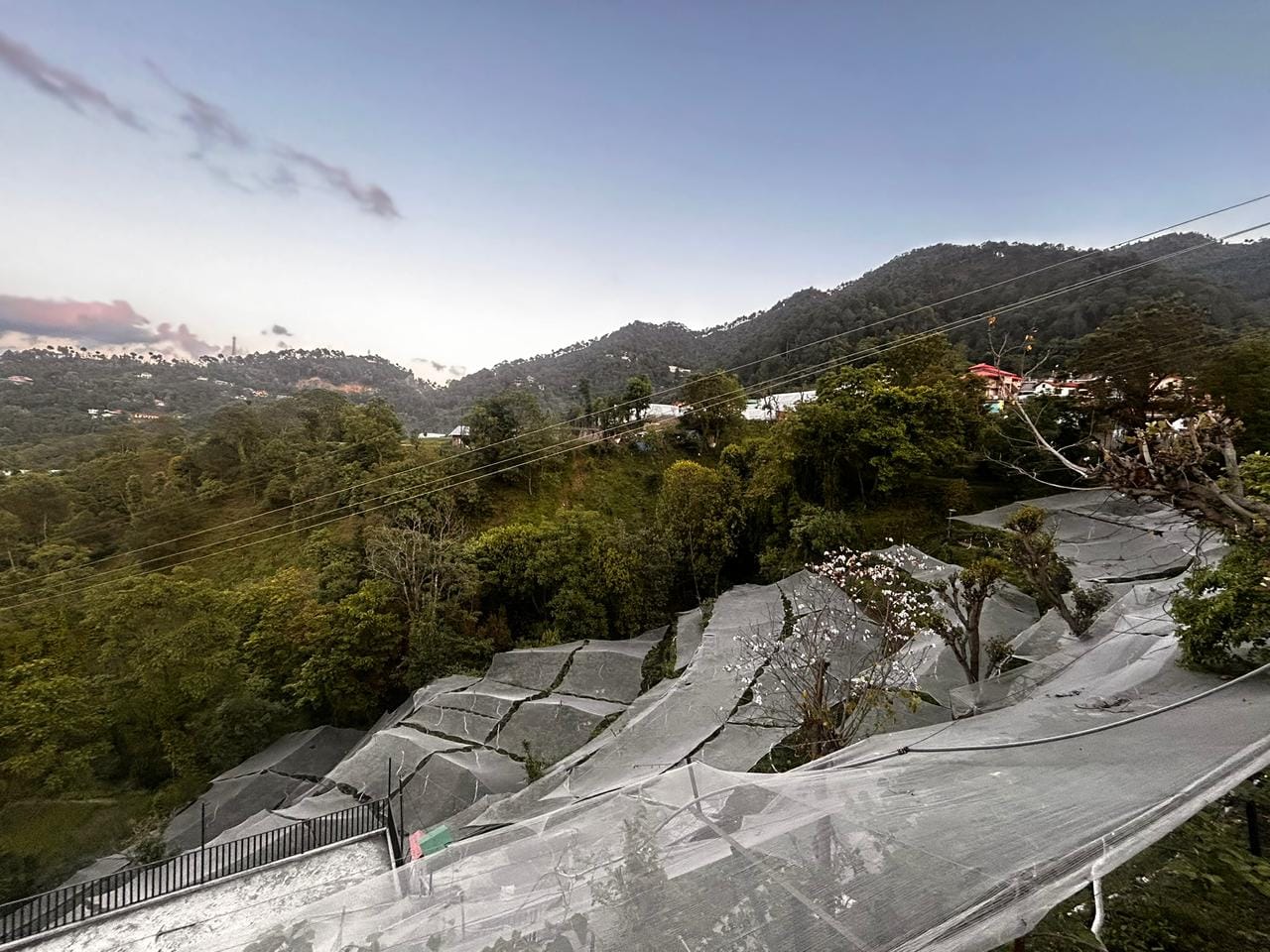
What’s further propelling this rise is a climate increasingly hostile to crops that came before kiwi: peaches, apricots and, in some areas, apples. A study published in ResearchGate on peach cultivation in Rajgarh district found that farmers have been losing between 20 and 30 trees annually to changing climatic conditions. Kiwi, which needs winter cold but is more tolerant of milder conditions than apple, has emerged as a practical alternative.
“Kiwi has risen as one of the most important crops in Himachal Pradesh, especially in the lower Himalayan elevations — it can emerge as an alternative to various traditional fruits,” said Satish Kumar Sharma, joint director of research (horticulture) at Dr Yashwant Singh Parmar University of Horticulture & Forestry, Solan. “It all started with government schemes in 2017 and saw a major boom in 2022 when demand for the fruit increased.”
Also read: Himachal farmers are ditching apples for persimmons. ‘Earnings on par with JEE packages’
The economics of kiwi
For many farmers in Himachal Pradesh, the shift from apple to kiwi makes complete economic sense.
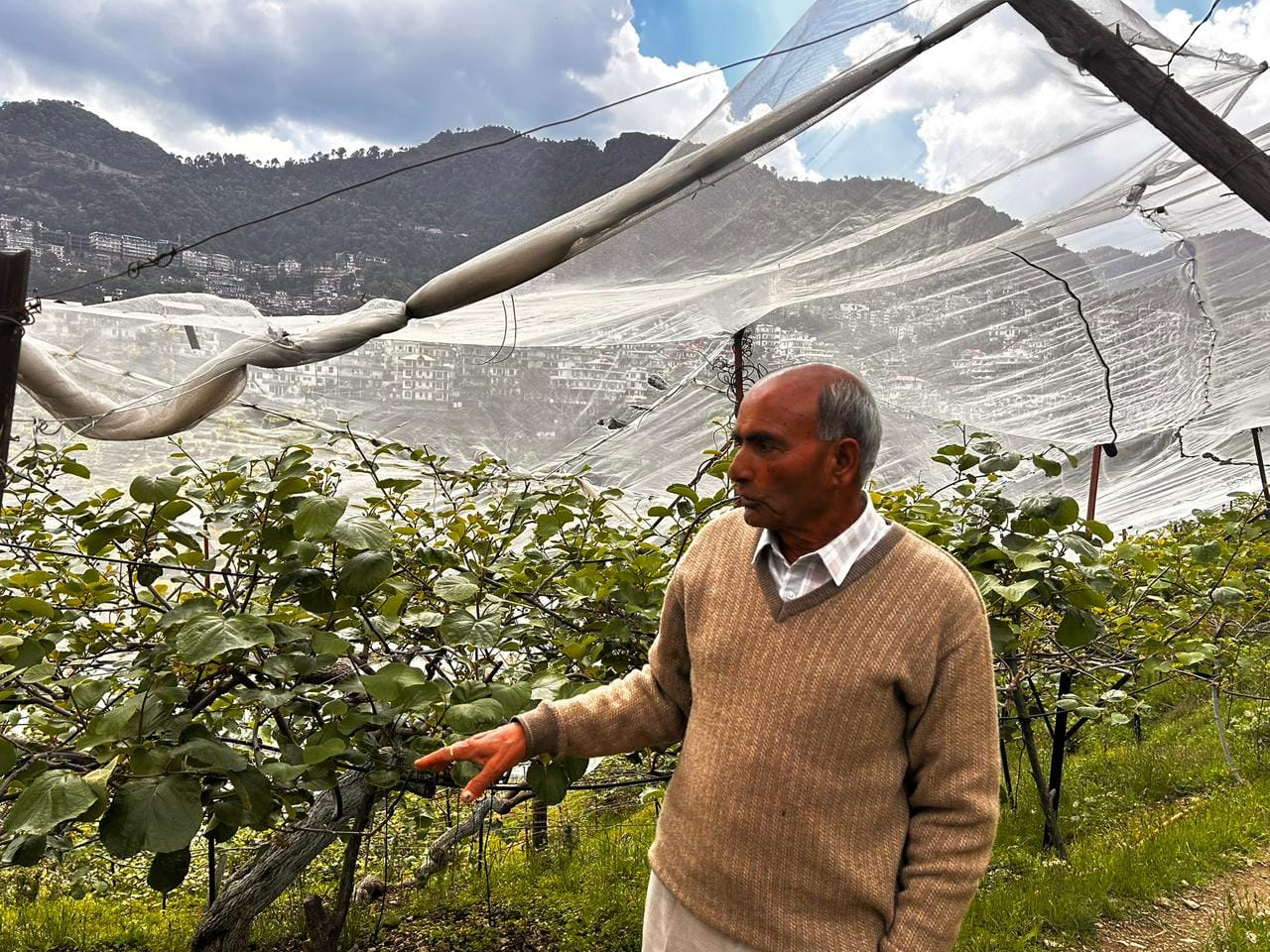
Apple cultivation requires around Rs 500 per plant annually in inputs. Kiwi requires roughly Rs 100. The initial investment in kiwi is higher — structures, wire trellis systems, iron supports — but the recurring cost of maintaining a kiwi farm is significantly lower than that of an apple orchard. Verma farms primarily through natural methods, which keeps his input costs further down.
“We achieved break-even in the fifth or sixth year,” he said. “Since we follow mostly natural farming, our input costs are very low. If I earn Rs 100, almost Rs 98 stays with me. In chemical farming, a big chunk goes into buying fertilisers and pesticides.”
Kiwi is harvested before it ripens, which gives farmers a window to package and transport it before it deteriorates. Verma ships his produce to Delhi, where it arrives within two days. Most of his produce goes to dealers in bulk; direct sales are limited.
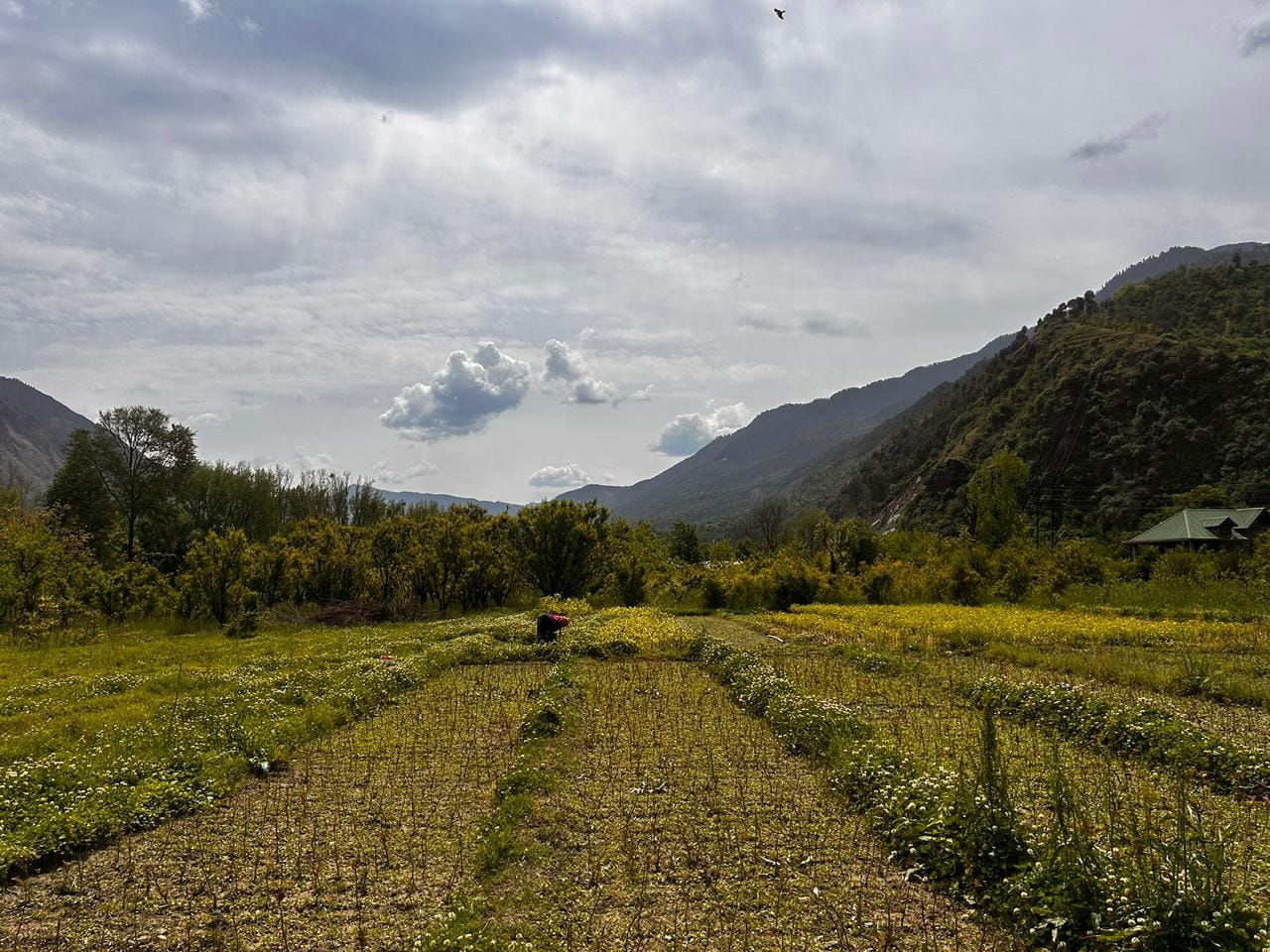
“Kiwi demands investment and patience,” he said. “Once that period is gone, the returns are strong.”
The income, however, is not predictable. With no minimum support price (MSP) for kiwi, farm-gate prices fluctuate with the market. Over the last three years, prices have ranged between Rs 250 and Rs 350 per kg.
“One year we sold kiwi at around Rs 350 per kg with about 10 tonnes of production – roughly Rs 35 lakh in revenue,” said Verma. “The next year, prices dropped to Rs 250 per kg due to imports, even though production increased to 12 tonnes. So income fluctuates with market rates.”
“Because of the cost and effort involved, we expanded step by step rather than all at once,” he added.
‘I was called a mad man’
Fifty-eight-year-old Chhering Paljung Negi began kiwi farming in 2006, when the fruit had few takers in the state. A few patches of land behind his home, used by his father for apple orchards for over two decades, were gradually converted to kiwi cultivation. He invested Rs 1,500 per plant. His neighbours and his father thought he had lost his mind.
“I was called a mad man by my father and my neighbours,” said Negi. “But Kiwi has potential, I knew that. It is an evergreen fruit.”
His little leap of faith eventually paid off. By 2020, Negi was earning Rs 4 lakh from kiwi. By 2025, that figure had risen to Rs 11 lakh.
“Kiwi was present in the university for years, and training was available,” he said. “But farmers were hesitant because the initial investment was high – structures, wires, and support systems made it expensive.”
Negi, who also grows persimmons, has since watched kiwi’s popularity spread well beyond Himachal.
“Farmers from Uttarakhand and Kashmir are also taking plants from nurseries,” he said.
The growth is evident from what has happened in the state’s nursery business. In 2024, Prakash Rana — one of the oldest kiwi farmers in Solan — sold around 5 lakh plants from his private nursery. Verma sold 12,000.
“Last year I had sold plants to two bank managers who had left their jobs to start kiwi farming in their village,” said Verma.
The demand for planting material is itself an indicator of how sharply interest has grown. Both private and government nurseries in Himachal, Rana said, are running out of plants. A season that once produced 10,000 plants and sold 3,000 now cannot meet demand even at 10 lakh plants.
Three decades, one researcher
The story of kiwi in Himachal Pradesh begins not with a farmer, but with a researcher.
Kiwi’s introduction in India dates to early experiments — at the Lalbagh botanical garden in Bengaluru and at an Indian Council of Agricultural Research institute in Phagli, Shimla — neither of which produced commercially viable results. The climate was unsuitable in both locations. The breakthrough came through multi-locational trials across Himachal, in Kullu, Solan and elsewhere, which established that kiwi grew well between 900 and 2,000 metres elevation under temperate conditions. The first commercial orchard came up inside Dr. Yashwant Singh Parmar University of Horticulture and Forestry.
In 1992, the year Prakash Rana planted his first four kiwi vines on a piece of land covered with pine trees and wild grass, Vishal Rana began his PhD at the university. He has not stopped since. Vishal Rana is now the joint director of research at Parmar University. Local farmers call him the “Kiwi Man of India”. Kiwi posters line his office walls; a close-up photograph of the fruit is his computer wallpaper. He has guided 30 PhD students, 15 of them on kiwi. He has been working on this crop for more than 25 years.
“I have been offered several positions — even in the Northeast — with salaries much higher than what I earn now,” he said. “But I chose to stay. I am here because of my passion, for this fruit and for my subject.”
The problem Rana and his team spent years addressing was the quality gap between Indian-grown and imported kiwi. Domestic kiwi was unable to compete with imported ones on taste or size. Rana’s team began working with four farmers in Sirmaur and Solan on orchard management, canopy management, harvesting practices, nutritional and water management, and pollination. Gradually, the quality improved.
About five years ago, Rana turned to social media. His videos on harvesting and orchard management now average around 90,000 views. He is currently working on developing a new variety that he says will be competitive with Zespri Gold — the premium variety patented by New Zealand.
“Our kiwi’s taste matches international standards,” he said.
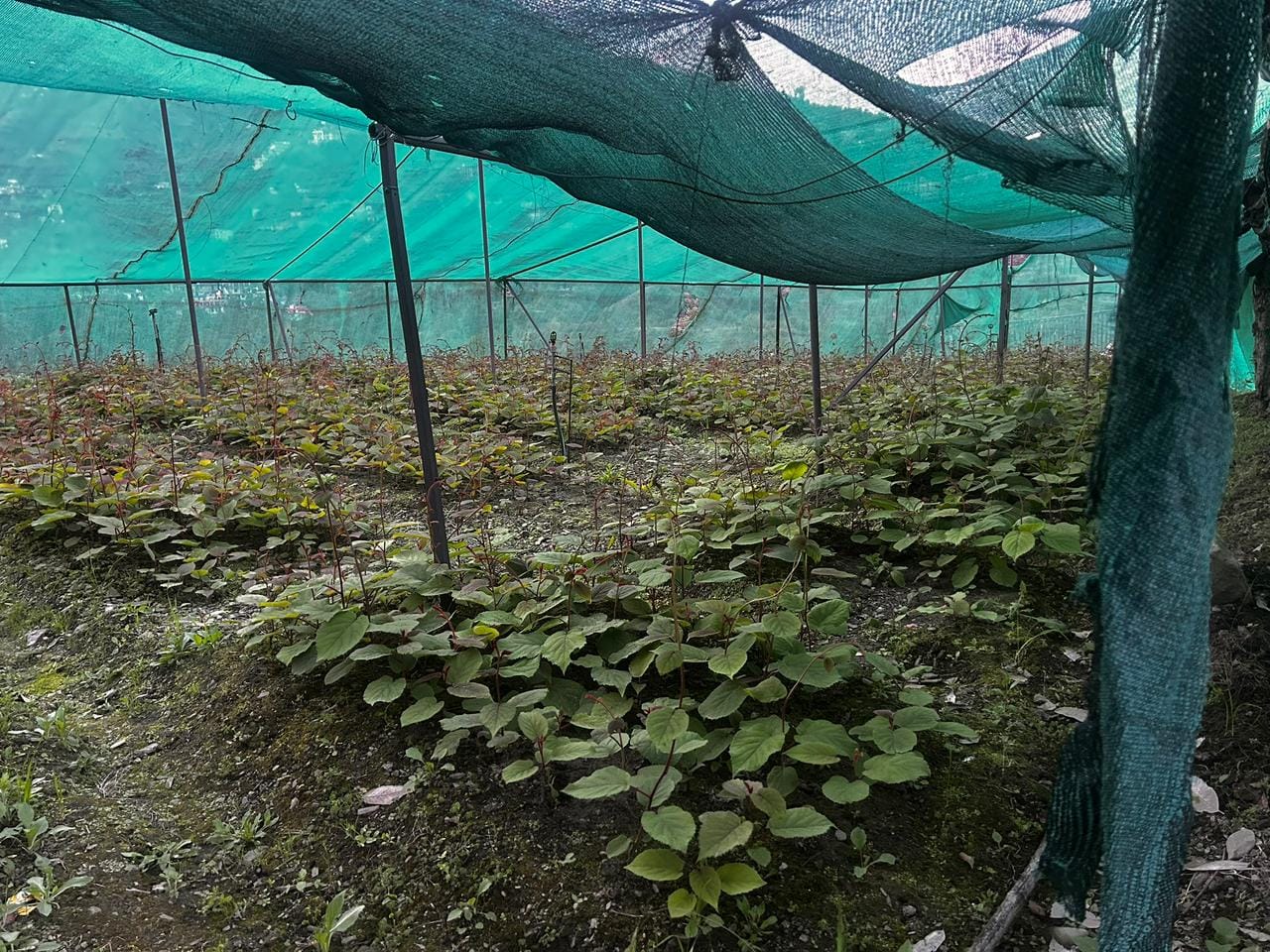
Prakash Rana’s trajectory runs parallel to the research story. He started with four plants and within two years had planted 300 trees across 8 bighas. He took his produce to Ludhiana and Delhi himself. Nearly 300 kiwi plants stand on his land, surrounded by growing urbanisation and scattered pine trees.
“At that time I sold kiwi at Rs 100-120 per kg,” he said. “I packaged them beautifully and started selling in Ludhiana and Delhi markets. I created the market for kiwi. It was a rich man’s fruit.”
In those early years, one kiwi sold for as much as a dollar. Last year, Rana earned Rs 20 lakh from the crop.
Government support, growing kiwi market
In 2017, the Himachal Pradesh government launched the Mukhyamantri Kiwi Protsahan Yojana, offering farmers a 50 percent subsidy on planting material, trellis systems and orchard establishment, with a budget of Rs 2 crore. Between 2024 and 2025, 39 farmers benefited from the scheme.
Arunachal Pradesh has moved in a similar direction. A comparable scheme was launched there last year, and the state produced nearly 4,500 metric tonnes of kiwi in 2022-23, with farm value reaching Rs 67.4 crore. Arunachal, which now accounts for over 50 per cent of India’s total kiwi output, is also home to India’s first certified organic, GI-tagged kiwi.
On the demand side, the market has been driven by urban consumption. In cities like Delhi, Mumbai and Bengaluru, kiwi consumption is growing at 10 to 12 percent annually, according to market estimates. Globally, the kiwi market is valued at $54.4 billion in 2025 and is projected to reach $95.4 billion by 2029. Right now, India’s domestic demand of around 19,000 metric tonnes per year is largely dependant on import, with around 4,000 metric tonnes annually from New Zealand alone.
“Horticulture is a long-term investment,” said Sharma. “You plant today and earn after three to four years. Kiwi suits farmers who can wait, offering steady, long-term returns unlike seasonal crops.”
Challenges for Himachal, benefits for India
While kiwi draws more farmers in, the business side remains complicated, forcing farmers to remain on their toes.
India’s October harvest, when domestic kiwi floods the market, puts it in direct competition with cheaper imported fruit. Kiwis from Iran, Chile, Spain and New Zealand suppress prices during peak season. Without MSP, farmers carry the full risk of price swings, which is evident from Verma’s revenue gap between two consecutive years.
The variety is also changing. Indian farmers have traditionally grown Allison, a smaller and sweeter variety. Market demand, driven largely by what consumers have come to expect from imports, has moved toward the larger Hayward variety.
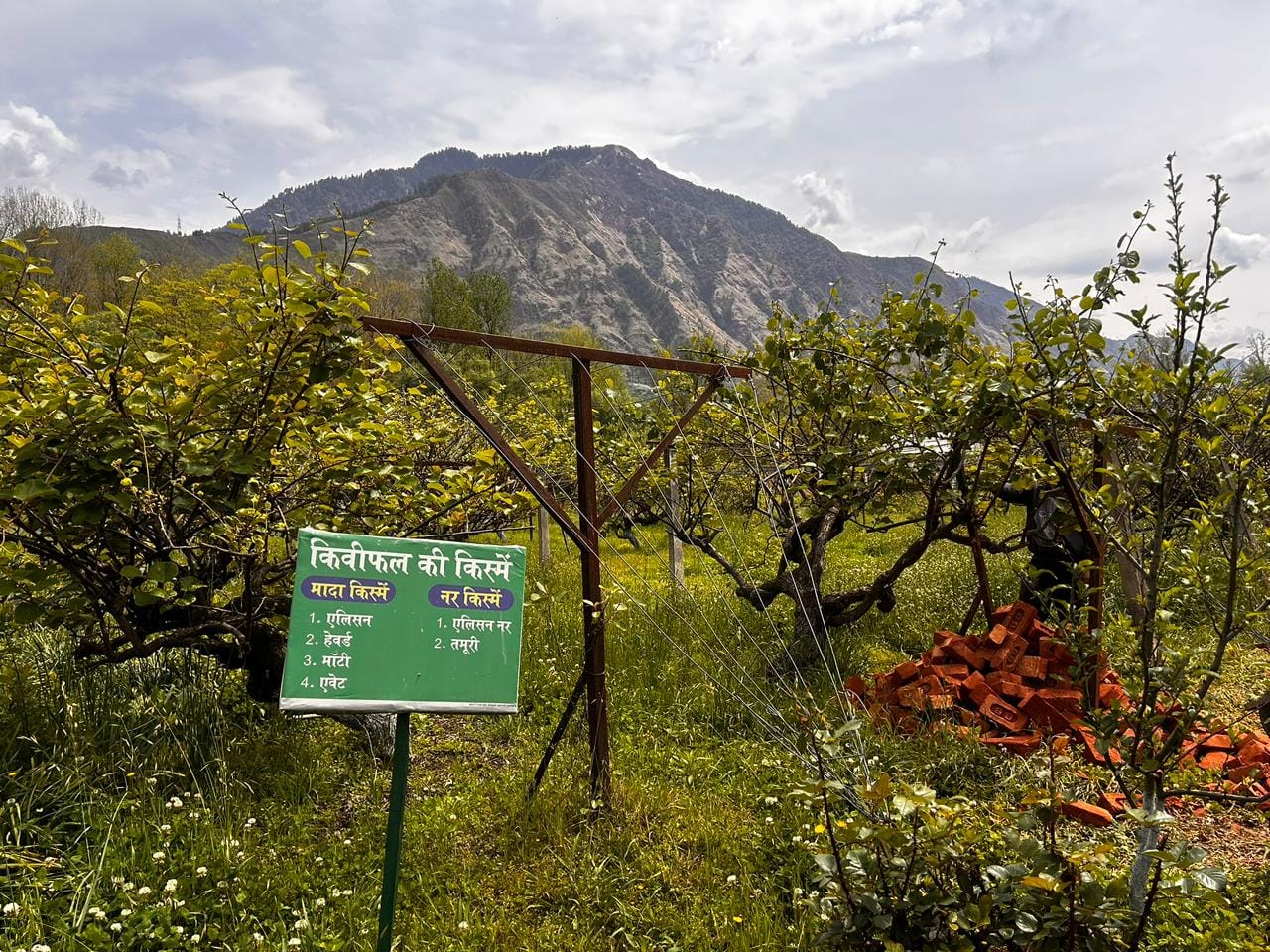
“Earlier, there was a craze for the Allison variety — it’s sweeter but smaller in size,” said Verma. “But market demand has shifted towards bigger fruits like Hayward, especially because imports from countries like Iran, Chile, and New Zealand are mostly of that variety. So we are also moving towards Hayward and adapting to what the market wants.”
Himachal Pradesh’s position as the country’s leading kiwi producer also faces growing pressure from within India. Farmers in Jammu and Kashmir and Uttarakhand are sourcing planting material from Himachal nurseries and building their own orchards. Arunachal Pradesh, with its university backing and GI-tagged certification, is a credible rival in the medium term. The state’s 50 percent share of national production will be harder to maintain as other regions incorporate the kiwi success story in their agricultural playbook.
Vishal Rana, who has watched the crop go from a university experiment to a commercial enterprise over more than three decades, is clear about what lies ahead.
“In coming years, India can be a potential global player in kiwi farming,” he said.
(Edited by Prashant Dixit)