



Hyderabad/New Delhi: Standing in the Eisenhower Executive Office Building earlier this month, US Vice President JD Vance delivered a stark message to India’s top four IT firms: Don’t lay off American workers and replace them with “foreign indentured servants”.
It isn’t just about Indian techies in the US losing their jobs, visa status and returning home. What he said was the final wake-up call for Indian IT companies too, caught off guard and bracing for a once-in-a-century disruption. They were caught in their old best-practices model of labour arbitrage for way too long to turn their investment toward innovating for the next big change.
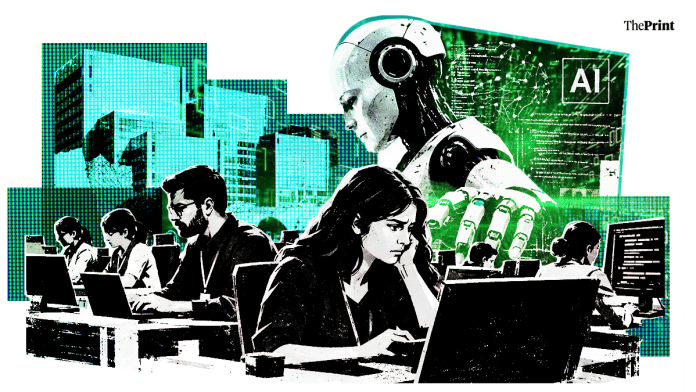
India’s $250-billion IT sector, which employs six million people—or half the country’s white-collar workforce—faces an existential threat: AI agents are fundamentally undercutting the value of a billable human hour.
The Indian software powerhouse was built on a beautifully simple economic equation. Why pay five times more for technical talent in the West when you can scale it cost-effectively in India?
Now, with labour cost arbitrage being replaced by knowledge arbitrage, a painful and belated realisation is setting in that India’s software service providers haven’t been ploughing enough money into research and development (R&D) and learning and development processes (L&D).
“Without exception, the top five or six players in India have misread the laws of the AI jungle,” Jaspreet Bindra, former Chief Digital Officer, Mahindra Group, said. He added that this led him to break away from digital consulting and establish his own AI-training firm.
In August 2017, the CEO of one of India’s top Bengaluru-based IT firms wanted to invest in OpenAI. The firm refused, and he resigned, Bindra recalls, saying he often uses this as an example to cite how promoters of software services providers simply did not see the AI wave sweeping them over.
This led many top executives from these IT firms to quit and set up their own enterprises, which invest heavily in technology first and people next. These companies— such as Hang Ten Systems, Sentient Investment, and Simplify Alpha—are winning large order books, quietly replacing Indian tech giants, said Aditya Narayan Mishra, chairman and MD of CIEL HR.
“Deals that used to be in billions have now fallen to hundreds of millions. Some companies are just about to keep their lights on,” said Mishra, painting a sombre picture of AI-inflicted damage.
‘If it ain’t broke, don’t fix it’
It was an Indian Prime Minister in office for barely seven months who unlocked India’s software potential.
In early 1991, Chandra Shekhar initiated the STPI scheme (Software Tech Parks of India), providing for high-speed satellite links that bypassed worn-out domestic telephone networks, making offshore software delivery commercially viable. For over three decades now, STPI has enabled the Indian IT sector to gain on its Western peers. India’s software exports surged from about $150 million in 1991 to over $6 billion by FY 2001, eventually scaling to $221.4 billion by FY 2025–26.
In its heyday, the 1990s and early 2000s, the Indian IT sector was the tide that lifted all boats. It birthed an aspirational middle class with steady disposable incomes and acted as India’s global projection. The industry had entered a cycle of creating a demand, servicing it, and on to the next.
It worked well for everyone. For India, for the youth and the industry. They were all locked in an ‘if it ain’t broken, why fix it’ mode.
But as AI transitions from an experimental tool into deployable labour, Indian IT giants are looking inward, reimagining the building blocks of the business, all the while accounting for a volatile variable: the half-life of a technical skill.
“There is no programmer, developer role any longer, right? Because machines can code. And which means you need to become that human who will tell the machine how to code better,” said Phani Pattamatta, COO of the industry body HYSEA (Hyderabad Software Enterprises Association).
Industry experts say key milestones in the machine learning breakthrough were visible as early as 2012, much before agentic engineering and automation made its public debut in 2023.
“But it was only after 2018, when the long-drawn, high-publicised feud between OpenAI’s chief executive Sam Altman and Elon Musk over AI, that the other tech giants such as Google, Microsoft, and IBM began jumping into it,” said Sridhar Seshadri, director of foresight and innovation at the think tank Global Forum for Sustainable Transformation.
“They realised there was something ‘big’ happening.”
Microsoft launched Copilot in September 2023 and within months, in December that year, Gemini tumbled out of Google’s AI basket, paving the way for the software industry to shift from simple code-completion tools to autonomous AI agents. These agents can generate entire features, pull requests, and handle testing or debugging workflows.
Witnessing this, Indian IT firms were once again hit by a freight train. They had hired by the droves during the COVID-19 pandemic, in anticipation of larger orders. Now, they suddenly started laying off lakhs of employees.
In the quarter ending September 2025, TCS reduced its headcount by nearly 20,000. According to the firm, this included voluntary exits and tighter bench rules. Further, global capability centres (GCCs) in India are estimated to have laid off at least 4,000-5,000 people this year.
“From 2010-12 until 2020, the industry was plateauing and demand was setting in. Suddenly, 2021 onwards, we started over-hiring,” explained Pattamatta, pointing to the post-Covid hiring spree.
But many continue to attribute the layoffs to course-correction more than AI-induced restructuring.
“AI hasn’t really shown up as a visible cause of significant layoffs or restructured hiring funnel through 2026. Right now, mainstream enterprise AI deployments aren’t mature enough to have replaced engineering roles or pushed job cuts on a significant scale,” said co-founder of the Bengaluru-based specialist staffing firm Xpheno, Kamal Karanth.
Karanth added that most layoffs so far trace back to “margin pressures, cost-cutting, or business restructuring under adverse market conditions, and not directly AI-driven”.
At 1.23 lakh, active tech jobs in India in October marked an 18-month high, according to Xpheno. Of these, 55 per cent were “mid-senior” vacancies and only 12 per cent were open to freshers. At 66,000, active jobs in IT services saw 57 percent year-on-year increase.
Naukri’s monthly JobSpeak index from October, however, points to a 4 per cent year-on-year drop in hiring across IT/Software Services.
Further, data collated by Xpheno shows that more than 15,000 IT professionals returned to India from the US in 2025. This number had already climbed to 7,500 by June this year.
Karanth said core tech and engineering functions in IT continue to lead active demand, accounting for about 50 per cent of total active openings.
AI de-bugged
The saga isn’t just about jobs being lost. It is about a software industry that ruled the game for three decades and then dropped the ball and is suddenly playing a breathless catch-up game.
Beyond the shrinking headcount paradox, AI has quietly marked the beginning of the dissolution of India’s decades-long reputation as the world’s back office. What threatens India’s labour cost arbitrage and the very baseline of the global offshore model is the industry’s shift from labour to capability arbitrage. Indian industry experts are calling it “algorithmic arbitrage”. And it is far more complex than the mere replacement of the global margin moat by a rising adoption of automated platforms.
“The business of white-collar software bodyshopping has altered dramatically,” Seshadri, also the author of AI for Everyone, pointed out.
Earlier, vendors, or software service providers, used to bill their overseas clients based on the number of manhours. But today, this has changed to fixed-price billing. For instance, if a US or European firm contracts an Indian software firm to write code to enable a 30 per cent saving in energy costs, and the Indian vendor delivers this outcome, the fee paid is a predetermined cost agreed upon based on the success of the outcome, not merely the number of hours that Indian coders put in.
Software employees are encouraged to co-opt digital twins (AI agents) while writing code or fixing malware, so that a job that requires 20 people today can be done with 10 humans and 10 digital twins.
“This is the surest way to ensure our margins take a hit. It is sad to constantly compare a human’s work output to an AI agent’s. As HR professionals, we often tell our senior management to disengage in comparing oranges and apples,” said a senior HR & talent hunt associate from Cognizant, who did not wish to be named.
The evidence of these occurrences has been underscored by a comprehensive tech industry analysis in Fitch Ratings’ report released in August. It explicitly warned that as global enterprises leverage automated software pipelines, the economic logic of hiring vast offshore engineering teams begins to look less competitive.
The Fitch Report released in August this year has evidence of these occurrences. In its comprehensive tech industry analysis, Fitch says, “Indian IT services firms are positioning themselves to lead AI-driven enterprise overhauls globally, though near-term discretionary tech spending remains flat. On the Clients’ side, although global enterprises are leveraging automated software pipelines, the economic logic of hiring vast offshore engineering teams is becoming less competitive.”
The AI bogeyman
The nastiest blow has come from clients shifting from people-hours to platform-subscriptions. The financial anatomy of tech procurement is rotating rapidly, turning human-centered operational expenditures into technology-centered ones, said Jaspreet Bindra, former Chief Digital Officer, Mahindra Group.
“Corporate budgets are aggressively rotating away from manual labor toward cloud infrastructure, AI agents, and enterprise AI subscriptions. In many large-scale corporate deployments, the labor savings realised by shrinking tech teams are being entirely swallowed up by skyrocketing bills for GPUs and cloud inference,” he explained.
Unlike others, Bindra begs to differ that Indian software firms are mere victims of the ‘AI Bogeyman’.
While he agrees that AI has led to alternative business models, he said much of the damage was inflicted because “Indian software service providers were both resistant to change and lackadaisical in the initial years when AI was merely a buzzword in corporate boardrooms”.
With newer AI variants being introduced to the market every few months, AI solutions are not only becoming expensive but also redundant. This is why companies are unable to ascertain which tool to deploy or if a certain AI suite is superior to the previous market entrant, Mishra added.
That there is a situation is certain. But how are Indian companies responding to it?
Also read: What were 30 foreign envoys doing in Vadodara? Garba, Gaekwads & a bid for soft power
Bottom line
The prevailing strategy within Indian IT firms is to get ahead of the curve faster than the rest of the world, as they did with the Y2K phenomenon, and move toward a ‘less coding, more AI integration’ model.
The pivot is based on the premise that greenfield coding is easier and faster, whereas brownfield coding is the opposite. And enterprise customers will continue to engage them, less for coding and more for AI integration.
“Companies are very complex inside; implementing AI is not simple; they will need help,” said an industry veteran.
Rohan Sharma, a US-based AI governance expert, said AI integration has opened the door to a ripe market for Indian IT giants—governance compliance, risk management, adherence, assurance. Sharma is a US delegate to ISO/IEC’s AI standards committee and member of the OECD.AI Expert Group on AI Risk and Accountability.
“And whoever can do that work, because those are the real jobs that are coming to market in the next two to three years. And if Indian offshore majors can capitalise on that, they can get those lucrative contracts rather than developing AI because we’re never going to catch up with the frontier labs and develop AI for ourselves,” he said.
Indian IT giants, too, have turned to AI frontier firms. TCS tied up with OpenAI, Infosys with Anthropic. Wipro has expanded its partnership with Google Cloud to “accelerate the enterprise-wide adoption of Gemini Enterprise and agentic AI”. On their part, AI frontier labs cut prices for the India market, even giving it away for free—because they need the data.
AI tools were initially subscription-based. Indian IT firms went into consumption mode, leading to raised costs since AI tokens are expensive. Industry insiders admit that the lens of individual productivity vis-à-vis enterprise productivity is no longer the sole factor determining the bottom line, despite the realisation that AI will corner a large chunk of coding roles.
As the industry braces for the point of impact, there’s little doubt that AI has put tech workers on a never-ending cycle of upskilling in a job market where the IT sector still accounts for one in two of “total active jobs”.
In a provocative three-legged paper led by HSBC’s Stephen Bersey, head of the banking giant’s US Tech Research, the authors argued that “enterprise software vendors themselves are best positioned to leverage AI within the enterprises responsible for the production of global GDP”.
Titled “Software is already eating AI”, the paper made a larger argument: AI is “destined to be subordinate to the overall software platform”.
In such a scenario, the Indian IT sector will be counting on building expertise to deliver brownfield projects to power the pivot into the AI age.
Nudged by AI, they have now simply caught up with the can pushed down the road for decades. And the industry is struggling to match the pace. Most Indian IT giants already run training programmes of up to 14 weeks for recruits to address that gap. With its revenue model in flux, the industry is now scrambling to retrain the workforce and make it AI-ready.
Infosys in its annual integrated report said: “generative AI might displace 92 million jobs such as front-end developers and testers, but it will create some 170 million new jobs for data annotators, AI engineers and AI leads.”
“The half-life of a skill is shrinking. Today it’s become a few months. And the worry that’s coming in is also because of this. What will change essentially is our ability to work alongside the machine,” said Pattamatta.
The World Economic Forum’s latest Future of Jobs Report pegged the global IT services sector’s exposure to AI at 93 per cent. In India, 88 per cent of firms surveyed said they saw AI and information processing technologies as the technology trend likely to drive business transformation, against a global average of 86 per cent. Moreover, 86 per cent of Indian firms said they are reskilling and upskilling their entire workforce to work better alongside AI.
Rohan Sharma, who has authored two books on AI governance, sees it as a wake-up call. Drawing a contrast, he said the education system in the US is aligned with academia to the extent that, in a lot of graduate programmes, the industry informs the curriculum.
“That’s one pattern India could adopt if they had some sort of flexibility in their academic curriculum, and they could adopt some sort of hybrid US model. Singapore is doing something more like private-public partnership collaboration, that kind of thing in which you subsidise the cost, incentivise the startup industry ecosystem,” said Sharma.
Either way, the world is changing and the Indian IT sector may have missed quite a few steps. Millions of Indian engineering graduates will struggle before they can play the new game.
“It’s no longer about learning a new kind of language. You’re learning a new kind of way to do networking in a database. Entry-level engineers don’t know the technology stacks or how the industry functions,” said Sharma.
(Edited by Ratan Priya)