



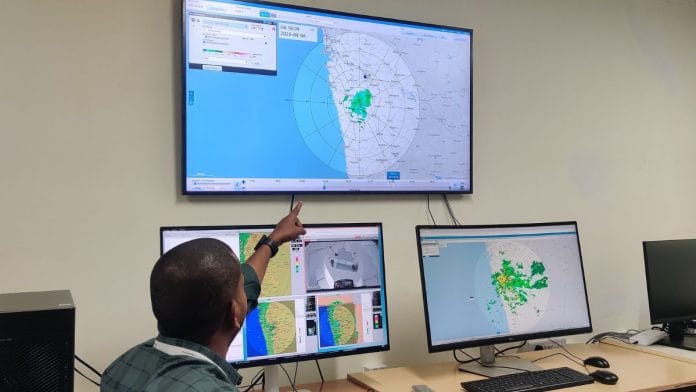
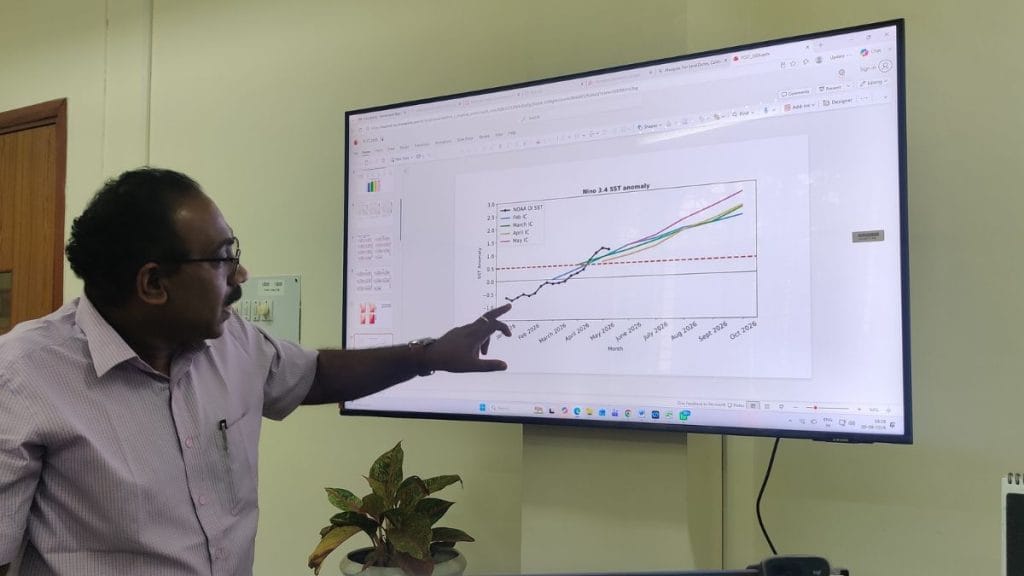
Pune: In February, when India was still in winter, scientist Prasanth Pillai was already looking months ahead. On his computer at the Indian Institute of Tropical Meteorology (IITM) in Pune, the first seasonal forecasts of the year were beginning to show unusually warm waters in the Pacific Ocean — the early signature of an El Niño that could alter weather thousands of kilometres away.
For India, that was not just a Pacific Ocean problem. El Niño can weaken the southwest monsoon, with consequences for crops, reservoirs, power generation and the wider economy. And this one was beginning to look unusually strong.
“This Pacific warming doesn’t die out in a few days, or weeks, or even months. So when you see it in models in February, you know it’s going to continue for a while,” explained Pillai.
Over the next few months, Pillai, 45, and his colleagues would become among the first scientists in the country to flag the possibility of a strong, or “super” El Niño. Soon after, the India Meteorological Department, warned well in advance and took necessary steps to inform agriculture, finance and other ministries of the upcoming El Niño phenomenon and its repercussions. By August, US forecasters were putting the probability of a very strong El Niño at more than 90 per cent, while the UK Met Office said the developing event could become the strongest in living memory.
IITM’s latest assessment is that El Niño is likely to persist until February 2027, with a 70–90 per cent probability, potentially contributing to a warmer winter and a record-breaking summer next year.
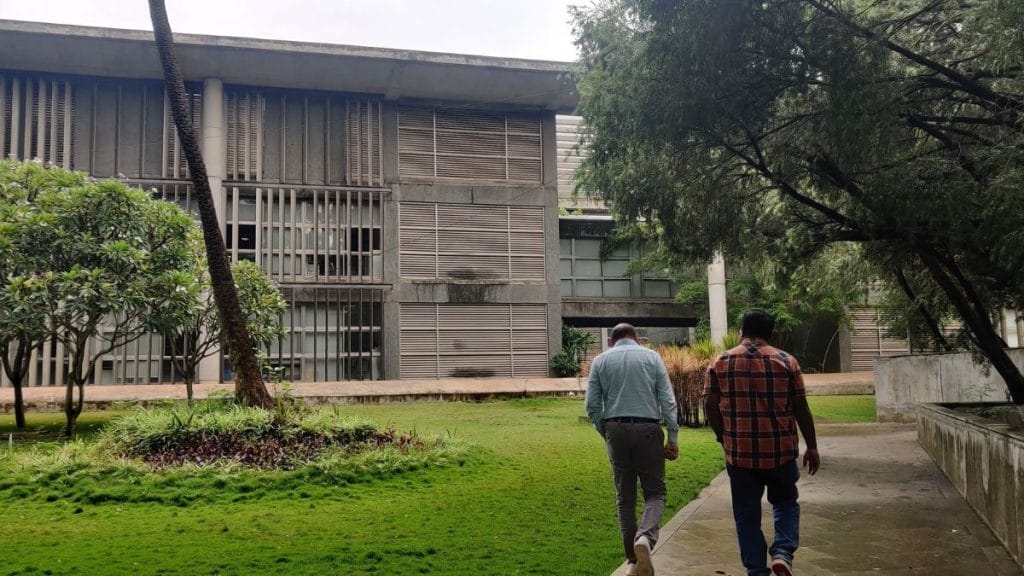
That is why scientists in this relatively quiet Pune campus have been watching the Pacific so closely. Their job is to make sense of a weather system that can change rapidly, connect events separated by thousands of kilometres and routinely defy the models designed to predict it.
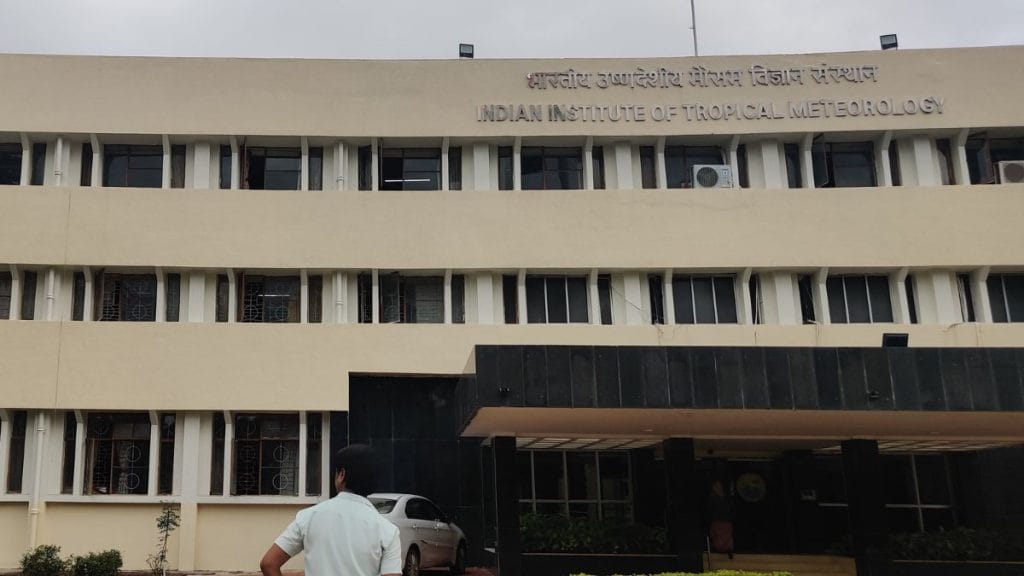
The 64-year-old institute, under the Ministry of Earth Sciences, is effectively the research engine behind much of India’s weather science. The India Meteorological Department issues the forecasts people see on their phones and television screens; IITM works much further upstream — building and improving models, studying the atmosphere and oceans, maintaining long-term climate records and trying to understand why forecasts go wrong.
As part of the Monsoon Mission team at IITM Pune, under senior scientist Anupam Hazra, 52, Pillai’s work is to predict the ever-elusive Indian monsoon through large-scale mathematical models that study everything from winds, moisture, cloud cover, and temperature. Armed with India’s fastest meteorological supercomputers, IITM Pune forms the research backbone of decoding India’s great weather equaliser and is trying to do something that has remained stubbornly difficult: make sense of the tropics.
But the IMD’s sister organisation does much more than track the monsoon. Its scientists fly into clouds to study their properties, simulate atmospheric processes in laboratories, analyse tree rings to reconstruct centuries-old monsoons and develop India’s own climate models for global assessments like UN IPCC. Unlike institutions focused primarily on day-to-day weather forecasting, IITM’s mandate is tropical meteorology — understanding weather and climate across the tropics, with India at its centre.
“Think of weather forecasting like predicting a journey from one station to another. In a less active region, it is like a train journey — the route is fairly predictable, and the journey changes only slowly. But in the tropics, it is more like travelling by bus through a busy city; things can change very rapidly,” explained Suryachandra Rao, director of IITM Pune.
“So predicting weather is a very challenging problem. That is why even the World Meteorological Organisation felt the need for having a dedicated centre for tropical meteorology, like IITM Pune.”
Monsoon Mission
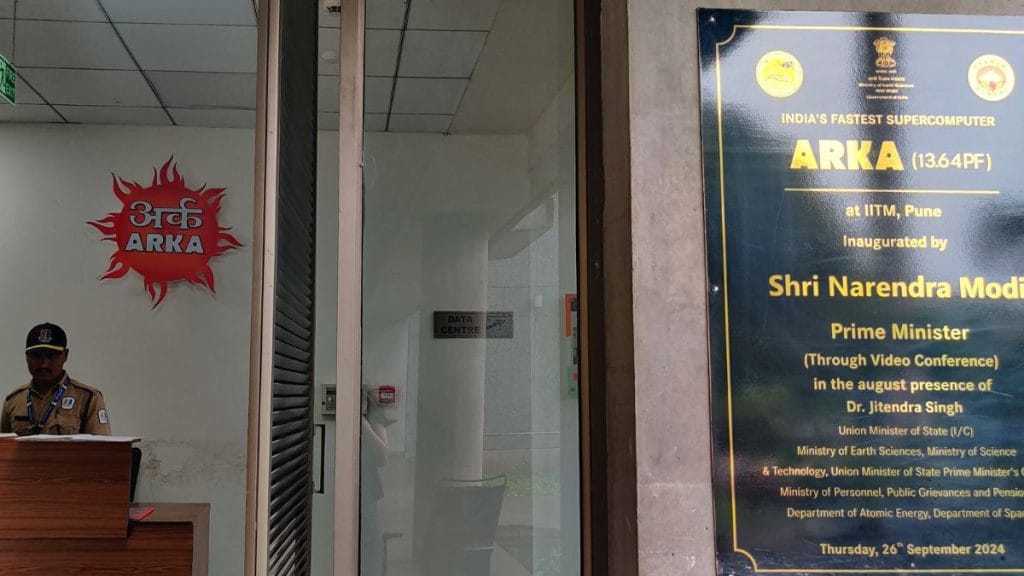
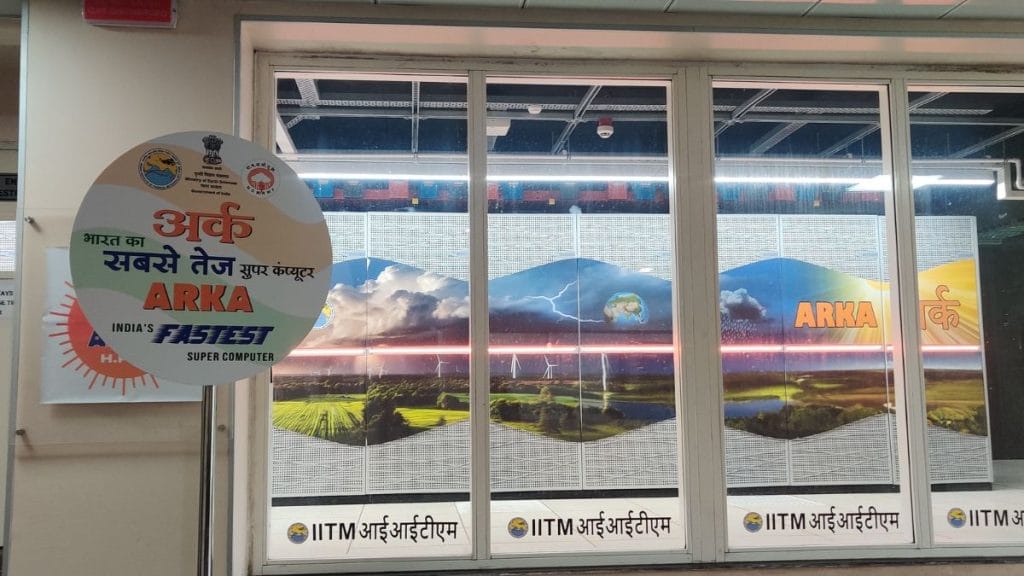
On an overcast day, the low hum of computers fills the air around one of IITM’s most important buildings. Inside is Arka, the country’s largest meteorological supercomputer, capable of 11.77 petaflops — 11.77 quadrillion calculations a second — with 33 petabytes of storage.
Arka was inaugurated in 2024 and changed the scale at which Indian weather models could operate. Since May 2025, the new Bharat Forecast System has been able to model weather at a 6-km resolution, compared with the earlier 12-km resolution. The next jump, to 3 km, is planned by 2028 under Mission Mausam.
That difference may sound small. In weather forecasting, it is not.
A 12-km grid can miss the local behaviour of a storm or a cloud system. A 6-km grid allows the model to see much smaller features and potentially tell a forecaster more precisely where heavy rain may fall.
“It’s a simple thing. As your compute power increases, so does the accuracy and the scale of your forecasts,” explained SMD Jeelani, the scientist who heads IITM’s high-performance computing system.
But Arka is only the muscle. The brains are the models being built and continuously modified by scientists across the campus.
One of the main teams is the Monsoon Mission, a collaboration involving IITM, the IMD, the Indian National Centre for Ocean Information Services and the National Centre for Medium Range Weather Forecasting. Set up in 2012, its objective was straightforward but enormous: build an India-centric system for predicting the monsoon.
The model needs to know what the atmosphere and oceans look like now before it can calculate what they might look like tomorrow. That means temperature, humidity, pressure, winds, moisture, ocean conditions and a host of other variables.
Hazra’s Monsoon Mission team sits on the other side of campus, and their main job is to gather insights and weather data from the IMD and global centres like the World Meteorological Organisation, and input them as ‘initial conditions’ in their forecast model.
“A weather prediction model is essentially a series of equations, which looks at the current state of the atmosphere and oceans, applies the laws of fluid dynamics and physics, and tells you what the weather will be for the next few days, weeks and months from now,” explained Dr Susmitha Joseph, a scientist leading the subseasonal prediction efforts in the Monsoon Mission team.
There are models for different horizons: the next few hours, the next 10 days, the next four weeks and the next three to four months.
But before any of those calculations begin, someone has to tell Arka the supercomputer what the atmosphere looks like right now.
The 5:30 am weather report
Every morning, meteorologists around the world take a snapshot of the atmosphere.
At 5:30 am IST daily, 900 radiosonde balloons are launched from observation stations, carrying instruments that measure variables including temperature, pressure and humidity as they rise through the atmosphere. Around 50-60 such launches are made daily by the IMD in India, while hundreds more take place around the world.
The data is fed into forecasting centres, including IITM.
By 8:30 AM, scientists such as Medha Deshpande from Hazra’s team begin feeding those observations into the models — just like her counterparts across the world.
Arka then works through the equations at a scale impossible for a human being to replicate. Within three hours, the models produce forecasts, largely in binary code. But the computer does not simply spit out a weather bulletin ready to be sent to your phone.
Scientists still have to interpret what the models are showing, compare different outputs, identify inconsistencies and understand where the model may be wrong. The IMD then uses this information alongside observations and other forecast guidance to issue public forecasts. Then they have forecast ready for the next 10 days.
IMD and IITM Pune work like two parts of a well-oiled machine. IMD issues daily forecasts; IITM performs rigorous ‘post-mortems’ on model discrepancies to figure out where it got things right — and where it went wrong. When the IMD’s forecast does not match what actually happens — an unexpected cloudburst, a dry spell or floods in the wrong place — IITM scientists can study the discrepancy and use it to improve the model.
In other words, the forecast is also an experiment.
The model used for India’s monsoon forecasting, the Monsoon Mission Climate Forecast System, began with a model procured from the US National Oceanic and Atmospheric Administration in 2012. It has since been repeatedly altered for Indian conditions.
“We procured an initial model from US-based NOAA, which was the base model on which we developed our calculations and adjusted it to our atmosphere,” said Dr Hazra, the Program Director of Monsoon Mission.
Over the years, the model underwent a Ship of Theseus-like transformation. The original model is now less a finished product than a starting point — its architecture retained, while Indian scientists continue to rewrite and refine the system.
And the models are no longer built only to tell people whether it will rain tomorrow. They are increasingly being developed for agriculture, energy, hydrology and other sectors that need to know what weather might look like weeks or months ahead.
To understand a cloud, go inside one
There is a limit to what a computer can learn from data collected on the ground. Sometimes, IITM scientists need to get into the weather themselves. That is the job of Thara Prabhakaran’s cloud microphysics team.
A cloud may look like a single white mass from the ground. Inside it is a moving laboratory of water vapour, droplets, ice particles and aerosols from sources ranging from sea spray to pollution. These tiny particles can affect how droplets form, how clouds grow and ultimately whether they produce rain.
“The fundamental issue that arises in weather forecasting models has to do with the clouds,” explained Prabhakaran. “So we’re studying the physics inside a cloud.”
Her team has an unusual way of doing that: it flies through them.
Inside a Beechcraft B200 aircraft are instruments capable of measuring temperature, winds and the size and characteristics of cloud droplets.
“Most of the insights that we get about clouds and rain droplets are from the ground. But the properties are different in the sky,” she explained. “The aircraft is like a flying observatory.”
Since the programme began, the team has conducted more than 200 research flights through clouds.
While ISRO and the IMD study the clouds from below, or from above through satellite imagery, Prabhakaran’s team is the only one that studies clouds from within, joining an elite group of nations including USA, UK, Germany and Israel that have dedicated airborne research fleets.
Since 2012 when their department was set up, they have published multiple research papers on the behaviour of pre-monsoon and monsoon clouds, the role of aerosol pollution in rain formation, and the difference between land and ocean clouds in the Bay of Bengal. But their goal goes one step further.
“We’re building up our base in observation and improving weather forecasts using this base,” explained Prabhakaran. “And eventually, this observation will help us in weather modification too – such as cloud seeding.”
The point is not simply to produce interesting cloud data. The observations are fed back into the models that try to predict rainfall — and, potentially, into efforts to manipulate it.
Well before Delhi government’s experiment, Prabhakaran’s team at IITM Pune tried cloud seeding over the Solapur region in Maharashtra to induce rainfall in a drought-prone region and reported an 18 per cent enhancement in rainfall under specific atmospheric conditions. The 2023 study examined roughly 272-276 convective cloud cases using a randomised double-blind protocol and reported a statistically significant result.
The important caveat is that cloud seeding does not mean making rain on demand. The experiments showed an effect only when the right kinds of clouds and atmospheric conditions were already present.
Looking back 1,000 years to understand tomorrow
For another group at IITM, understanding India’s weather means looking in the opposite direction — not into the sky, but into the past.
At the Centre for Climate Change Research, scientists study how India’s monsoon interacts with the rest of the climate system: the Pacific Ocean, the Indian Ocean, aerosols, glaciers, Arctic ice and the warming atmosphere.
It is the kind of work that makes an El Niño in the Pacific relevant to a scientist sitting in Pune.
“Accurately predicting climate means you need a lot of data—not just temperature and precipitation, but also variables that indirectly affect it,” project scientist Anoop Mahajan explained. “Physics drives day-to-day weather, but chemistry can drive long-term changes by influencing physics.”
The centre has developed the IITM Earth System Model, India’s own climate model, which contributes to the modelling work used in Intergovernmental Panel on Climate Change assessments.
“This Earth system model, named IITM-ESM, allows us to take a holistic view of the different drivers of climate change – and understand and quantify global warming,” said Swapna Panicker, one of the project scientists at CCCR.
But models need long records to be useful. And instrumental weather records do not stretch back far enough to tell scientists what the monsoon was doing centuries ago. So they look at trees.
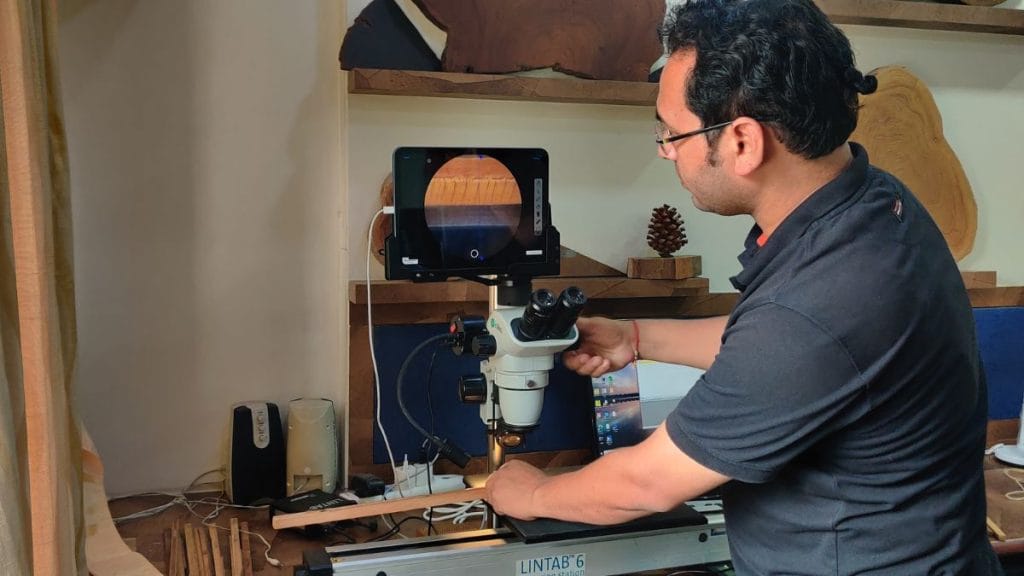
Scientists collect samples from fallen, long-lived trees — including Himalayan conifers and teak from central and peninsular India — and study the rings formed as the trees grow. Ring width, wood density and oxygen isotope ratios can preserve clues about past rainfall and drought.
At IITM, these records have been used to reconstruct annual monsoon variability as far back as roughly 500 to 1,200 years.
The exercise is not academic nostalgia. Knowing how the monsoon behaved during past droughts and wet periods gives scientists a longer baseline against which to understand today’s increasingly warm climate.
“Climate is an embedded system. So today’s weather is tomorrow’s climate. Every day what is happening, over the year, it becomes the climate,” said Suvana Fadnavis.
Her team’s work stretches from observations collected at monitoring stations across India to the chemistry of the atmosphere and simulations of the Earth’s future climate.
One of their most visible efforts is the Monsoon OnLine (MOL) portal, managed by Dr. Roxy Mathew Koll, which brings together daily and weekly monsoon observations. The long-term monsoon dataset on MOL plots El Niño and La Niña conditions alongside all-India summer monsoon rainfall, allowing users to see the historical relationship between ENSO and Indian rainfall.
Most importantly, it has been IITM scientists who have shown through their work that an El Niño year does not automatically mean reduced monsoon rainfall.
Koll’s work, for example, suggests that rapid warming of the Indian Ocean could weaken the relationship between El Niño and Indian monsoon. Meanwhile, Dr. Fadnavis’ team has shown that during El Niño years, aerosol loading over the Indo-Gangetic Plain can be higher than normal, which can reduce the drought associated with El Niño.
“We look at 30-years, 50-years, and even 100-years of climate systems to make sense of our current climate,” said Fadnavis. “By systems, we don’t just mean monsoon, but also heat, melting glaciers, Arctic ice changes. They’re all connected.”
Also Read: India rolls out 3 AI-based models for faster, more accurate weather forecasts
The problem with monsoon forecasting in India
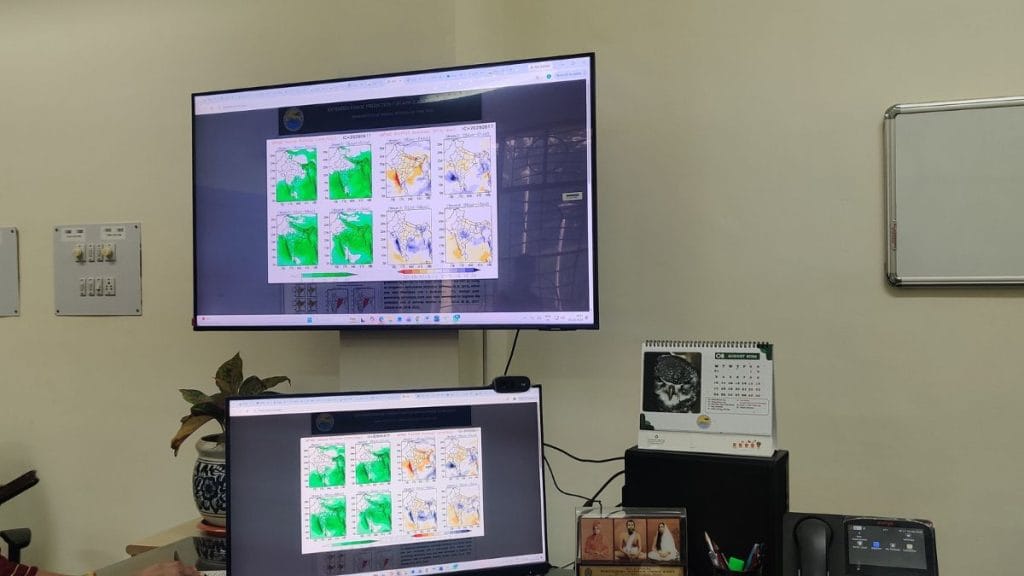
Every month since February, Pillai’s team has been running the model to see how Pacific sea surface temperatures are set to change, and every month the graph has climbed a little higher.
The models can pick up broad direction but they cannot eliminate uncertainty. That is the central problem IITM has spent decades trying to solve.
In much of North America and Europe, weather systems are often dominated by large-scale warm and cold fronts that move in relatively predictable ways. Tropical weather is more restless. A small change in sea-surface temperature, soil moisture or upper-level winds can alter the behaviour of a much larger system.
A storm can intensify, a rain system can collapse or a dry spell can break. And it can happen quickly.
“People often say that weather forecasts are so much better in the US or UK, as compared to India. But if those same institutes did weather forecasting in India, they would fail more than we do,” said Rao. “This is because tropics are very active, and things develop and dissipate just as fast.”
The problem is recognised well beyond India. Many meteorologists in South America also explain how existing weather forecasting models are built on data from high-income countries in the mid-latitudes, which have decidedly different weather patterns as compared to the tropics.
India is therefore not simply trying to do the same forecasting better; it is trying to solve a different forecasting problem.
That was the gap IITM was created to work on: understanding the complicated machinery that drives tropical weather in the first place.
Its work now extends well beyond India. Its forecasts and predictions are used by countries like Nepal, Bhutan, and Sri Lanka. IITM also hosts the International Monsoons Project Office (IMPO), which is a joint agreement with the World Meteorological Organization, and its work has found praise by global bodies like the European Geosciences Union, for trying to resolve the “monsoon prediction deadlock.”
But the stakes are no longer just about getting tomorrow’s rain right. As temperatures rise and extreme rainfall, heatwaves and other weather events become more consequential, the cost of a bad forecast rises with them.
Back in Pune, the scientists are still watching the Pacific. Outside the institute, the Pune monsoon is doing what it has always done: arriving, intensifying, breaking apart and surprising everyone. The city experienced its wettest July in 13 years, a fitting reminder that despite models and forecasts, scientists are still learning about Indian monsoons.
(Edited by Stela Dey)