



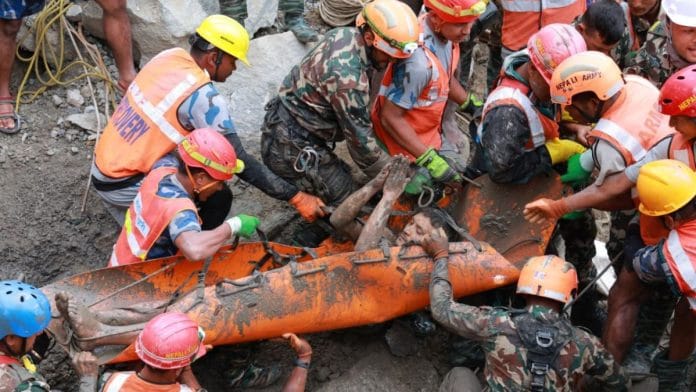
Kathmandu: “Hunncha” — “okay” in Nepali — was the word that changed everything for rescuers searching a flooded hydropower tunnel in Nepal.
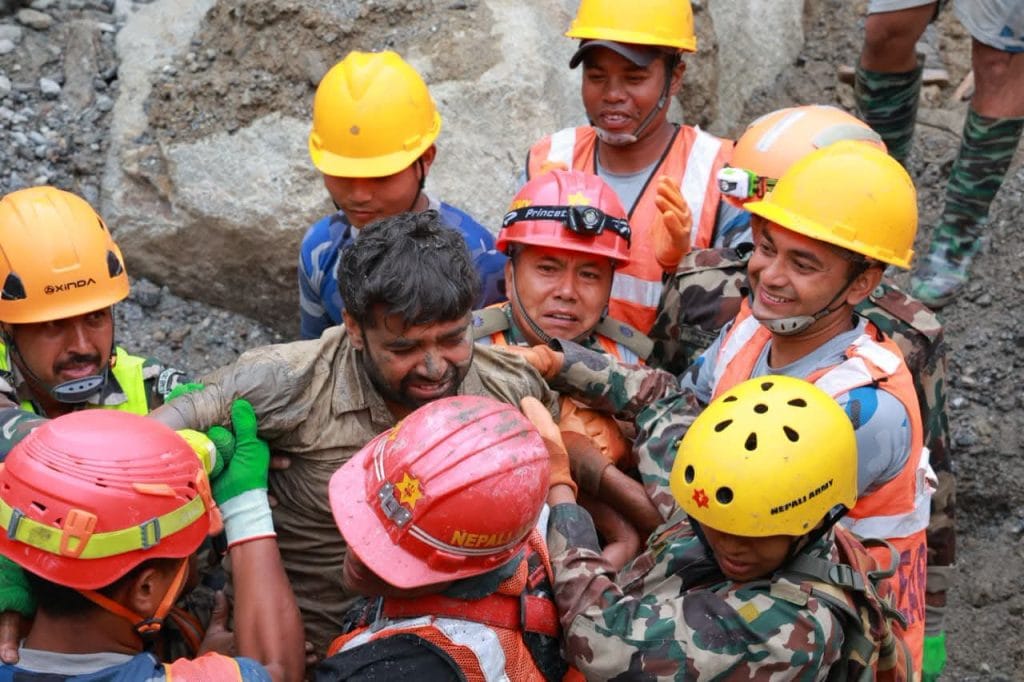
For nine days, there had been no word from the workers trapped inside the Upper Trishuli 3A hydropower project after floods struck the Trishuli River on 26 August. Then, at around 7 am on 4 September, rescuers crawling through a narrow opening heard a faint voice from the darkness.
“Is anyone there? We are coming to rescue you, don’t worry,” they called out.
“Hunncha,” came the response.
The voice belonged to 30-year-old Sanjay Shah, an operator at the hydropower project, who had been trapped underground with his colleague Kabir Mahajan, a mechanical supervisor.
Shah had the opportunity to escape the underground tunnel when the floods hit, but he stayed behind to help his colleagues. That instinct may have ultimately saved his life.
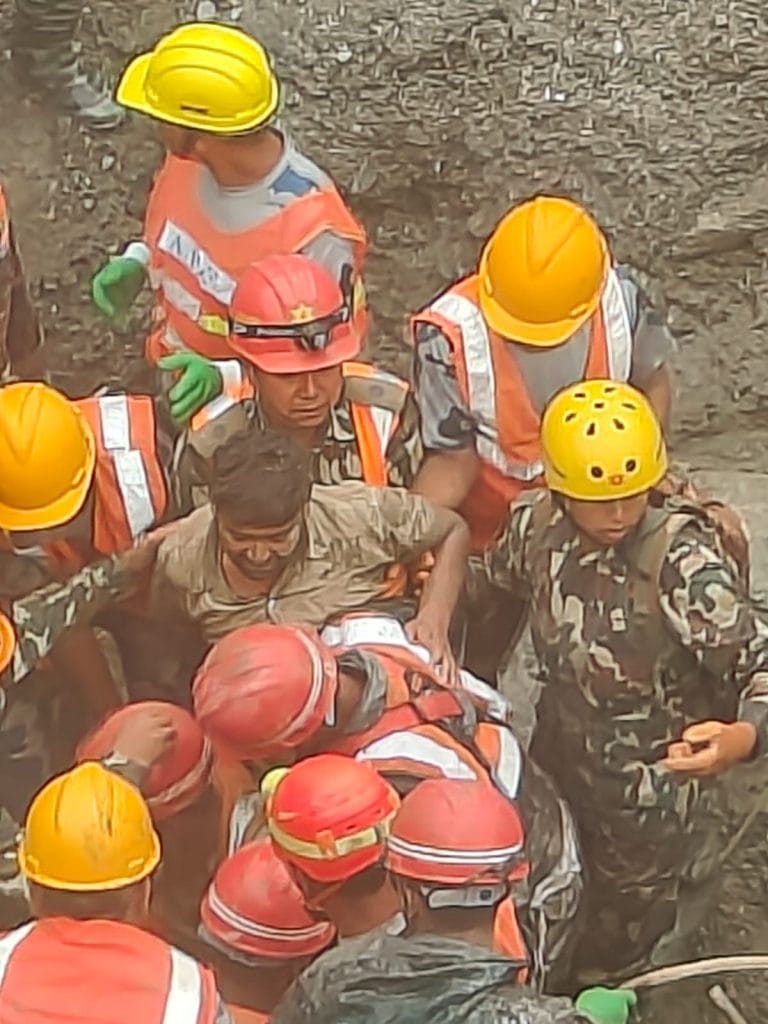
Both Shah and Mahajan were brought out alive after spending nine days inside the mud-filled tunnel — a rescue that has renewed hope among families of more than 900 people feared trapped across 12 tunnels linked to six hydropower projects. They were found around 170 metres deep inside the access point to the tunnel made by the Nepal Army.
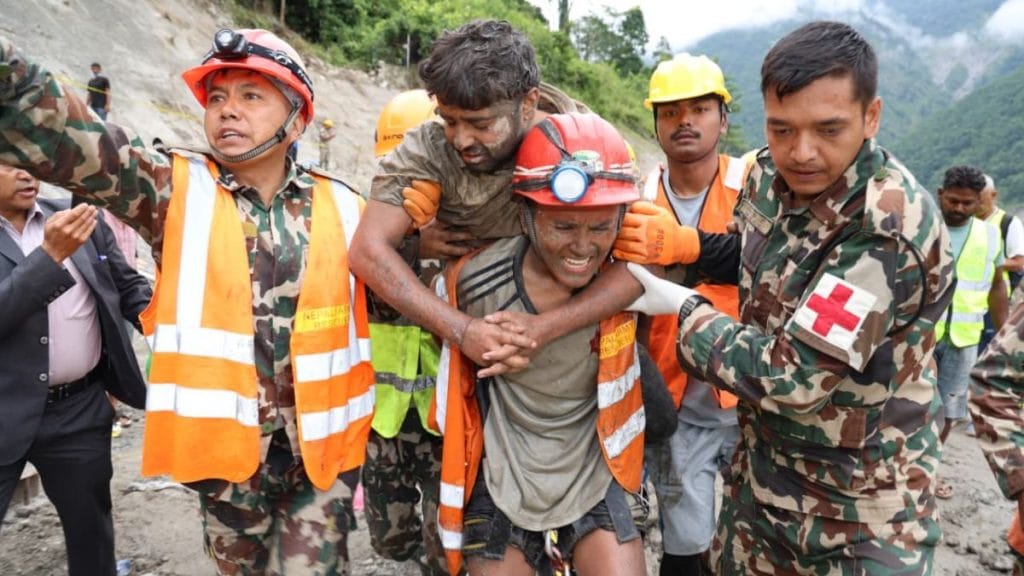
Shah was working at the Upper Trishuli 3A hydropower project, whose tunnel ran parallel to the flooded river. After hearing about the floods, he tried to get 40-45 workers to safety.
“I used to work in the control room as an operator, so it was my duty to save everyone’s lives; I couldn’t just run away,” said Shah, breathing through an oxygen mask, to the Nepal Army on Friday morning. “But while herding everyone out, I lost time to escape myself.”
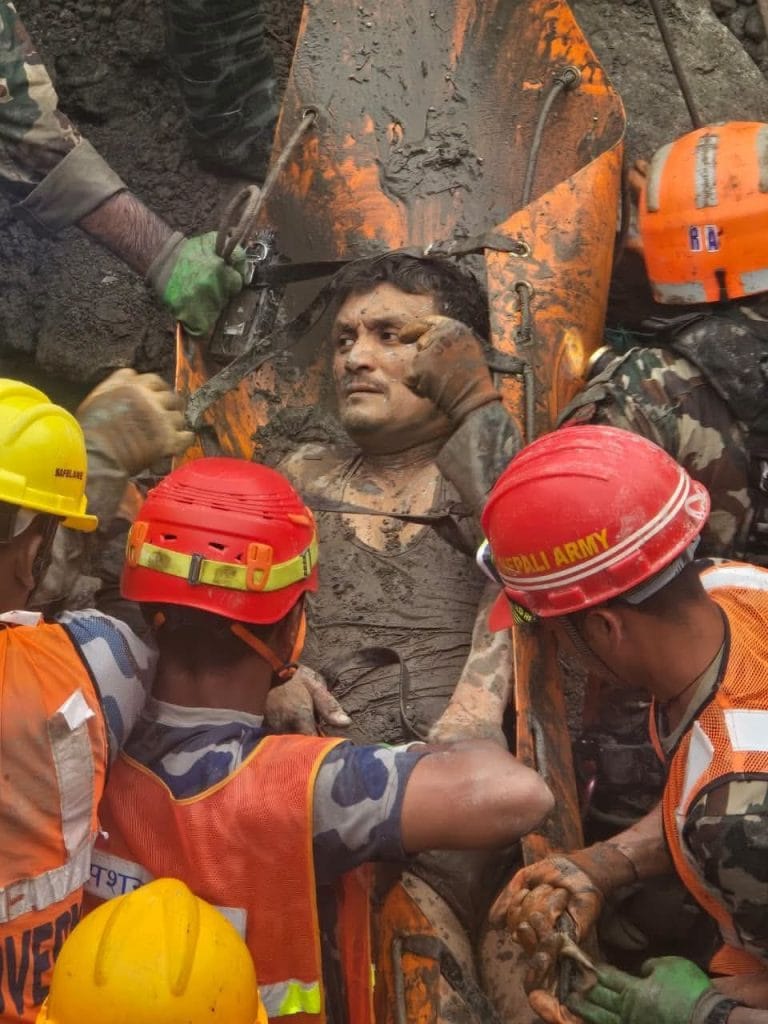
When they came out, neither Mahajan nor Shah were in a condition to walk, or even stand up. Mahajan’s legs were almost paralysed from the waist down. They were immediately provided with oxygen masks, and arrangements were made to airlift them to Kathmandu.
Shah remained conscious enough to respond to a few questions through his oxygen mask, as he lay on a stretcher outside the tunnel, being attended to by the Army’s doctors.
“He said that there could be about four or five people still inside the powerhouse, and that the rest had escaped when he had informed them about the flood,” said Sagar Dhakal, an MP and hydraulic engineer who was involved in the rescue efforts. “But we realised that most of them might have been swept away by the flood, because we couldn’t find them anywhere else in the tunnel.”
The rescue effort
The night before the rescuers made first contact, security personnel cleared a small entry point into the tunnel amid heavy rocks and debris by performing a controlled blast. Afterwards, they used water jets to clear an area just big enough for three rescuers to crawl through.
The personnel had entered around 100 metres into the tunnel, through knee-deep mud, before they heard Shah and Mahajan’s voices.
“Once they heard that people were alive, within two hours we had mobilised personnel and created a plan to bring the survivors out on stretchers,” said Brigadier General Rajaram Basnet, spokesperson for the Nepal Army.
More than 100 personnel from the Nepal Army and Armed Police Force were involved in excavating the debris and rescuing the people, but the effort began much earlier, with a team of government engineers figuring out how to find the tunnel in the first place. Located right at the border between Nuwakot and Rasuwa districts, the hydropower project was directly in the flood’s line of fire.
When Dhakal reached the tunnel on 27 August, a day after the floods, he thought the hardest part of the rescue would be getting there. Then he saw the devastation. The roads had been swept away, yet the rescue operation needed excavators, drilling machines and borewells — heavy equipment that now had to reach a region with no motorable road left.
“Even a perfect hydraulic engineer could not imagine the scale of this flood. We build hydro projects in a high place because we don’t expect flood water to reach there,” said Dhakal. “But think that this disaster was so strong that, if you look at the area now, you could never guess that there used to be a hydropower project there once.”
He was there with another MP, Shriram Neupane, also a hydraulic engineer, and a team of hydropower experts who had coordinated with the Prime Minister’s Office and the Home Ministry, and realised where they were needed the most.
Since many roads in Nuwakot and Rasuwa districts were built alongside the Trishuli River, the floods swept them away, cutting off access to the affected areas. Dhakal and Neupane had to be ferried by an Army helicopter to reach the tunnel safely.
“This is an enormous feat, achieved by the Nepal Army and the entire team. And importantly, this rewrites the textbooks on how to do a rescue,” said Arnold Dix, an Australian geologist helping with the rescue efforts, in an interview with ABC News.
Also read: Miraculous rescue in Nepal: 2 workers found alive in Trishuli tunnel 9 days after floods
Finding a tunnel that had disappeared
With no knowledge of where the survivors might be, the rescue team could not indiscriminately bomb the silted tunnels; instead, they precisely used geolocation, drone mapping, and blueprints of the tunnel’s interiors to identify the structure from the mess of debris, mud and silt that now covered it.
“We had no idea where the tunnel began or ended. Originally, it had a headrace, a cable duct, and multiple entrances,” said Dhakal. “But after the floods, everything was blocked, and there were huge rocks and boulders covering everything.”
At the same time as Dhakal and Neupane were at the Upper Trishuli 3A tunnel, other Nepali engineers and Army personnel were working on the 11 other tunnels in Rasuwa and Nuwakot that had been similarly inundated by the deluge on 26 August — altogether a massive simultaneous operation that even involved teams from India and China in certain tunnels.
“For eight days, our teams had been continuously working on every tunnel where people were feared trapped,” said Brigadier General Basnet. “In each one, the conditions were different, the damage was different, and the way to enter was different.”
“As difficult as it was for the personnel to reach the affected sites, it became even more difficult once Dhakal, Neupane and the other security forces realised that they needed heavy-duty drilling machines, excavators and water and air management systems to properly perform the rescue operation.”
This was not simply a “drill through the tunnel” rescue: rescuers first had to locate buried tunnel structures, then remove enormous quantities of debris and rock, deal with water, and create a safe passage all without collapsing the remaining tunnel.
Tunnel rescue missions globally — from the 2010 Chilean miners rescue, to the 2018 Thailand cave rescue and the 2023 Silkyara tunnel rescue in Uttarakhand — have shown that underground rescues depend as much on patience, mapping and improvisation as on heavy machinery.
But the harsh Himalayan landscape of Trishuli, and the avalanche sent up by the glacial collapse that triggered the floods, had no precedent in the world.
“The biggest challenge was that we didn’t know where the tunnel was. If you don’t know where it starts or ends, how do you know where to enter?” explained Dhakal.
He knew they had to get creative. For the first two days, Neupane, Dhakal and the engineers from the Nepal Electricity Authority, which operated the plant, set about reconstructing it from scratch. They mapped out all its entrances, the location of its powerhouse and the headrace, and then transposed it onto the wall of debris that they saw in front of them.
“We also had to use satellite data and real-time drone photogrammetry, because we were essentially locating an invisible tunnel inside a mountain,” said Dhakal.
Once they found the approximate location, they realised all three access points into the tunnel—the main headrace entry, the tailrace, and the cable duct—were blocked by debris. Of the three, the cable duct offered the best chance and became the sole focus of the rescue effort from then on. They airdropped excavators and drilling machines near the site and began working, finding a ray of hope.
“A section of the tunnel was filled with mud, but we also noticed that water was flowing out of it, at the rate of about 2 litres per second,” said Udayraj Neupane, another engineer on site. “This meant that maybe water has not accumulated inside, and there could have been some wiggle room.”
This hunch proved right, as slowly but surely the excavation work found an entry point into the cable duct tunnel. Multiple times during the operation, however, personnel also had to reckon with rain and the possibility of additional flash floods.
“The work was not uniform. Anytime rains would increase, we would have to halt operations and run uphill in case there was another flash flood,” said Dhakal. “We were working right next to the river, after all.”
Also read: How one school teacher’s split second call saved 50 kids from Nepal floods
Nine days underground
Despite the consistent work, until 4 September, rescue teams across 12 different flooded tunnels on the Trishuli River had recovered only dead bodies from within. The rule of thumb of rescue operations is that after the first 72 hours, the chances of survival drop drastically because of oxygen supply, food and water requirements, and the possibility of injuries.
So when Shah and Mahajan were brought out alive after 200 hours buried in mud and sludge, inside a dark cavern with possibly little to no access to food or water, it was hailed as nothing less than a miracle.
“We had almost lost hope; it had been so long. We’re so happy that he’s back home,” Bidya Dangol, Mahajan’s sister, told a Nepali news outlet on 4 September.
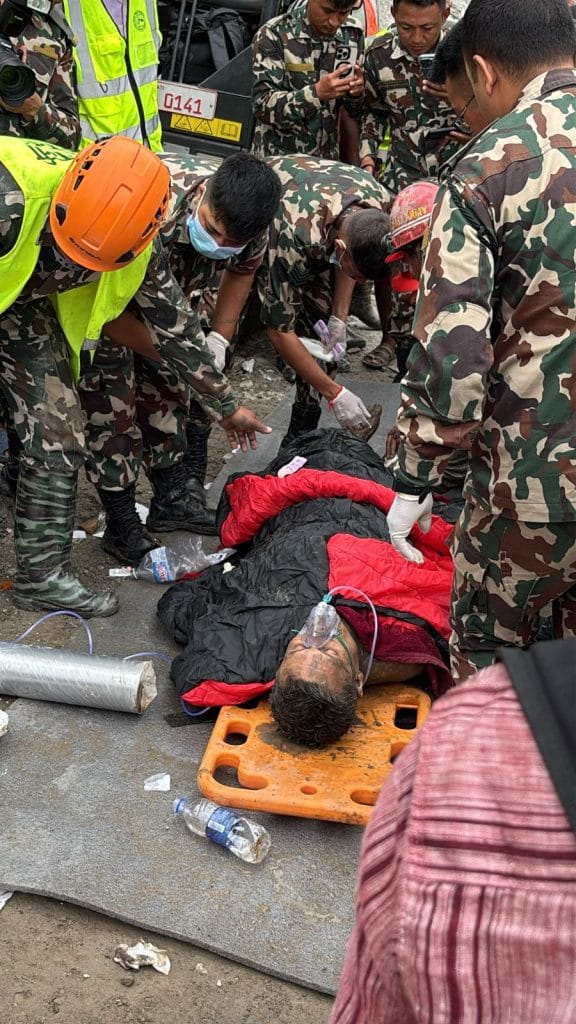
As Mahajan and Shah undergo treatment at a hospital in Kathmandu, the rescuers and engineers, too, consider their survival a mystery. Looking at the structure of the tunnel, they have certain theories.
“There was some water seepage into the cable duct tunnel, which may have helped maintain an oxygen pocket, and could also be a water source,” said Dhakal. “Also, they were deep inside the mountain, which could have helped stabilise the temperature, so they did not get hypothermia. But we need to talk to them to know more.”
In the minute-long interview Shah gave to the Nepal Army, however, through his oxygen mask, his mantra for survival was something different.
“I was chanting the Harekrishna Mahamantra when I was inside,” he said in a low voice. “It worked. Hare Krishna …”
(Edited by Saptak Datta)