





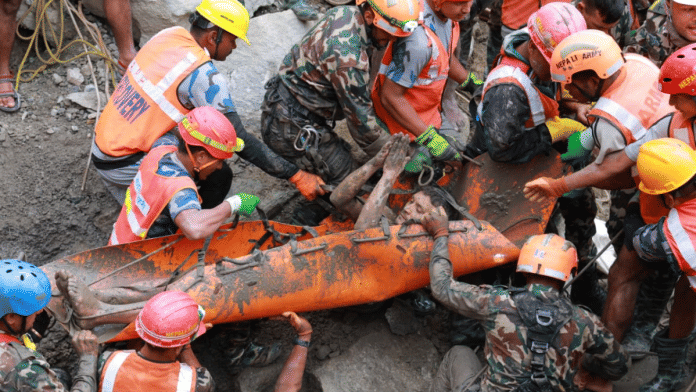

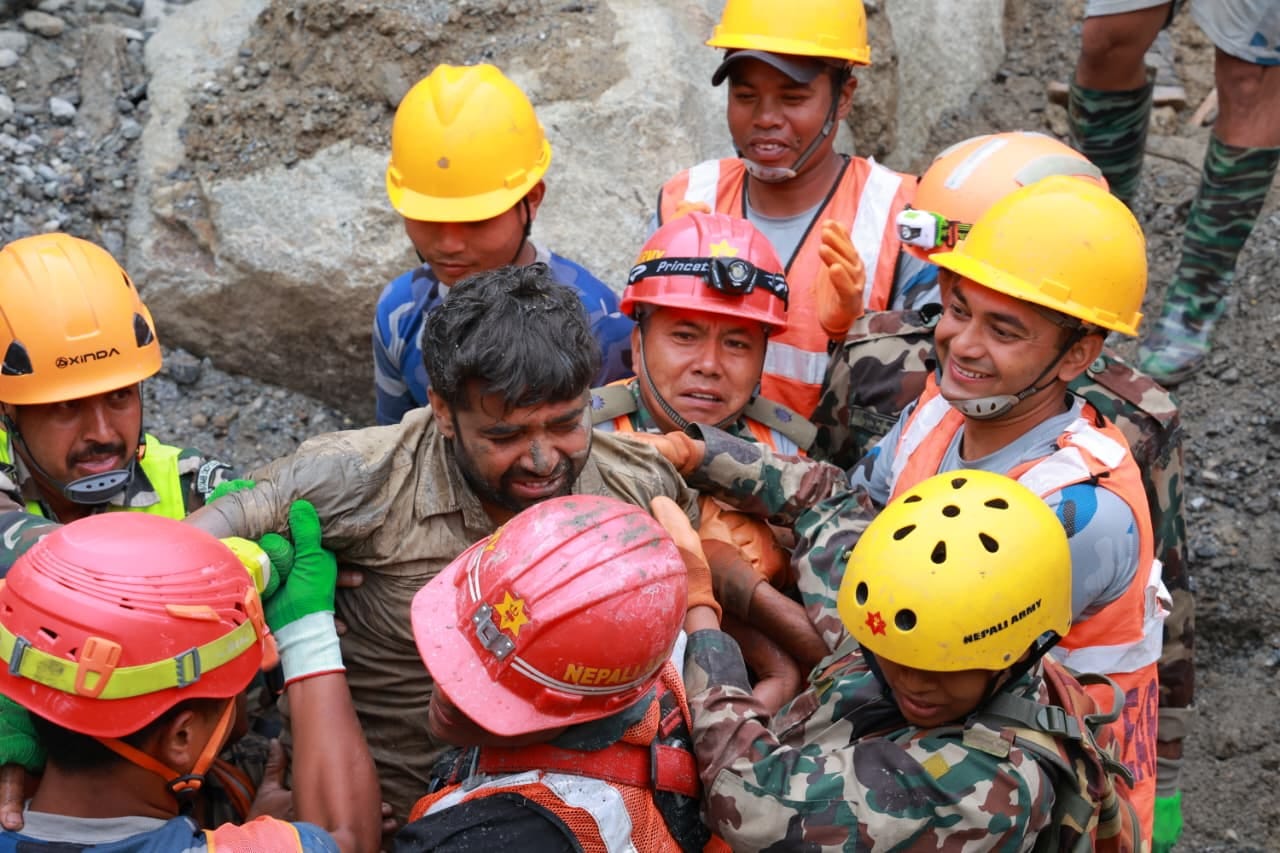
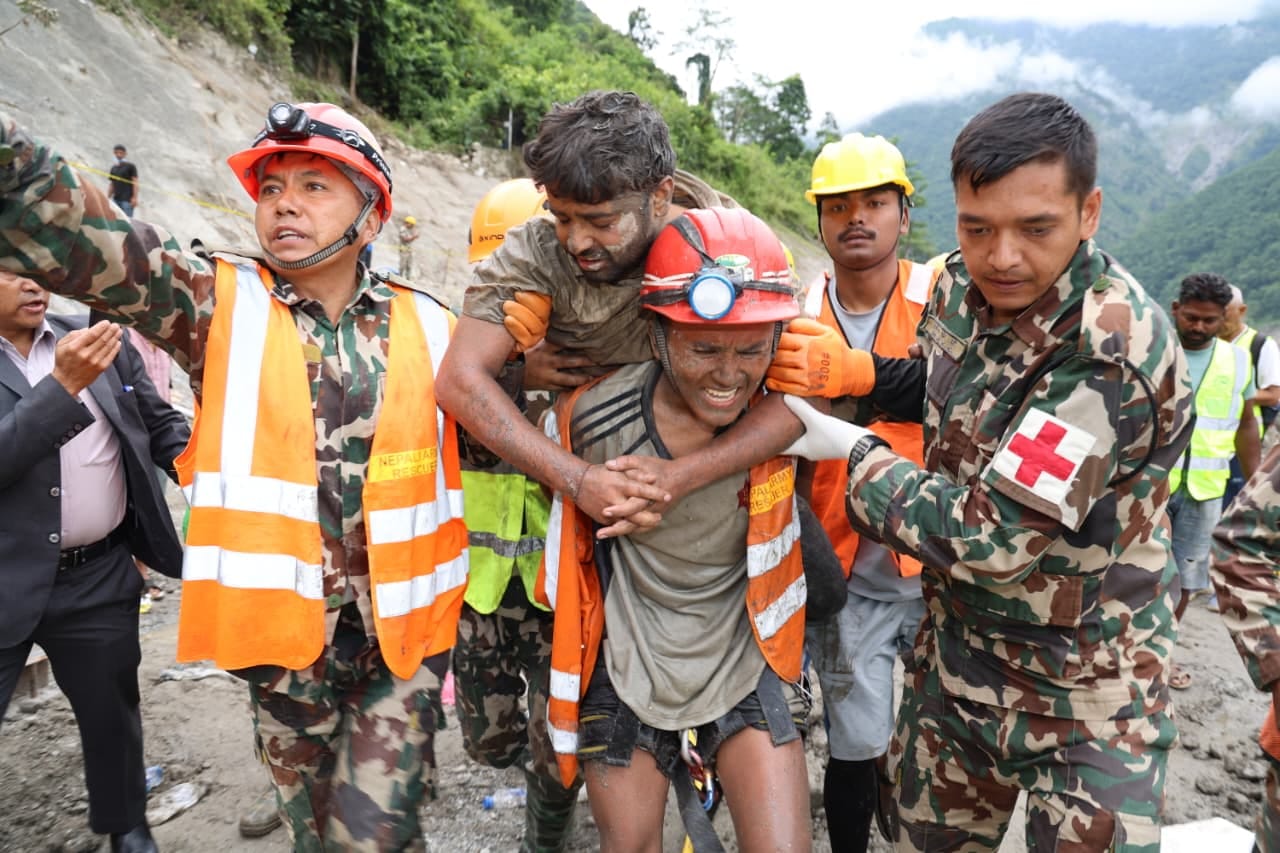
Kathmandu: The first two workers have been rescued from a hydropower tunnel in Nepal’s Trishuli River, nine days after flash floods struck the Rasuwa district. Rashtriya Swatantra Party lawmaker Shri Ram Neupane, in a Facebook post, shared that Sanjay Shah has been brought out alive from the Trishuli 3A Hydropower Project, which borders the Nuwakot and Rasuwa districts.
At 9:30 am, Neupane posted that a second person has been rescued from the same project, marking them the first two rescued from inside the hydropower project since the floods. Over 900 people are feared trapped along 12 different hydro projects along the Trishuli River.
The Nepal Army also confirmed the rescues at 9:30 AM, saying that two workers—Sanjay Shah and Kabir Mahajan—have been safely rescued and are undergoing medical treatment. The Army added that around 40 more people are expected to be trapped in the Trishuli 3A Project, with rescue operations underway.
Earlier on 4 September, Neupane, also an engineer involved in the rescue operations, posted that the Nepal Army and armed police personnel heard voices from inside the tunnel, raising hopes that the trapped workers might be alive.
“The rescue teams are intensifying operations to enter the tunnel. It is a promising sign that we heard voices from inside the tunnels,” read Neupane’s post.
According to Neupane, early Friday morning, security personnel at Trishuli 3A confirmed that more than one voice could be heard inside the tunnel. As they entered the tunnel, the rescue workers said, “Don’t worry, we are coming to rescue you”.
In response, they heard a faint voice say, “hunncha”, which means “okay” in Nepalese.
Photos shared by Neupane on his Facebook show that both rescued workers are on stretchers with oxygen masks, and the Nepal Army is working to go deeper into the 3A Trishuli project to rescue other workers who might be alive.
The Nepal Army, Armed Police Force, along with the Nepal Police, have deployed over 20,000 personnel across the country to aid in search, rescue and relief operations after the devastating floods on 26 August. More than 1,200 people have been confirmed dead since the floods hit, while 4,200 are still missing.
One major undertaking for the Nepal security personnel was to rescue the workers, technicians and engineers feared trapped inside hydropower project tunnels and underground powerhouses along the Trishuli River. Specialised teams from India and China arrived on 30 August to aid in the rescue operations.
However, since the exact situation of the tunnels was unknown and no contact was established with any trapped people, some experts shared that the probability of finding the workers alive was low. There were also concerns that since the flood mainly consisted of mud and debris, oxygen access inside the tunnels would be low.
The security personnel had earlier only managed to recover certain bodies from some tunnels, such as the Chilime Hydropower Tunnel on Monday and Tuesday.
(Edited by Insha Jalil Waziri)