


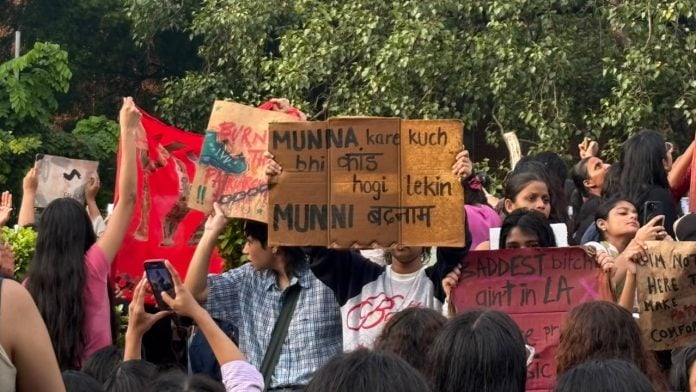
New Delhi: More than 3,000 students walked from Miranda House to the Faculty of Arts on September 28, to raise their voice against repeated instances of sexual harassment at Delhi University’s North Campus.
They spoke of men following them on bikes and cars, slowing their vehicles to stalk them, cat calling them as they walk back from the metro station, and stretches around the campus that they would rather not walk alone after sunset.
“Raja beta rapist hai (The prince is a rapist),” women students chanted loudly. “Naari apne aap ki, nahi kisi ke baap ki (A woman belongs to herself, not to anyone),” slogans echoed through the lanes in the area.
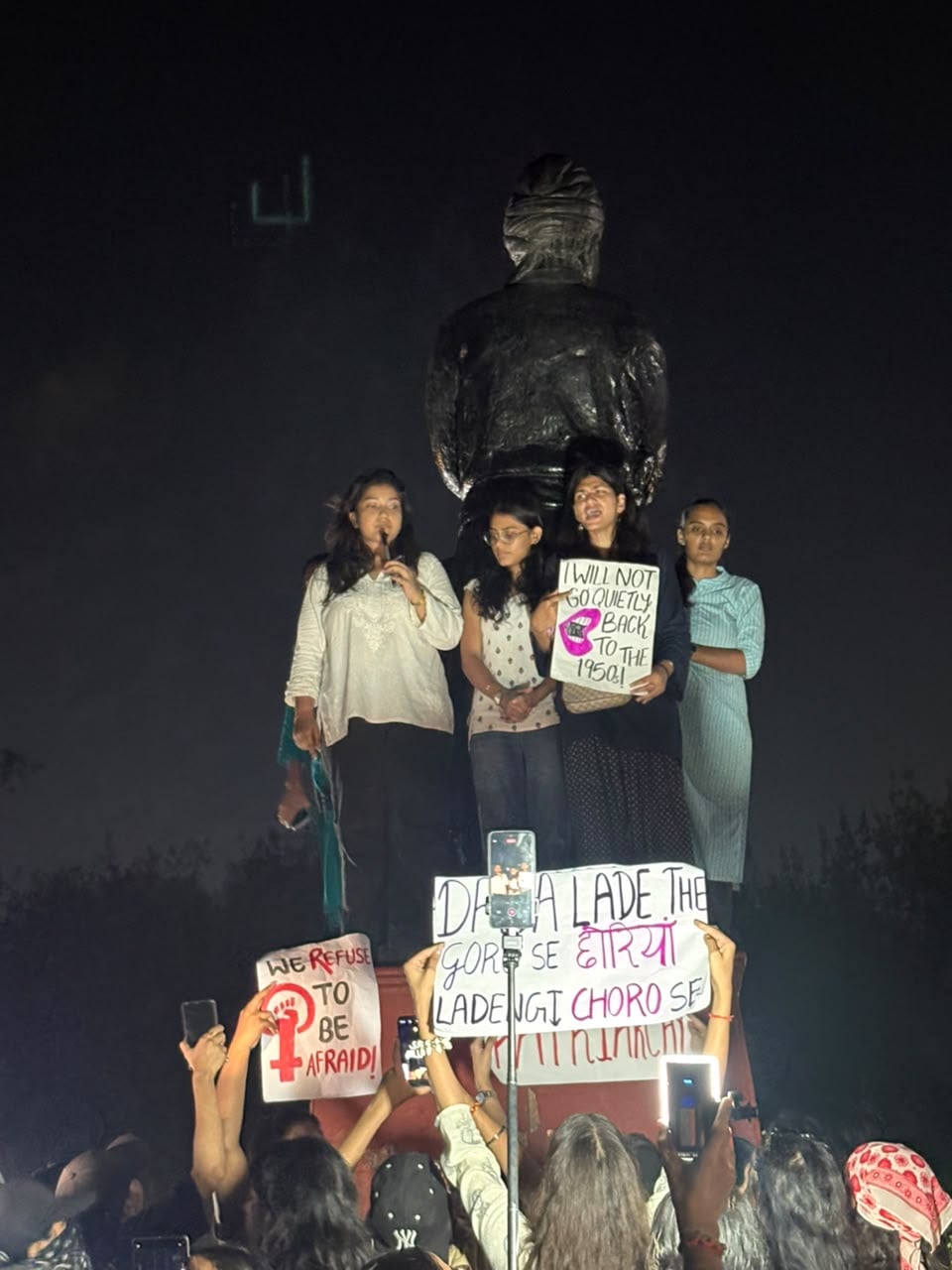
The march, Hum Auratein Aazad Hain, was organised by students of Miranda House in solidarity with a 17-year-old girl who was gang-raped at Aastha Kunj Park near Kalkaji Mandir on September 21. It followed a solidarity protest organised by students of Lady Shri Ram College for Women (LSR) a few days earlier. The students of Miranda House and LSR — both women’s colleges — initially planned it as a much smaller gathering. But the turnout grew significantly.
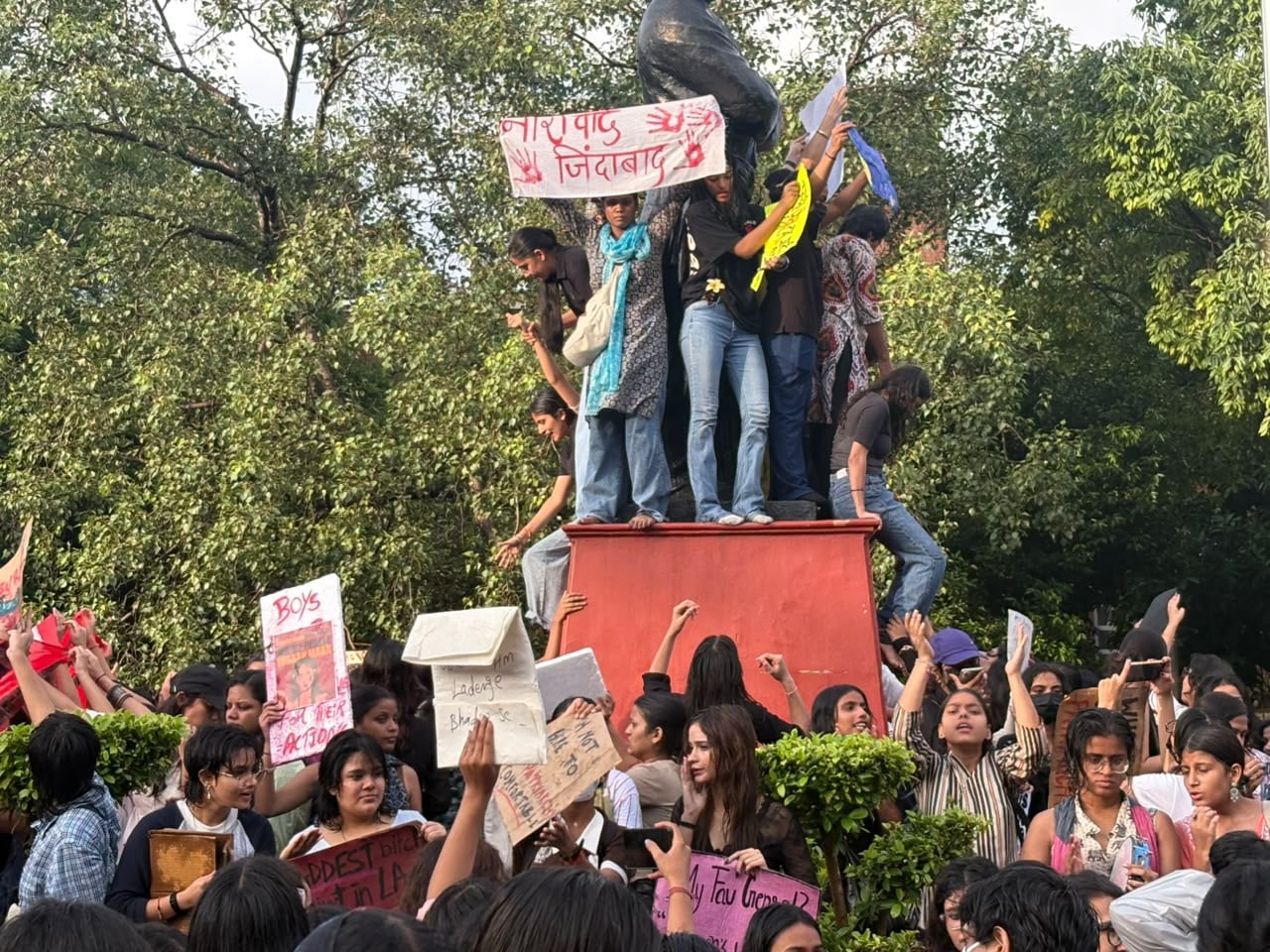
“We were expecting around 300 to 400 people, but more than 3,000 eventually joined the march,” said a third-year student from Miranda House.
It’s not an evening problem
For many, safety is central to the decisions they make every day — whether to walk to the college, which mode of transport to take home, or if they should stay back in college to finish their assignments.
“Safety is not necessarily a concern in the evening hours. Even during morning or late afternoon or early evening, men lurk around with their big cars around the campus and shamelessly cat call,” claimed a Miranda House student, requesting anonymity.
Across North Campus, students described poorly-lit stretches, men following women on bikes, and spaces they avoided when alone. Through the protest march, women students shed light on how instances of sexual harassment on campus have become everyday experiences, and demanded that their safety be taken seriously rather than an afterthought.
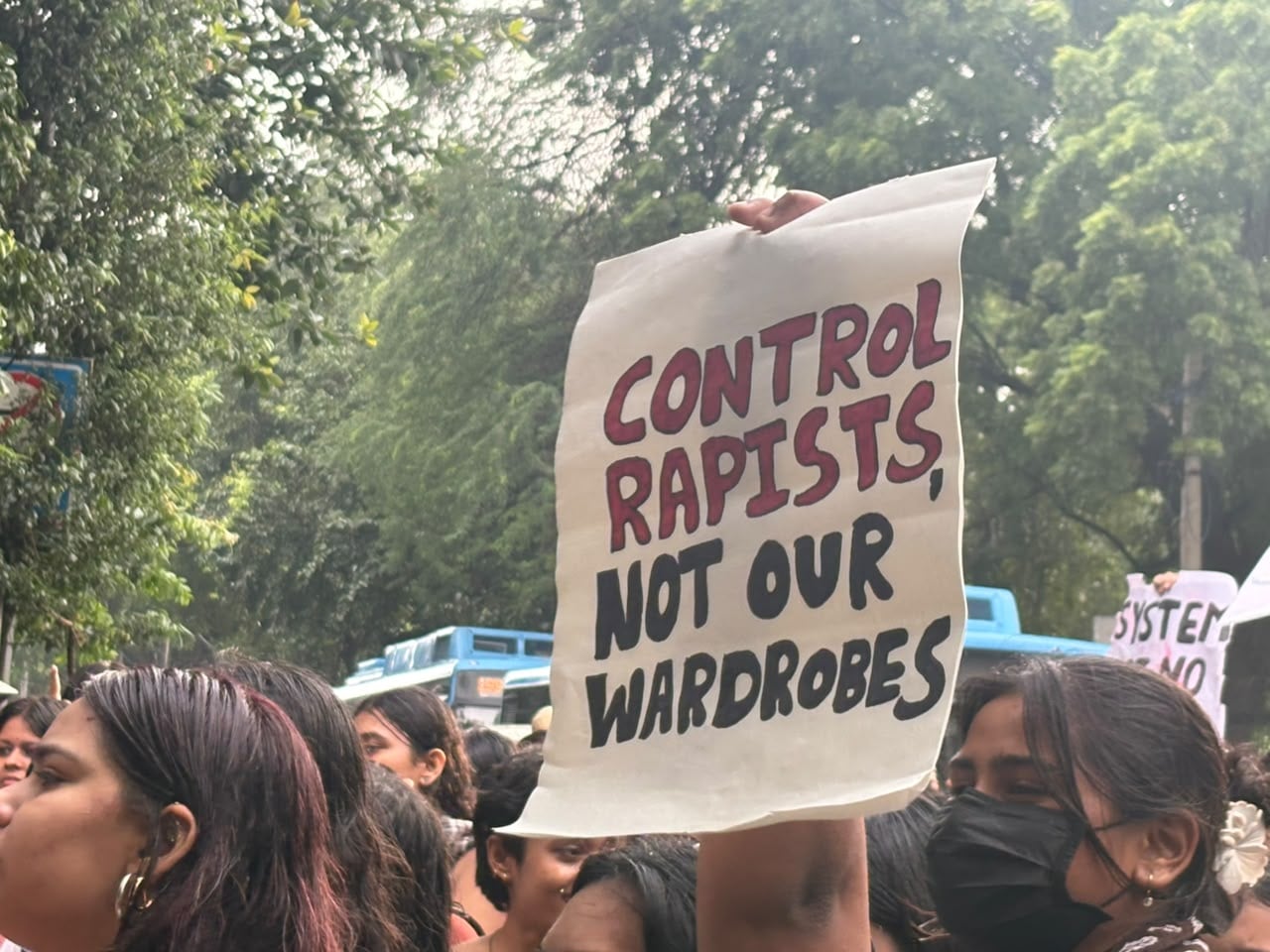
The march came after a series of wider protests pressing for women’s safety in Delhi. The capital city reported at least 13 cases of alleged rape and sexual assault since the beginning of September. The incidents included a teenager who was allegedly gang-raped and killed in north Delhi to minors allegedly assaulted in homes, hotels and public spaces.
The anxiety is not confined to Delhi. In Punjab, students at Lovely Professional University protested after reports that a female student was sexually assaulted on campus, allegations the university denied. The protests later turned violent, with students blocking the Delhi-Amritsar highway and clashing with police. In Bihar’s Jamui, protests followed the assault and molestation of a teenage girl and boy returning from coaching classes, with student groups demanding accountability and better security for girls.
North Campus replete with dark, unsafe stretches
For women students, safety concerns are not confined to a location. It is the route they take home, turns they avoid after dark, stretches where they walk faster, and the roads where they call a friend and keep looking over their shoulder.
For a former Miranda House hostel resident from Sikkim, that unease began outside the college gates. On the walk from Vishwavidyalaya metro station towards the college, she said, men on bikes would repeatedly ride past, honk, whistle and pass lewd comments at women.
“The hostel was not the problem. Miranda House had no curfew and its authorities were accommodating towards women. It’s quite safe. But outside the hostel, such incidents happened too frequently,” she said.
The route towards Patel Chest was another recurring concern. Patel Chest, adjoining to North Campus, houses food joints and libraries for self study, and is a popular hangout joint frequented by students. Around Patel Chest, students said, the streetlights work. What makes the area uncomfortable is the number of men who keep lurking there, prowling to target women students, following them, and asking them if they wanted a ride.
Another former hostel resident recalled a particularly dark stretch along Chhatra Marg, where a structure by the road blocks visibility. A friend had once told her not to walk behind it and to remain where she could be seen from the main road. “Make sure that you’re visible,” the friend had told her.
Darkness is not always the issue. Functioning streetlights, therefore, are not a panacea for women’s concerns over their safety.
Jasleen, a student at Law Faculty, recalled an incident which happened early in the morning, at around 5 am. She was walking from Hudson Lane towards Kamla Nehru Ridge with seven other girls, when two men on motorcycles began following them. Despite the women’s attempt to push back, the men did not relent. Eventually, the women had to take refuge in a nearby hostel for safety.
“It was something that shouldn’t have happened, especially on campus,” Jasleen said. “This just shows that men are not scared of the forces.”
While this is not an isolated incident, instances of sexual harassment climb during the Delhi University Student Union (DUSU) elections. A 21-year-old student, requesting anonymity, said that groups of men in cars gather around the Vice Chancellor’s Office during election periods and interfered with women, who are running or exercising in the lawns.
“They just won’t let you continue doing your physical activity. They will stand there, stare us down, and cat call,” she said.
“Whether it’s a festival or a college fest, women often feel unsafe, especially in the days leading up to Holi. Men throw water balloons at girls and women, sometimes deliberately targeting their private parts. Students in North Campus have experienced this, and I have also had a balloon thrown at me. We feel unsafe in the weeks leading up to Holi,” Jasleen said.
Away from the main college buildings, students described stretches where the basic infrastructure itself becomes unreliable.
A student, pursuing Chemistry Honours from Miranda House, requesting anonymity recalled seeing a man masturbating openly near Vishwavidyalaya metro station around noon. She said that people continued walking past and laughing, while there wasn’t any police personnel nearby.
Another student, pursuing BA (programme) in Economics, recalled walking from Kamla Nagar to Vishwavidyalaya metro station around 3 am about a year and a half ago. She described the stretch from the Kamla Nagar roundabout to the DRC turn as being “completely dark”. She recalled carrying a stick, and her friend carrying a knife for their safety.
Gaps in infrastructure costing women their safety
After the 2012 Delhi bus gang rape case, the government’s response to women’s safety centred on improving infrastructure and police patrolling, fixing poorly lit areas, installing CCTV cameras, and setting up systems for women to report complaints.
In 2016, the Delhi government said it had identified 7,438 dark spots in areas under the North and East Delhi municipal corporations and launched a programme to illuminate them. The same year, 46 additional dark spots had been identified, of which, lights were installed at 42 stretches.
Besides, the Delhi government said in February this year that more than 2.5 lakh cameras were being maintained by the PWD and proposed installing additional 50,000 cameras under a surveillance plan, estimated at Rs 646 crore.
Students say the presence of such infrastructure does not necessarily make them feel safer.
“There are a lot of streetlights,” said the third year Miranda House student, “But CCTV surveillance is not enough.” She claimed students have also faced difficulties when trying to access CCTV footage after an incident.
“Even after having infrastructure, the lights are not on. You have streetlights, you have cameras, but what is the use if they are not working? There are still so many places where it is completely dark, and that is where you feel unsafe,” said a student.
For Ilakya, a member of the independent student body Bhagat Singh Chhatra Ekta Manch, the problem goes beyond installing CCTV cameras. “There are CCTV cameras, but how will they prevent the crime from happening? They can only make sure that if it happens, it can help identify the perpetrators,” she said.
In 2021, ‘Pink Booths’ were also introduced as women-focused roadside assistance points. In the next three years, 135 such booths had been opened across Delhi. However, a spot check by The Indian Express found several locked, understaffed or non-functional.
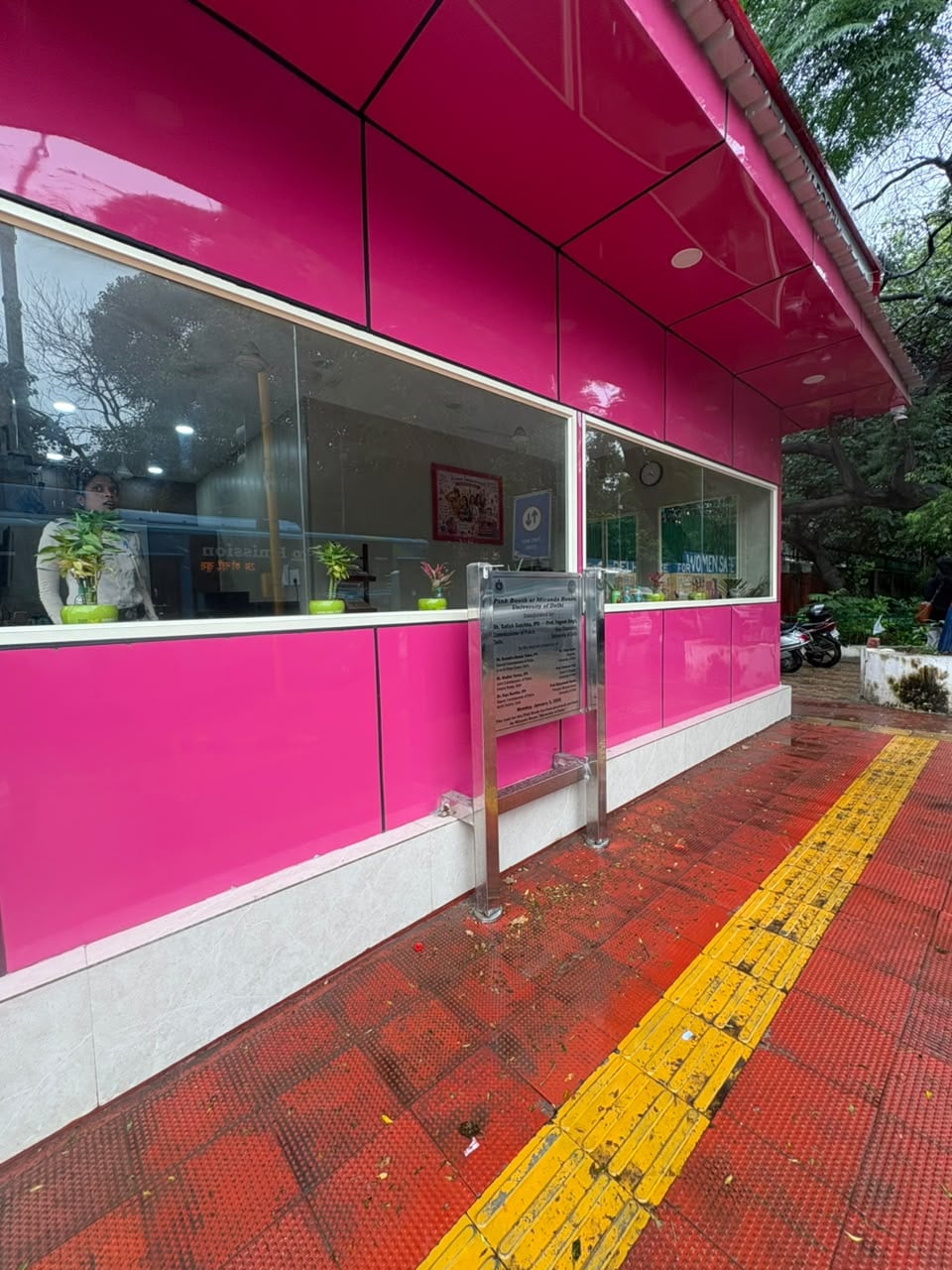
A Pink Booth was installed near Miranda House in January this year by the Delhi Police as a round-the-clock facility with women staff, which offers services such as e-FIR registration, cybercrime complaints and assistance to women in distress. It also includes CCTV monitoring and communication facilities.
Despite knowing about the booth, students said they did not feel encouraged to go there to file a complaint, citing past instances when officers failed to take necessary action.
Ilakya pointed out that women’s hostels applying curfews for students as a safety measures. But this step not only restricts women and their access to public spaces, but also absolves the authorities from all responsibility.
“This is a very problematic thinking that if you stay inside the hostel, you will be safe,” she said. “If you really want to change things, you should educate men,” Ilkaya said.
Students said they want unsafe places to be made safer, rather than being told to avoid them. Their demands, therefore, extend beyond CCTV cameras. They want functioning streetlights on roads and in parks, more reliable DTC and shuttle services, functional public toilets, and public spaces that remain accessible after dark.
Women’s safety a political issue?
The third-year Miranda House student said the students had initially set out to conduct a safety audit of North Campus. The plan was to divide the gathering into smaller groups, check the condition of street lights and CCTV camera coverage around Miranda House, Daulat Ram College and the Patel Chest area in North Campus.
“We planned to compile the findings and submit a report. But the plan changed when the march drew more numbers. We had initially sought permission for around 400 people. But after the posters circulated on social media, other colleges and student groups began issuing their own calls for the same venue, route and time,” she said.
She added that the college’s student union coordinated with the police and alerted the authorities that the turnout could be larger than expected.
“The march was meant to be independent and non-political, and it was open to women and queer participants. Later, other students and student organisations also joined us,” she said.
Some students, however, argued that women’s safety was inherently a political issue and questioned why members of political organisations should be excluded from raising their voices. Others pushed back, saying the march should not become a platform for individual political ideologies and that its focus should remain on women’s safety.
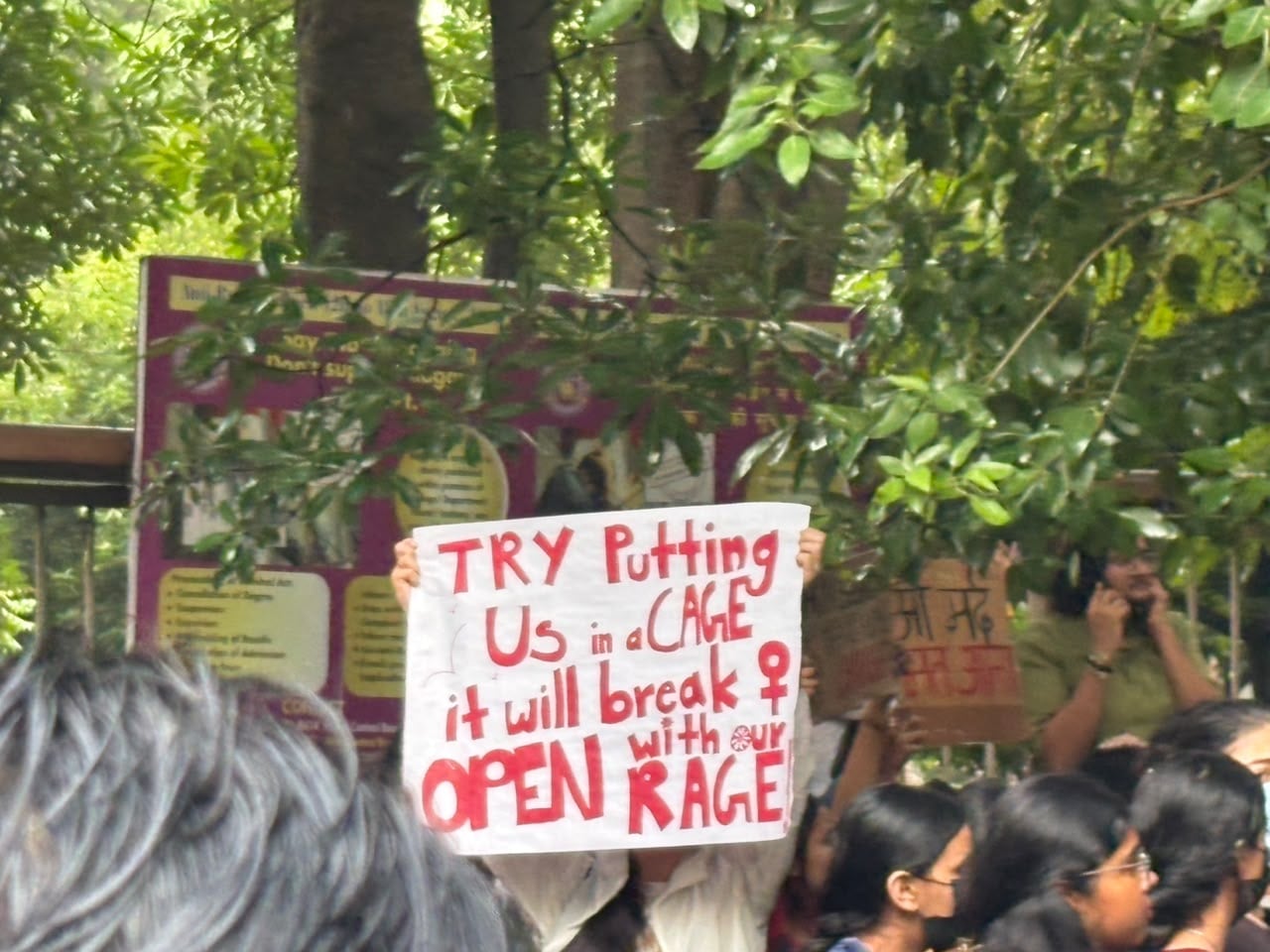
Through much of it, the march barely stopped. Rain came down intermittently, but the posters stayed raised, and the slogans continued as the crowd moved from Miranda House towards the Arts Faculty. Students carried handwritten placards and shouted slogans despite the rain.
“We want the streetlights to work. We want the cameras to work. We want the police booths to work. We want public transport that lets us get home safely,” said one student at the march. “And we want to be able to walk through North Campus without first asking ourselves whether we should be there at all.”
(Edited by Aakriti Handa)