







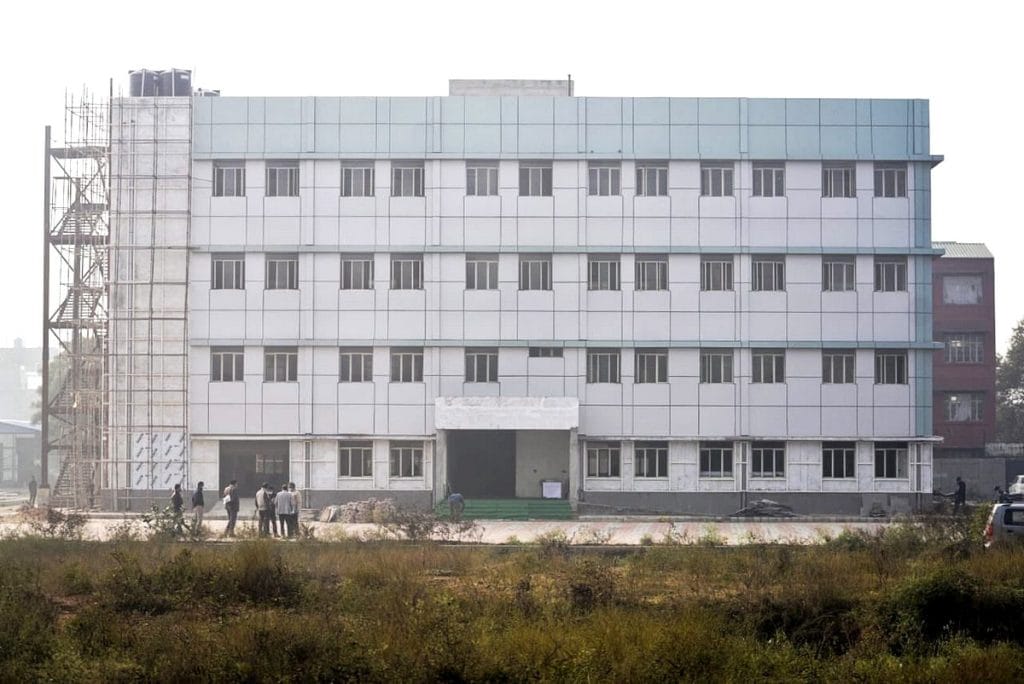
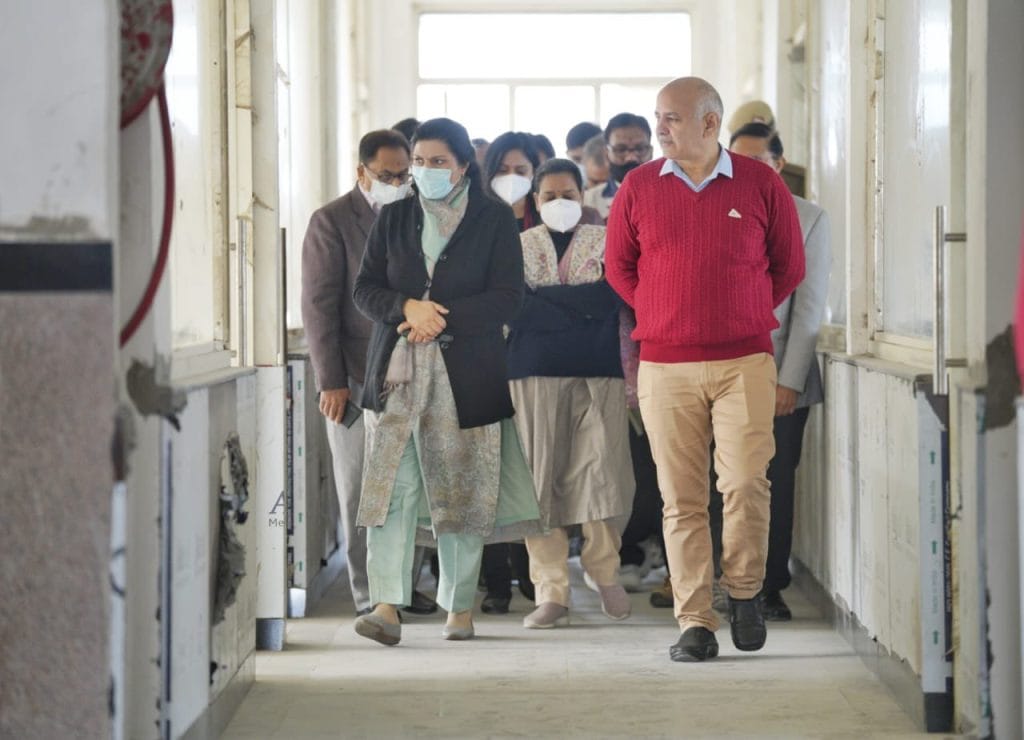
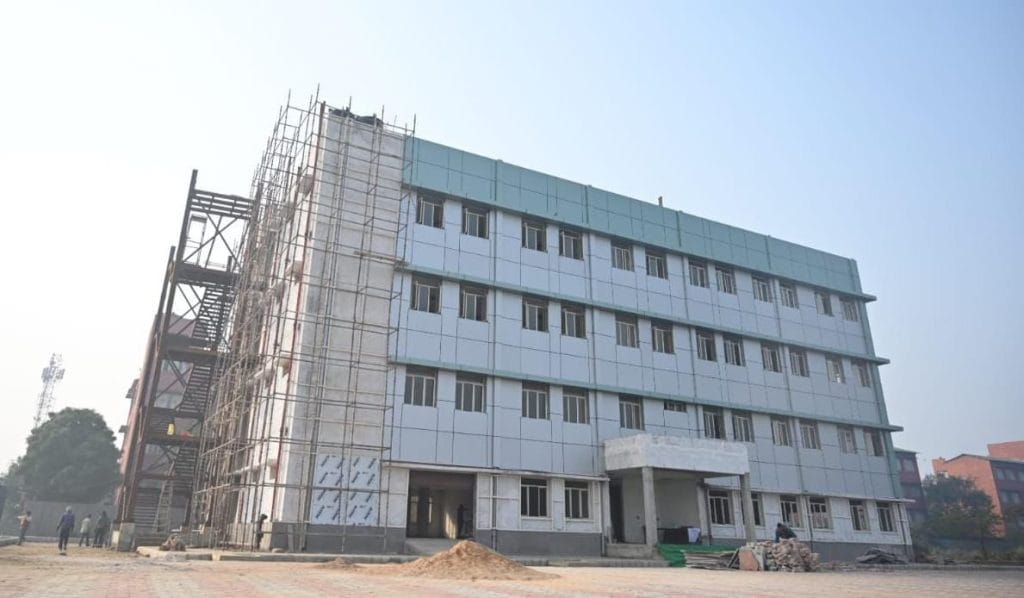
New Delhi: On the first day of 2022, AAP leader Manish Sisodia posted a photograph on Twitter that looked like a promise. It showed him standing inside a glistening four-storey structure in Bakkarwala village, West Delhi—its facade wrapped in green and silver aluminium composite panels, catching the January morning light. The building looked brand new, polished, ready.
“What a great start to the new year!” wrote Sisodia, then Delhi’s deputy CM and education minister. “Visited the under-construction campus site of the upcoming Delhi Teachers University at Bakkarwala village. I wish this university becomes a landmark in teacher training and produces the best teachers in the world.” He later said 5,000 students could apply for admission from that year.
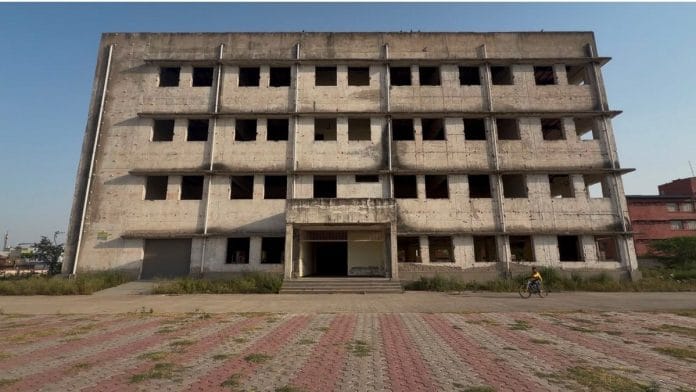
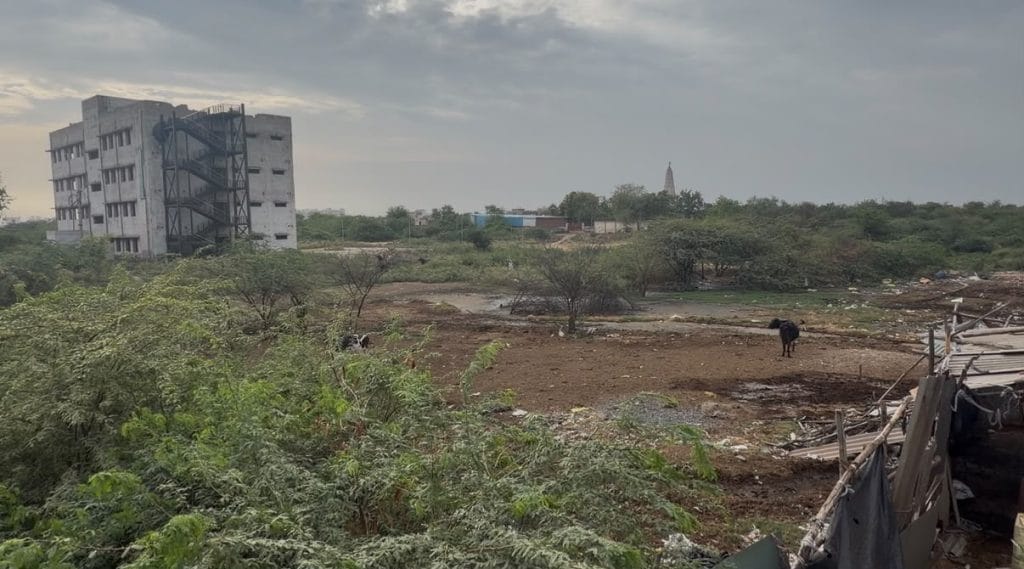
Four years later, those same panels have been stripped from the walls by thieves. The green is gone. The silver is gone. There are no students or teachers. There is no institution. There are only two security guards watching over a decaying shell of bare concrete and rust. The Delhi government spent Rs 8.59 crore constructing the building, yet it has never hosted a single class.
This is the story of what happens to an infrastructure project when it is so far away from Lutyens’ Delhi that no one notices when it fails.
Even before the campus fell to ruins, the project was trapped in a red-tape stalemate. Over the years, three Delhi government bodies passed responsibility for the site between them. Without a clear owner, the building could not secure the electricity connection needed for its final safety clearances.
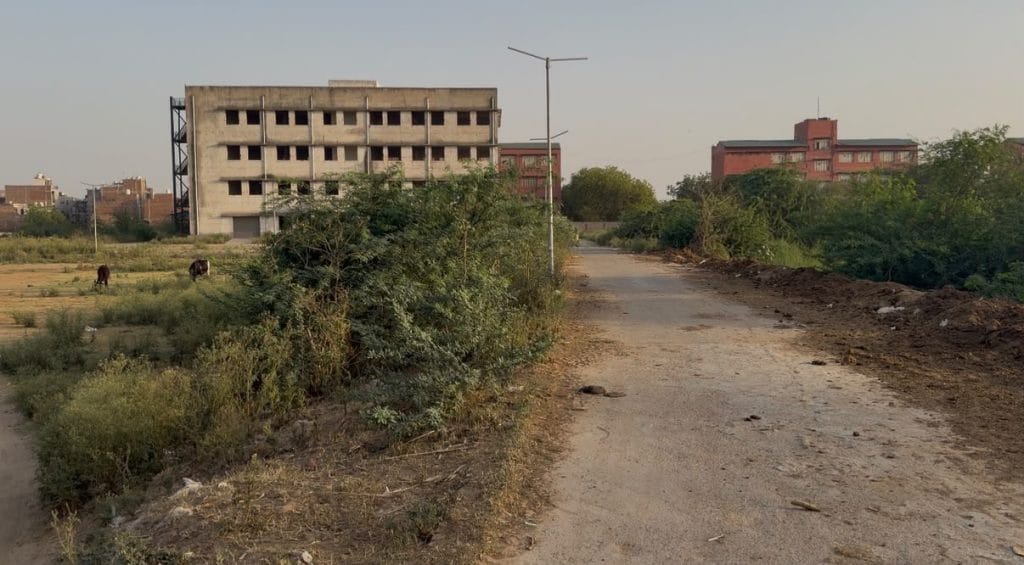
Located in outer West Delhi past Nangloi, Bakkarwala village is accessible via roads that narrow as the main arteries of the city are left behind. While housing colonies have steadily expanded and estimates put the population at around 27,000—up from around 18,000 in the 2011 Census—it has a distinctly rural character, with many of the fields dedicated to cucumber cultivation. A government school now educates children up to Class XII, but the nearest college is over an hour-and-a-half away. The closest Metro station requires a roughly 25-minute journey by road, and there is no shop or commercial establishment within a kilometre of the proposed campus.
When the Delhi government announced that Bakkarwala would be the site of a major educational hub over a decade ago, the news met with high expectations from residents. To develop the project, the government identified approximately 58 bighas and 6 biswa—roughly 12 acres—of Gram Sabha common land. In January 2015, the Director of Panchayat issued a formal allotment letter to the Directorate of Training and Technical Education to establish an ITI, a driving training institute, and a women’s college.
While some villagers protested the takeover, the land was handed over on 26 March 2015 in the presence of revenue department officials.
“The Education Department convinced the villagers that they would build this building here,” reads a memorandum signed by village residents and submitted to senior government officials that year. “The village has more than ten thousand children and youth in the surrounding area. They lack important public facilities like a library and sports complex. With your cooperation, thousands of youth will get the right place and environment to strengthen their future.”
Ten years on, 572 residents would sign a petition demanding the building and land be put to community use rather than left languishing.
Also Read: Why a Rs 300-crore luxury housing project is empty in Delhi’s Vasant Kunj
Fixed address, fluctuating identities
The Bakkarwala site went through an identity crisis even before the building came up. The same plot was earmarked for five institutions over the past decade.
Government documents from 2016 reveal the original vision. The planning branch of the Directorate of Training and Technical Education wrote to the Chief Project Manager (Education) at the Public Works Department (PWD), laying out the plan: an ITI on approximately one acre, with an initial capacity of 1,000 students, expandable to 2,000; and a polytechnic on 1.5 acres offering five disciplines, beginning with 300 students and growing to 700. The total built-up area proposed for both institutions was 20,000 square metres, with common areas including an auditorium, indoor sports facilities, an academic block, and a residential block. ITI courses would run for one year, and polytechnic courses for three.
Following boundary wall approvals in 2015, the main structure, a four-storey building, received administrative approval in June 2017 with an initial sanction of Rs 5.32 crore. The work was awarded to a contractor and construction began on 18 October 2017.
In November 2020, a new institutional identity entered the picture. The Delhi government approved the integration of six World Class Skill Centres into the newly established Delhi Skill and Entrepreneurship University (DSEU); Bakkarwala was among the upcoming centres covered by the decision. A DTTE notification in January 2021 formally recorded the integration for academic purposes, but added that the actual transfer of the land and building would be “finalised subsequently”.
Just a year later, plans changed again. During a field visit to the near-complete Bakkarwala campus on 1 January 2022, Sisodia announced that the building would become the campus of the newly formed Delhi Teachers University, the first ever in Delhi. The construction file was transferred from DTTE to the Department of Higher Education. A revised administrative sanction was issued for Rs 8.59 crore.
But the Delhi Teachers University (DTU), which had been set up under a Cabinet decision of December 2021 and notified in January 2022, never moved in. Instead, it started running at a school at Outram Lane in GTB Nagar, close to Delhi University’s North Campus. In January this year, the DDA handed over 12.69 acres at Narela for the permanent DTU campus, with the Delhi government paying Rs 92.16 crore for it.
Bakkarwala, meanwhile, became stuck in an administrative no man’s land. No one seemed entirely sure what the campus was supposed to be anymore.
A Times of India report in September 2023 captured the confusion in its headline: “Building ready for over a year, but is it an ITI or a teachers’ university? No one seems to know.”
Google Maps, the report noted, listed the structure as both Delhi Teachers University and ITI Bakkarwala. PWD’s own documents described the work as “Construction of SPS Structure (4 storey) for ITI at Bakkarwala.”
A building without an owner
Before theft and vandalism stripped away much of its infrastructure, the Bakkarwala campus was an impressive structure by local standards.
Rising over the surrounding fields and low-rise settlements, it stood in sharp contrast to a village better known for its high crime rates and the emergence of several local gangsters—such as the notorious car thief Manoj Bakkarwala—than for educational institutions. For many residents, the sprawling multi-storey complex represented the promise of higher education, government investment, and a new identity for an area long associated with sensational headlines.
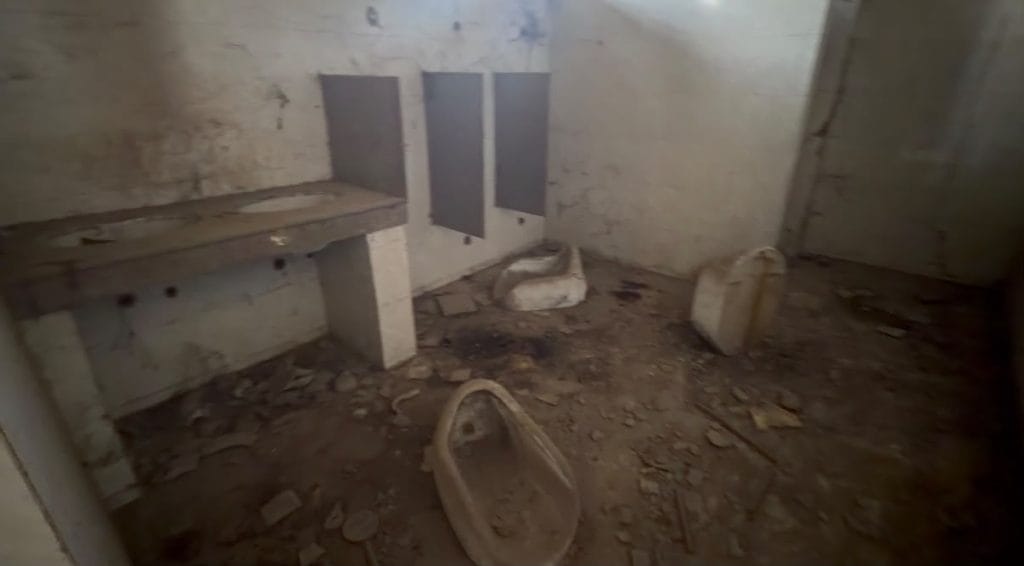
The building had a lift. It had stainless steel railings on accessible ramps and stairways. It had false ceilings, switchboards, MCBs, fire pumps and pipelines, LT panels, wiring, sanitary fittings, and an ACP-sheet facade. Windows were intact. The PWD construction log records the work as complete on 25 April 2022.
What the building never got was a functional electricity connection. With ownership of the land disputed between departments, no agency could submit the documents required by BSES to sanction a load. Without electricity, the lift and fire systems could not be commissioned. An NOC from the fire department could not be obtained. And without that NOC, the building could not legally be handed over.
The stalemate persisted for years.
DTTE maintained the land was DSEU’s responsibility. DSEU argued the land had not yet been formally transferred. PWD, which had physically built the structure, repeatedly wrote to the departments requesting that someone take possession so it could stop being responsible for a completed building lying idle.
“Despite repeated requests, no agency has taken responsibility for maintenance or security, and the building stands vandalised,” PWD wrote in a 2024 letter accessed by ThePrint.
PWD’s audit team from the Principal Accountant General also flagged the idle building, noting that Rs 5.58 crore approved for expenditure after its handover had remained “blocked” since April 2022.
Officials at DSEU’s Dwarka headquarters said the Bakkarwala building was not suitable for academic programmes and that the university would not take it over. Yet in its written response, DSEU also acknowledged that PWD had formally handed the structure over to it in July 2025.
“In this regard, it is submitted that the matter, at present, pertains to the Directorate of Training and Technical Education (DTTE),” said the written response. “Further, with respect to the building constructed at Bakkarwala, it is informed that the said building was handed over to Delhi Skill and Entrepreneurship University (DSEU) by PWD on 27.07.2025.”
Calls and messages to the Deputy Director at DTTE did not receive a response; this report will be updated if a response is received. Despite multiple attempts, the AAP did not respond to queries seeking comment.
A catalogue of loss
By the time officials began taking stock of the extent of the damage at Bakkarwala, there was very little left to be salvaged.
On 10 January 2024, PWD’s assistant engineer visited the site and what he saw was bad enough for him to file a police complaint at Mundka police station. The complaint, which later became part of the record in a Delhi High Court case, is a catalogue of loss.
The engineer found “stainless steel railings for the physically-challenged ramp missing; false ceiling boards and framework damaged and looted; switch box frames, switches, MCBs and fire pumps missing from their installed locations; window glass in broken condition”. An unknown person was also reported to be present inside the building during the inspection.
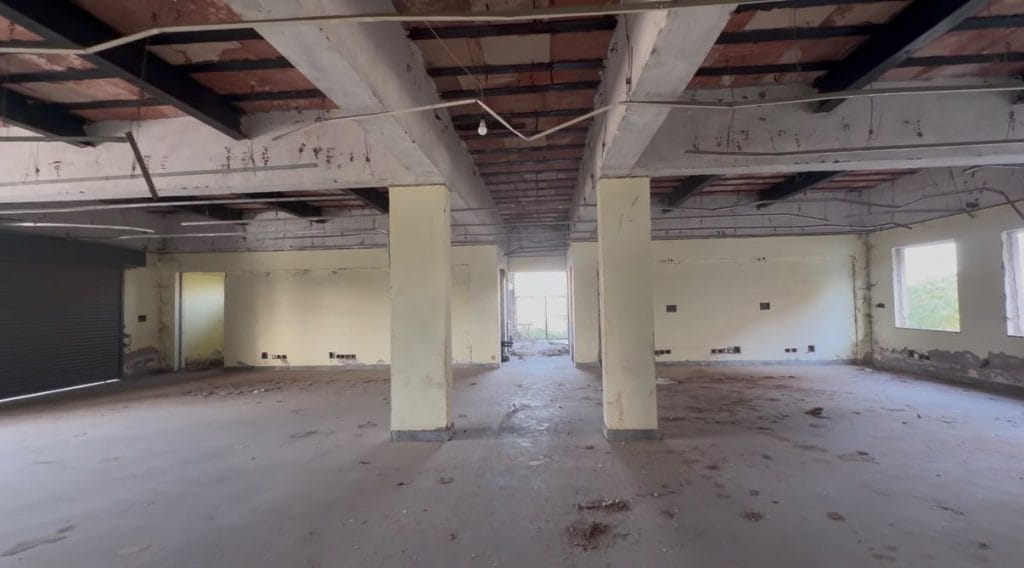
A joint inspection by DSEU and PWD in October 2024 painted an equally bleak picture. In a report submitted to the Secretary of the Training and Technical Education Department, officials said almost all civil and electrical fittings had gone missing, leaving only the building’s basic structure. The boundary wall was nowhere to be seen. No watch and ward was in place. DSEU said it would not take over a building unfit for academic use.
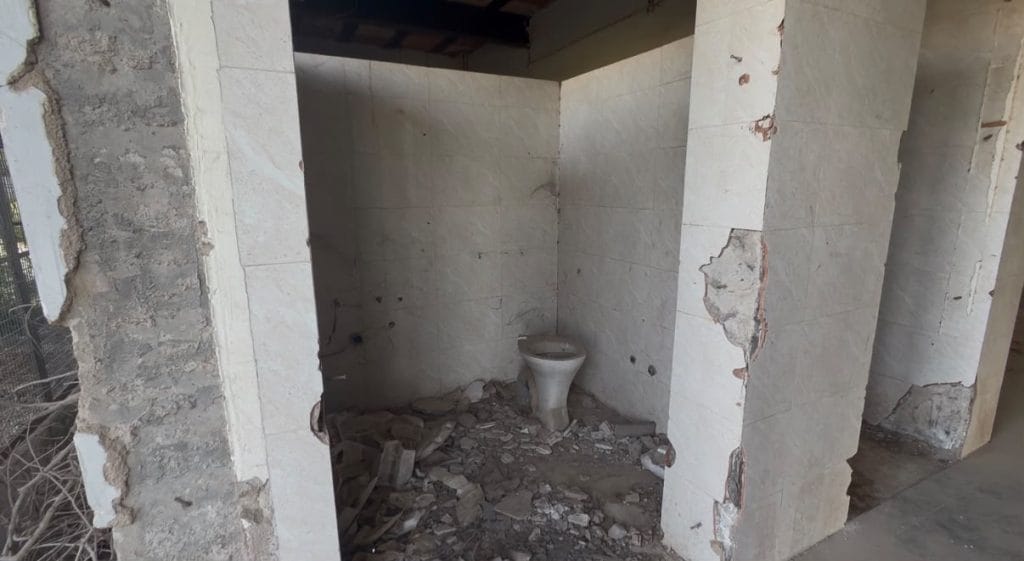
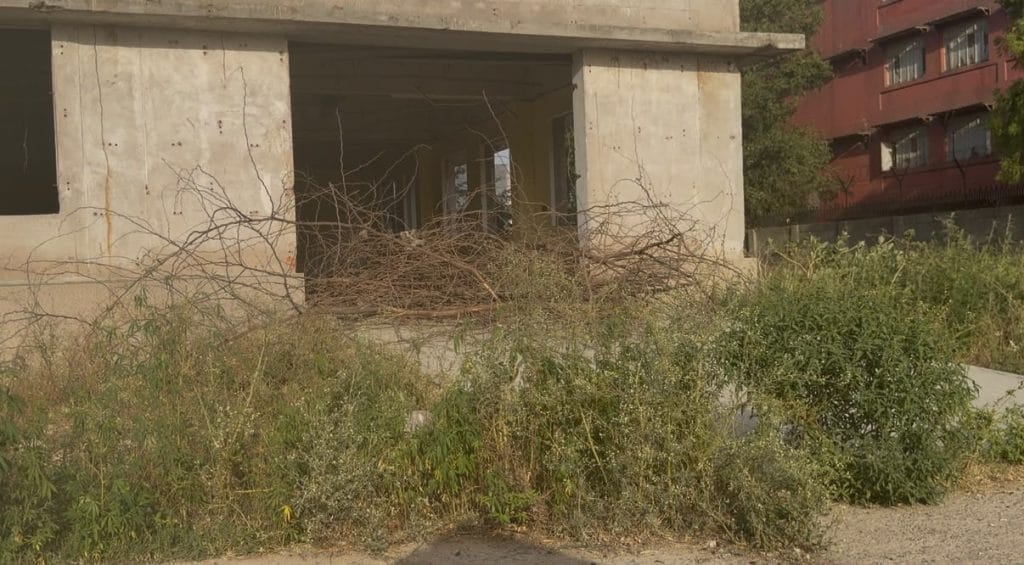
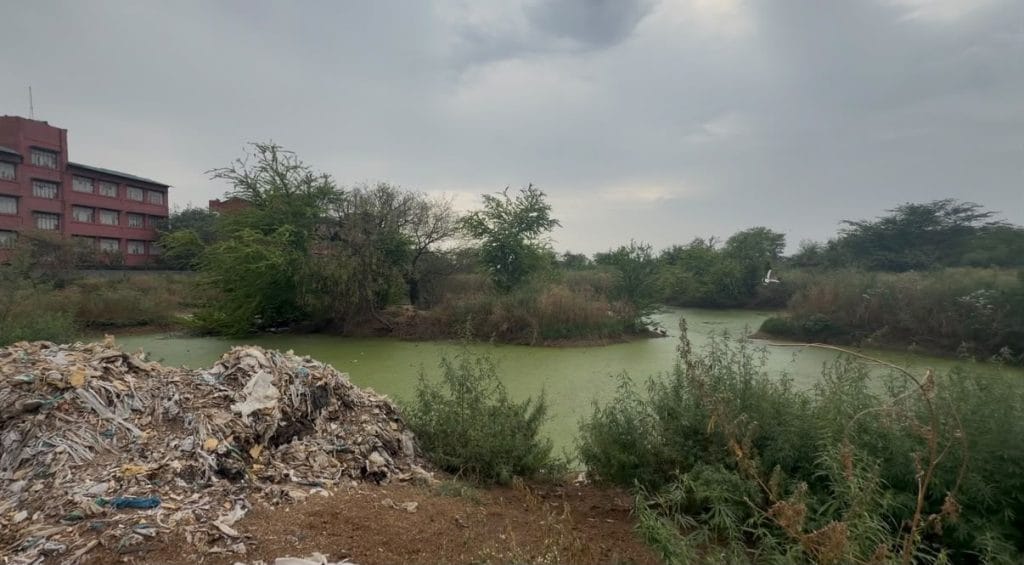
Today, the building is just a skeleton. False ceilings have been pulled down, exposing red stone slabs. Wires hang from walls where electrical fittings once sat. Garbage has accumulated across the plot. Cows graze freely where a polytechnic and ITI were supposed to stand. A functioning government school sits next to the site, its own approach road broken and waterlogged since the campus construction altered local drainage.
Two guards now stand watch over the campus around the clock. They were posted only after years of neglect, when much of what could be stolen had already disappeared.
Letters and litigation
In October 2023, Paras Tyagi, a lawyer, urban activist and founder of the NGO Centre for Youth Culture Law and Environment (CYCLE), began tracing the paper trail and writing to government departments.
His initial representations to the Lieutenant Governor’s office, the Chief Secretary, and the Education Minister were forwarded down the administrative chain: from the minister’s office to the Director of Education, then to the Estate branch, and finally to the DTTE.
The DTTE replied that the land fell within its jurisdiction and that action would be taken, but none followed.
In August 2024, Tyagi filed a formal grievance with the LG’s Listening Post. The response, issued the following month, stated that the building had been handed over to DSEU and marked the complaint “Closed”, without addressing the fact that the building remained abandoned and vandalised.
In October 2024, Tyagi wrote again to the LG, the Chief Secretary, and then Education Minister Atishi about the local fallout.
“Requesting your intervention in resolving this pressing issue,” the letter read, pointing out that the community had cooperated to allow the university on Gram Sabha land, only to see the building left completely unutilised. “The village was pained to experience such decision-making.” No responses were received.
An RTI application filed with the Education Department in December 2025 met a similar fate. DTTE’s Planning Branch transferred it to DSEU under Section 6(3) of the RTI Act, saying the information was not available with DTTE and might be available with DSEU.
The matter finally reached the Delhi High Court this year. In March 2026, Chief Justice Devendra Kumar Upadhyaya and Justice Tejas Karia heard a public interest litigation filed by Tyagi’s organisation.
The order, citing the petition, captured the nub of the Bakkarwala impasse: “[A] four-storey government building was constructed on an area of 12 acres of Gram Sabha land between the years 2017 and 2022 with the huge costs around Rs. 10-15 crores and the building was intended to serve as the ‘Delhi Teachers’ University’ or a ‘World Class Skill Centre’, however, even after completion of the construction, the structure has been left abandoned and unutilized.”
During the hearing, the Delhi government’s counsel Sameer Vashisht argued that the Gram Sabha land fell under the supervision of the District Magistrate and that it was for the DM to examine Tyagi’s grievances and take a decision.
The bench accepted that course. It gave Tyagi a fortnight to file a detailed representation, and the DM three months from the day it reaches him to consider it personally and decide. The order added that if the abandoned building was found to have resulted in public money going to waste, “responsibility for such waste of public money shall also be fixed by the District Magistrate.”
Also Read: 7,400 flats for poor, zero residents—how red tape made Delhi’s Bhalswa project a ghost town
‘We are not asking for something extraordinary’
The residents of Bakkarwala have revised their expectations. They are no longer asking for a university.
A petition signed by 572 residents on 19 December 2025, and submitted repeatedly to government authorities, makes three requests: convert part of the campus into a public library; develop the surrounding land into indoor and outdoor sports facilities; and establish a youth welfare centre.
The same demand resurfaced in Tyagi’s PIL, which sought a “Village Community Knowledge & Sports Hub” and asked the court to impose exemplary costs and damages for the “mismanagement of Gram Sabha land”.
The village’s Lal Dora—its inhabited core—covers only 35 acres, leaving little room for new public infrastructure. In practical terms, the 12-acre campus is the only sizeable developed parcel of land that could still serve the community.
“The village only has a school that goes up to Class 12,” one resident said. “After that, children have to travel one and a half hours to reach the nearest college. We are not asking for something extraordinary. We are asking for what was taken from us to be given back in some useful form.”
Meanwhile, young people still leave the village early in the morning to attend college somewhere else.
This article is part of a series called ‘Delhi’s Deserted Projects’. Read all articles here.
(Edited by Asavari Singh)