



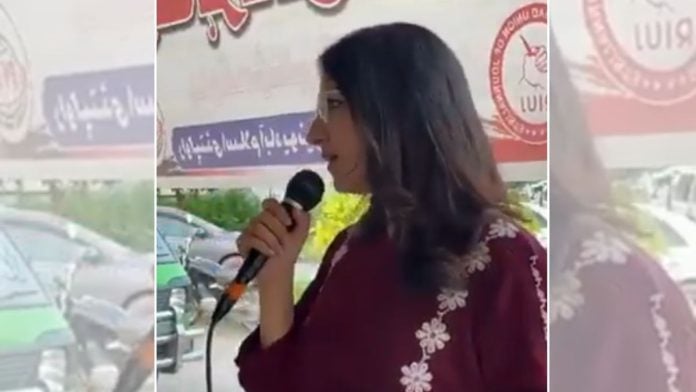

New Delhi: In Pakistan’s media landscape, journalists don’t just face the indignity of working under severe restrictions and threats; they must also stay quiet when their organisations don’t pay them salaries. One journalist spoke up in solidarity with her colleagues and lost her job a day later.
“Every institution in Pakistan is overly sensitive and intolerant. They cannot tolerate even the slightest criticism. It is extremely shameful that a journalist, @Absakomal, was fired from her job merely because she spoke up in support of her fellow journalists who had been deprived of their salaries,” journalist Kiyya Baloch, a researcher at PEN Norway, posted on X.
At an event for the Pakistan Federal Union of Journalists in Karachi on Monday, Absa Komal, a 33-year-old broadcast journalist formerly with BOL Network, spoke at length about the condition of journalists in Pakistan, noting that it has been three months since any of them received their salaries.
“The TV heads and the management treat us as second–class citizens. In their other businesses, the salaries are credited on the 1st, but journalists are told they are going through a crunch,” she said.
Komal added that when it comes to firing, people with the lowest salaries are removed first.
“Young, wide–eyed journalists who come into this profession with a lot of hopes are not paid and are removed while those sitting on top—now millionaires after decades of revenue and no business models to resurrect these channels—are never touched,” she said.
In her address, Komal noted how it feels like journalists have to beg for their salaries.
“Since the time non-journalists have taken over media channels, the downfall began, and now we are not treated as professionals and are made to feel like beggars. Bureaus in Quetta and elsewhere are taken down, and yet journalists continue to work in dire situations,” she said.
Also read: Diljit Dosanjh had unlikely fans cheering him on for Wembley show—Pakistanis
Country-wide support
Journalists across the country are rallying behind Komal. Many are also sharing their personal experiences.
“@AbsaKomal is such a sane voice in the industry. Sadly, anyone who speaks about salaries seems to face the same fate. Back in 2013, when Capital TV stopped paying salaries, on one tweet they issued a show cause notice to me. I later resigned along with several other colleagues,” Pakistani journalist Irfana Yaseer wrote on X.
Pakistani independent journalist Asad Ali Toor asked for Komal to be “immediately restored on screen”.
“We journalists raise voice for all the helpless citizens and take their issues to ruling elites but ironically we cannot tell the crisis of low & delayed salaries… We are humans and have families and have the same needs like any other common citizen, why we cannot talk about injustice to us. More power to Absa for speaking the bitter reality of media without mincing words,” Toor posted.
Some are describing the condition of Pakistani journalists as ‘bonded labour’.
“Taking @AbsaKomal, the credible journalist off air for saying that salaries weren’t paid to journos for the last 3 months exposes d culture of bonded labour in tv channels. It means that journos aren’t allowed to speak against their own exploitation,” former Pakistani senator Afrasiab Khattak said.
Others are highlighting the way forward.
“Federal and provincial governments should make advertisements conditional upon the payment of salaries and dues to media workers. There are several such examples in Karachi where media workers who had been giving decades to newspapers and channels reached the point of starvation, but the channels did not pay their dues and salaries. Several journalists lost their lives due to this very pressure,” Pakistani journalist Tanweer Awan wrote on X.
Komal was earlier the host of a prime-time talk show on Dawn TV. She has served as a presenter on Geo News and hosted the show Report Card, with several years of experience in radio broadcasting. In 2025, she went viral after the DG ISPR spokesperson winked at her in response to a question on Imran Khan’s continued incarceration.
In a 2025 podcast with Asad Ali Toor, Komal had spoken at length about how the transfer of ownership of media channels to real estate owners bent on profit-making impacted journalism in the country and led to a credibility crisis.
“Earlier, TV channels were made to pressurise the ruling powers; now it is mostly to oblige them,” she had then said.
(Edited by Prasanna Bachchhav)