



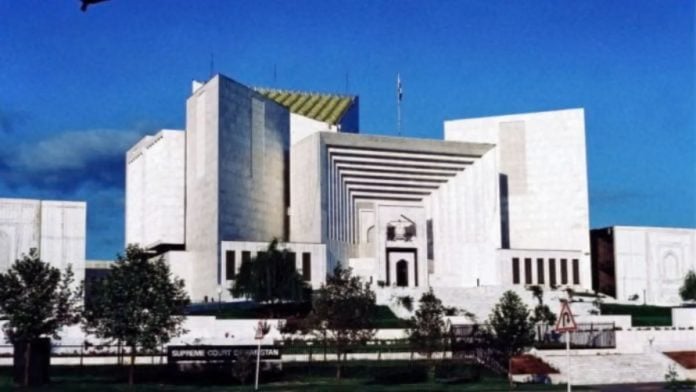
New Delhi: Pakistan’s hardline blasphemy laws continue to tighten their noose around religious minorities who are offered no respite even decades later. The country’s Supreme Court Tuesday upheld the death sentence of a Christian man accused of publishing blasphemous material online in 2011, even as it acquitted his brother in the same case.
The court dismissed the appeal of 49-year-old Qaiser Ayub on 7 October, upholding his death sentence. His brother, 46-year-old Amoon Ayub, was however acquitted for lack of evidence.
The brothers, who are from Lahore, were accused of publishing blasphemous content on a website registered in Qaiser’s name in 2011. Qaiser, a computer science graduate, has maintained that he shut down the website in 2009 and that a Muslim acquaintance, Shahryar Gill, later revived it while retaining Qaiser’s name in the copyright information, according to reports.
After the allegations emerged, the brothers left Pakistan for Singapore and later Thailand. Qaiser was arrested after returning to Lahore in 2014, while Amoon was arrested the following year. A trial court sentenced both men to death in 2018, and the Lahore High Court’s Rawalpindi Bench upheld their convictions in 2022.
Rao Abdur Raheem, founder and chairman of the Legal Commission on Blasphemy Pakistan, described the decision in media reports as a ‘milestone’ in the enforcement of the country’s blasphemy laws.
“This is the first time the barrier of the Supreme Court has been crossed in 40 years in the history of Pakistan since Section 295-C was added to the blasphemy law,” he said in a video circulating on social media.
Raheem appeared outside the court wearing garlands alongside Muhammad Saeed, the complainant in the case. Section 295-C of Pakistan’s penal code prescribes the death penalty for derogatory remarks about the Prophet Muhammad. According to Pakistani outlets, the two brothers allegedly posted various ‘un-Islamic posts’ on their social media accounts. The forensics reportedly came back positive and the case was sent to court.
A country, unchanged
The case comes at a moment of apparent change in Pakistan’s response to blasphemy-related accusations. Registered cases have fallen sharply this year, while attacks linked to the allegations have also declined, according to figures cited by the Human Rights Commission of Pakistan and the Armed Conflict Location and Event Data (ACLED) Project.
According to ACLED data released this year, there was only one blasphemy-related riot or attack over 12 months. Between 2021 and 2024, Pakistan witnessed an annual average of more than seven blasphemy-related riots or attacks per year, the report states. The Human Rights Commission of Pakistan (HRCP) report added that newly registered blasphemy legal cases fell by roughly two-thirds, dropping to just 13 cases in the first half of 2026.
The shift follows a crackdown on hard-line Islamist groups overseen by Pakistan’s army chief, Field Marshal Asim Munir, according to a Reuters report. The campaign has targeted Tehreek-e-Labbaik Pakistan, or TLP, a prominent religious movement whose political mobilisation has often centered on blasphemy and demands for severe punishment of those accused.
TLP was banned in 2025 by the Maryam Nawaz-led government. Its leaders have since been jailed, its mosques sealed and its bank accounts frozen.
But the crackdown has not changed the law itself. Section 295-C remains in force, and blasphemy is still punishable by death, and the minorities in Pakistan continue to pay the price for the law.
Also read: ‘Their Faiz and ours’: Mohammed Hanif on Indian protesters singing Pakistani poet
The cost of an accusation
For Pakistan’s religious minorities, even an unproven accusation can carry grave consequences. In August 2023, a mob attacked a Christian settlement in Jaranwala, in Punjab, after two members of the community were accused of blasphemy. The mob damaged churches, homes, and a cemetery.
In 2013, a mob attacked Joseph’s Colony, a Christian neighborhood in Lahore, looting and burning more than 150 homes after a Christian man was accused of blasphemy. In 2009, violence in Gojra, also in Punjab, left seven people dead after a mob set fire to a Christian settlement.
The law has also been used in cases that rights advocates say were personal disputes rather than genuine religious offenses. In 2014, Pakistan’s Supreme Court warned that many blasphemy cases stemmed from property conflicts or personal and family vendettas, and could lead to violence against entire communities.
Christians, who account for roughly 2 per cent of Pakistan’s population, have faced a disproportionate burden of such accusations.
According to an independent digital data journal, Adaad, Ahmadis (a persecuted minority community) accounted for 26 per cent of those accused of blasphemy between 2020 and 2025, despite making up just 0.07 per cent of the population recorded by religion in the 2023 census. That year saw the highest number of accused in the six years.
One of the most well-known cases is that of Asia Bibi, a Christian farm labourer sentenced to death after a workplace dispute over drinking water escalated into a blasphemy allegation. She spent eight years on death row before Pakistan’s Supreme Court acquitted her in 2018. She later left the country.
Two prominent Pakistani figures who advocated changes to the blasphemy laws after her case — former Punjab Governor Salman Taseer and former federal minister Shahbaz Bhatti — were assassinated in 2011.
Pakistan has also faced international criticism over its treatment of religious minorities. The US Commission on International Religious Freedom in 2022 recommended that the country be designated a Country of Particular Concern because of its religious-freedom violations.
Human Rights Watch has repeatedly called on Pakistan to reform or repeal laws that discriminate against religious minorities, arguing that the blasphemy and anti-Ahmadiyya provisions violate the country’s obligations under the International Covenant on Civil and Political Rights, which Pakistan ratified in 2010.
(Edited by Ratan Priya)