



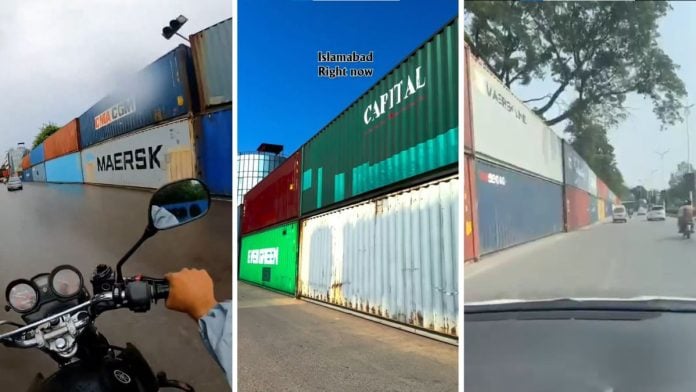
New Delhi: Pakistan’s capital is being turned into a steel fortress ahead of a march on 27 September by supporters of jailed PTI leader and former prime minister Imran Khan. More than 20,000 police personnel from Punjab and Sindh are being deployed, with the Punjab government under Maryam Nawaz also calling in the federal paramilitary force Pakistan Rangers to Rawalpindi, Attock, Jhelum, and Mianwali, BBC Urdu reported Wednesday. Authorities have also turned to erecting barriers using a tool that is now pervasive in Pakistani politics: containers.
At least 2,000 shipping containers have been used to wall off parts of Islamabad, according to reports, with some welded together and fitted with outward-facing metal spikes.
Local police said Wednesday that the Islamabad-Peshawar Motorway, the Islamabad-Dera Ismail Khan Motorway, and the Grand Trunk Road would be closed at several points.
The planned marches are expected to set out from Karachi, Pakistan’s largest city, and Lahore.
The last time containers went up on this scale, in 2024, Pakistanis turned the blockade into a backdrop. Viral videos showed a couple staging a wedding photoshoot in front of containers placed to block PTI supporters, while others climbed over the barriers to make their point. PTI’s UK handle shared one such video as promotion for the party itself, captioning it: “You might think this is a scene from a video game, but it’s not. This is the reality in Pakistan, where the illegal regime has blocked public protests by placing shipping containers on major highways. Undeterred, people are finding ways to climb over them to make their voices heard.”
The practice has become so familiar that Pakistanis have coined a term for it, “containeristan”, while journalists and officials call it “containerisation”.
“Islamabad is again being turned into ‘Containeristan’. Takes a really shaky regime to do this,” Pakistan’s former special representative to the UN, Maleeha Lodhi, posted on X.
Pakistan’s politics, behind a wall of containers
The use of shipping containers to control movement in Pakistan dates back almost 30 years. The first recorded use came in July 1996, when then-prime minister Benazir Bhutto used containers to block Jamaat-e-Islami leader Qazi Hussain Ahmad from entering Islamabad.
The tactic resurfaced in 2007 under military ruler Pervez Musharraf. Containers were used to seal off Karachi to prevent the sacked chief justice, Iftikhar Chaudhry, from addressing lawyers. Later that year, Rawalpindi was locked down with containers ahead of Nawaz Sharif’s attempted return from exile.
The practice became a regular feature of political protests from 2014, when Imran Khan and cleric Tahirul Qadri led a mass sit-in, or dharna, in Islamabad. During the sit-in, Khan and other leaders lived and worked from a container for weeks, The Guardian reported. Commentators have since credited Khan with helping popularise what came to be known as “container politics”—the structures serving as both barricades and stages from which politicians address protesters.
During protests against the government of Nawaz Sharif in 2016, transporters said as many as 4,000 containers had been seized.
The tactic has also been used to contain religious and sectarian marches. Routes were sealed ahead of Jamiat Ulema-e-Islam’s Azadi March in 2019, when transporters put the container count at more than 10,000. Bridges were blocked to contain local protests in Khyber Pakhtunkhwa, including one in 2021.
During the 2022 Azadi March, the government again used containers to block major roads, highways, and entry points into Islamabad, preventing PTI demonstrators from reaching the city centre.
Islamabad’s high-security Red Zone, which contains government buildings and foreign embassies, is routinely sealed with containers whenever a major march is expected.
The use of containers has also drawn criticism on civil-liberties grounds. The Islamabad High Court last week ruled that “no political party, leader, provincial government or public office holder has the legal right to occupy public roads, highways, interchanges, toll plazas or buildings during protests,” The Nation reported. The ruling came after a petition challenged PTI’s planned long march.
Also read: Cyclist Fariba Hashimi dressed as a man to train in Afghanistan. Wins silver at Asian Games
‘Great Wall of containers’
The containers are not purpose-built for security operations. They are ordinary freight containers, normally used to move commercial cargo, and are diverted from established shipping routes, particularly the Karachi-Islamabad corridor.
Police and paramilitary forces requisition containers from private transport and logistics companies. In some cases, the containers are still loaded with commercial goods, including food, medicine, chemicals and export shipments.
The latest blockade has also drawn attention on social media.
Pakistani X user Nighat Abbas described the measures as a ‘Great Wall of Containers’.
“Pakistan’s Government is welding more than 1,000 shipping containers together to build steel fortress across the capital to block PTI supporters from entering the city. This is how political dissent is being silenced in politically and democratically failed State Pakistan,” she wrote.
Another X user, Hussain Yaqub, questioned the government’s use of privately owned containers.
“Islamabad is not a shipping yard, and private property is not free state equipment,” he wrote, adding that with more than 2,000 containers reportedly deployed, the government should publish the requisition orders, compensation rates, and payment status.
“Bahut saare containers me thoda sa Islamabad reh gaya hai (Amid the many containers, a little Islamabad is left),” one user sarcastically remarked.
(Edited by Prasanna Bachchhav)